>
Blenniiformes (Blennies) >
Labrisomidae (Labrisomids)
Etymology: Nemaclinus: Greek, nema, -atos = filament + Greek, klinein, kline = sloping and bed, due to the four apophyses of sphenoid bone (Ref. 45335).
Issue
Needs a taxonomic reference.
Environment: milieu / climate zone / rango de profundidad / distribution range
Ecología
marino bentopelágico; rango de profundidad 25 - ? m (Ref. 52855). Subtropical
Western Atlantic.
Tamaño / Peso / Age
Madurez: Lm ? range ? - ? cm
Max length : 2.9 cm SL macho / no sexado; (Ref. 52856)
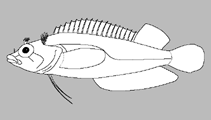
Radios blandos dorsales (total) : 7 - 37; Espinas anales: 2. Common amongst Labrisomids: small, often elongate fishes; largest species about 20 cm standard length, most under 10 cm standard length. Head usually with cirri or fleshy flaps on anterior nostrils, eyes, and laterally on nape; gill membranes continuous with each other across posteroventral surface of head. Each jaw with an outer row of relatively large, canine-like or incisor-like teeth, often with patches of smaller teeth behind; teeth usually also present on vomer and often on palatines (roof of mouth). Dorsal and anal fins long, frequently highest anteriorly; dorsal-fin spines often flexible, outnumbering segmented dorsal-fin soft rays; 2 usually flexible spines in anal fin; pelvic fins inserted anterior to pectoral-fin bases, with 1 spine not visible externally; all fin rays, including those of caudal, unbranched (simple). Cycloid (smooth to touch) scales present at least posteriorly on body. Body coloration: varying from drab to brilliant hues; usually with irregular vertical bands, spots, or marbled pattern. Species distinguished by: dorsal fin consisting of spines and 7 to 37 segmented rays; pectoral-fin rays 12; central pectoral-fin rays elongated, filamentous; pelvic-fin soft rays 2; first anal-fin spine of males shorter than second spine; known only from depths greater than 25 m; no cirrus on anterior nostril; only 1 or no cirrus on each side of nape; scales in lateral-line series usually 35 to 41; lateral-line tubes or canals present at least anteriorly on body (Ref.52855).
Body shape (shape guide): elongated.
Life cycle and mating behavior
Madurez | Reproducción | Puesta | Huevos | Fecundidad | Larva
Robins, C.R., R.M. Bailey, C.E. Bond, J.R. Brooker, E.A. Lachner, R.N. Lea and W.B. Scott, 1991. Common and scientific names of fishes from the United States and Canada. Am. Fish. Soc. Spec. Publ. (20):183 p. (Ref. 3814)
IUCN Red List Status (Ref. 130435: Version 2025-1)
Threat to humans
Harmless
Human uses
Herramientas
Special reports
Download XML
Fuentes de Internet
Estimates based on models
Phylogenetic diversity index (Referencia
82804): PD
50 = 1.0000 [Uniqueness, from 0.5 = low to 2.0 = high].
Bayesian length-weight: a=0.00537 (0.00222 - 0.01301), b=3.08 (2.87 - 3.29), in cm total length, based on LWR estimates for this (Sub)family-body shape (Ref.
93245).
Nivel trófico (Referencia
69278): 3.2 ±0.4 se; based on size and trophs of closest relatives
Fishing Vulnerability (Ref.
59153): Low vulnerability (10 of 100).
🛈