>
Perciformes/Zoarcoidei (Eelpouts and pricklebacks) >
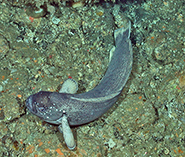
Zaproridae (Prowfish)
Etymology: silenus: Named after Silenus, a drunkard demigod who fell in a marsh on a revel and became covered with slime (Ref. 6885).
Eponymy: Silenus, in Greek mythology, was a companion and tutor to the wine-god Dionysus. He was usually drunk, and the binomial may have been inspired by the fact that the holotype was preserved in alcohol. (Ref. 128868), visit book page.
More on author: Jordan.
Environment: milieu / climate zone / rango de profundidad / distribution range
Ecología
marino demersal; rango de profundidad 0 - 675 m (Ref. 50550), usually 0 - 500 m (Ref. 28981). Boreal; 0°C - 4°C (Ref. 56462); 66°N - 34°N
North Pacific: Hokkaido, Japan and western Kamchatka, Russia to Navarin Canyon in the Bering Sea, Attu Island in the Aleutian chain and San Miguel Island, California, USA.
Length at first maturity / Tamaño / Peso / Age
Madurez: Lm 57.0 range ? - ? cm
Max length : 88.0 cm TL macho / no sexado; (Ref. 2850); common length : 42.9 cm TL macho / no sexado; (Ref. 56462); peso máximo publicado: 7.0 kg (Ref. 56462); edad máxima reportada: 9 años (Ref. 56462)
Short description
Claves de identificación | Morfología | Morfometría
Espinas dorsales (total) : 54 - 57; Radios blandos dorsales (total) : 0; Espinas anales: 0; Radios blandos anales: 29 - 30. Caudal rounded.
Body shape (shape guide): short and / or deep; Cross section: compressed.
Adults occur near bottom (Ref. 2850). Young to 7.2 cm are pelagic or bathypelagic, usually associated with jellyfish (Ref. 6885). Juveniles take shelter under the medusae and are often mistaken for medusafish Icichthys lockingtoni (Ref. 50276).
Life cycle and mating behavior
Madurez | Reproducción | Puesta | Huevos | Fecundidad | Larva
Eschmeyer, W.N., E.S. Herald and H. Hammann, 1983. A field guide to Pacific coast fishes of North America. Boston (MA, USA): Houghton Mifflin Company. xii+336 p. (Ref. 2850)
IUCN Red List Status (Ref. 130435: Version 2025-1)
Threat to humans
Harmless
Human uses
Pesquerías: pesquerías de subsistencia
Herramientas
Special reports
Download XML
Fuentes de Internet
Estimates based on models
Preferred temperature (Referencia
123201): 1.4 - 8.9, mean 4.7 °C (based on 1470 cells).
Phylogenetic diversity index (Referencia
82804): PD
50 = 1.5000 [Uniqueness, from 0.5 = low to 2.0 = high].
Bayesian length-weight: a=0.01738 (0.00677 - 0.04463), b=2.97 (2.75 - 3.19), in cm total length, based on LWR estimates for this (Sub)family-body shape (Ref.
93245).
Nivel trófico (Referencia
69278): 3.7 ±0.1 se; based on diet studies.
Generation time: 6.1 ( na - na) years. Estimated as median ln(3)/K based on 1
growth studies.
Resiliencia (Referencia
120179): Bajo, población duplicada en un tiempo mínimo de 4.5-14 años (tm= 5.1; K= 0.18; tmax=9;).
Fishing Vulnerability (Ref.
59153): Moderate to high vulnerability (54 of 100).
🛈
Nutrients (Ref.
124155): Calcium = 17.6 [9.1, 33.0] mg/100g; Iron = 0.374 [0.139, 0.762] mg/100g; Protein = 15.8 [12.9, 19.4] %; Omega3 = 0.282 [0.150, 0.532] g/100g; Selenium = 22 [9, 54] μg/100g; VitaminA = 4.75 [0.88, 24.05] μg/100g; Zinc = 0.289 [0.193, 0.435] mg/100g (wet weight); based on
nutrient studies.