>
Perciformes/Scorpaenoidei (Scorpionfishes) >
Sebastidae (Rockfishes, rockcods and thornyheads) > Sebastinae
Etymology: Sebastes: Greek, sebastes = august, venerable (Ref. 45335); reedi: Named after the research vessel named in honor of Dr. G.B. Reed, chairman of the Fisheries Research Board of Canada and educator (Ref. 6885).
Eponymy: The ‘G.B. Reed’ was a research vessel of the Canadian Department of Fisheries and Oceans. The vessel was named after Dr Guilford Bevil Reed (1887–1955), a medical researcher who became joint Chairman (1947–1953) of the Fisheries Research Board of Canada. (Ref. 128868), visit book page.
Environment: milieu / climate zone / Tiefenbereich / distribution range
Ökologie
seewasser bathydemersal; tiefenbereich 137 - 375 m, usually 274 - 366 m (Ref. 27437). Deep-water; 60°N - 41°N, 145°W - 124°W
Eastern Pacific: northern Gulf of Alaska to Crescent City, northern California, USA.
Size / Gewicht / Alter
Geschlechtsreife: Lm ? range ? - ? cm
Max length : 58.0 cm TL Männchen/unbestimmt; (Ref. 2850); max. veröff. Alter: 99 Jahre (Ref. 39247)
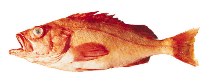
Rückenflossenstacheln (insgesamt) : 13; Rückenflossenweichstrahlen (insgesamt) : 14 - 15; Afterflossenstacheln: 3; Afterflossenweichstrahlen: 7 - 8. Head spines weak - nasal, preocular, supraocular, postocular, tympanic and parietal spines present, coronal and nuchal spines absent (Ref. 27437). Lower jaw long, with moderate, wide symphyseal knob (Ref. 27437). Caudal fin moderately indented (Ref. 6885). Red with yellow to orange in color, smaller specimens mixed with black; 3 vague dark bands across head; jaws red; mouth pinkish white with yellow and black blotches; lateral line pinkish (Ref. 27437).
Body shape (shape guide): fusiform / normal.
Found on rough bottoms (Ref. 2850). Minimum depth reported from Ref. 27437. Viviparous (Ref. 34817).
Life cycle and mating behavior
Geschlechtsreife | Fortpflanzung | Ablaichen | Eier | Fecundity | Larven
Ovoviviparous (Ref. 6885).
Eschmeyer, W.N., E.S. Herald and H. Hammann, 1983. A field guide to Pacific coast fishes of North America. Boston (MA, USA): Houghton Mifflin Company. xii+336 p. (Ref. 2850)
IUCN Rote Liste Status (Ref. 130435: Version 2025-1)
Bedrohung für Menschen
Harmless
Nutzung durch Menschen
Fischereien: kommerziell
Tools
Zusatzinformationen
Download XML
Internet Quellen
Estimates based on models
Preferred temperature (Ref.
123201): 4.7 - 6.4, mean 5.9 °C (based on 5 cells).
Phylogenetic diversity index (Ref.
82804): PD
50 = 0.5000 [Uniqueness, from 0.5 = low to 2.0 = high].
Bayesian length-weight: a=0.01000 (0.00495 - 0.02022), b=3.09 (2.92 - 3.26), in cm total length, based on LWR estimates for this Genus-body shape (Ref.
93245).
Trophic level (Ref.
69278): 3.9 ±0.66 se; based on food items.
Widerstandsfähigkeit (Ref.
120179): niedrig, Verdopplung der Population dauert 4,5 - 14 Jahre. (K=0.12-0.13; tmax=99).
Fishing Vulnerability (Ref.
59153): High vulnerability (63 of 100).
🛈