Environment: milieu / climate zone / depth range / distribution range
Ecology
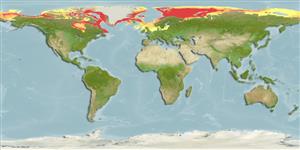
Marine; demersal; depth range 0 - 930 m (Ref. 58496). Polar; 84°N - 51°N, 180°W - 180°E
Western Atlantic: Canadian Arctic to Hudson and Ungava bays and Newfoundland in Canada. Eastern Atlantic: Greenland, Iceland, Jan Mayen, Spitzbergen, Barents and Kara seas, Bohuslän in Norway (Ref. 4926). Reported from the Alaskan Beaufort Sea (Ref. 28503).
Size / Weight / Age
Maturity: Lm ? range ? - ? cm
Max length : 15.7 cm SL male/unsexed; (Ref. 4698); common length : 7.0 cm SL male/unsexed; (Ref. 35388); common length :12 cm SL (female)
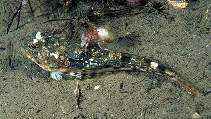
Dorsal spines (total): 7 - 10; Dorsal soft rays (total): 17 - 23; Anal spines: 0; Anal soft rays: 12 - 17. Yellowish with brown spots, most numerous on back; narrow stripes on soft dorsal, pectoral and caudal fins, with dark spots on fin rays (Ref. 4698). Head height equal to head width. Males with a long pointed genital papilla (Ref. 35388).
Body shape (shape guide): elongated.
Found on muddy, sandy or rocky bottoms or among algae (Ref. 4698). Maximum depth at 930 m (Ref. 58426). Benthic (Ref. 58426). Feeds on benthic polychaetes, crustaceans (Hyppolyte, Boreophausia), and large hyperiids (Phascolosoma) (Ref. 4698). Males usually below 7 cm and females below 12 cm. Lives at temperatures -1.7-10°C. Female lays 150-1,000 eggs with a diameter of 3mm (Ref. 35388).
Life cycle and mating behavior
Maturity | Reproduction | Spawning | Eggs | Fecundity | Larvae
Robins, C.R. and G.C. Ray, 1986. A field guide to Atlantic coast fishes of North America. Houghton Mifflin Company, Boston, U.S.A. 354 p. (Ref. 7251)
IUCN Red List Status (Ref. 130435: Version 2025-2)
Threat to humans
Harmless
Human uses
Tools
Special reports
Download XML
Internet sources