



Platichthys stellatus (Pallas, 1787)
Starry flounder
Adicionar as suas observações no Fish Watcher
| Native range | All suitable habitat | Point map | Year 2050 |

|
| This map was computer-generated and has not yet been reviewed. |
| Platichthys stellatus AquaMaps Data sources: GBIF OBIS |
Adicionar o seu Fotografias e vídeos
Fotografias | vídeos | Selos, moedas, diversos. | Imagem do Google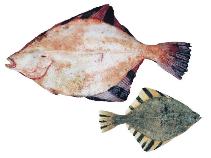 Platichthys stellatus
Fotografia de Archipelago Marine Research Ltd.
Fotografias | vídeos | Selos, moedas, diversos. | Imagem do Google
Fotografia de Archipelago Marine Research Ltd.
Classificação / Nomes Nomes comuns | Sinónimos | Catalog of Fishes(Género, Espécies) | ITIS | CoL | WoRMS | Cloffa
> Pleuronectiformes (Flatfishes) > Pleuronectidae (Righteye flounders) > Pleuronectinae
Etymology: Platichthys: Greek, platys = flat + Greek, ichthys = fish (Ref. 45335).
More on author: Pallas.
Etymology: Platichthys: Greek, platys = flat + Greek, ichthys = fish (Ref. 45335).
More on author: Pallas.
Taxonomic Remarks
Hybridizes with Parophrys vetulus - the hybrid, called Inopsetta ischyra, may be found from the Bering Sea to San Francisco, California, USA (ref. 6885). Also hybridizes with Kareius bicoloratus (Ref. 27547).
Ambiente: milieu / zona climática / intervalo de profundidade / gama de distribuição Ecologia
marinhas; Água doce; estuarina demersal; catádromo (Ref. 126106); intervalo de profundidade 0 - 375 m (Ref. 6793). Polar; 73°N - 33°N, 124°E - 119°W
Distribuição Territórios | Áreas FAO | Ecossistemas | Ocorrências | Mapa dos pontos | Introduções | Faunafri
Northern Pacific, from the Yellow Sea along coasts of Korean Peninsula, Russian Far East, and Japanese Arch. to the Arctic, including Chukchi and Beaufort seas, extending to the south through the Bering Sea to California.
Comprimento na primeira maturidade / Tamanho / Peso / Idade
Maturidade: Lm ?, range 35 - ? cm
Max length : 91.0 cm TL macho/indeterminado; (Ref. 2850); common length : 57.5 cm TL macho/indeterminado; (Ref. 12193); peso máx. Publicado: 9.1 kg (Ref. 2850); Idade máx. registada: 42 anos (Ref. 117245)
Max length : 91.0 cm TL macho/indeterminado; (Ref. 2850); common length : 57.5 cm TL macho/indeterminado; (Ref. 12193); peso máx. Publicado: 9.1 kg (Ref. 2850); Idade máx. registada: 42 anos (Ref. 117245)
Descrição breve Chaves de identificação | Morfologia | Morfometria
Espinhos dorsais (total) : 0; Raios dorsais moles (total) : 52 - 66; Espinhos anais: 1; Raios anais moles: 38 - 47; Vértebras: 34 - 37. Distinguished by the presence of both eyes on the same side of the head, dorsal and anal fins that are marked with dark and light (white to orange) bars, and especially, by the stellate, bony tubercles scattered over its body (Ref. 27547). Dorsal originates over middle of upper eye; anal with a sharp, forward pointing spine (often buried in skin) before first ray; pectorals are bluntly pointed; caudal slightly rounded (Ref. 27547). Eyed side dark brown to nearly black, sometimes with indefinite blotchings (Alaskans specimens sometimes with a greenish tinge); blind side white to creamy; dorsal fin with 4 to 7 dark bars with white to orange spaces between; anal fin with 4 to 6 such bars; caudal fin with 3 or 4 dark longitudinal bars on its posterior part; in rare cases, the blind side may be partly or completely colored like the eyed side, or white may be present on the eyed side, creating a piebald effect (Ref. 27547, 28897, 28898).
Body shape (shape guide): short and / or deep.
Body shape (shape guide): short and / or deep.
Found inshore, often in very shallow water and in estuaries during the summer; moving into deeper water in the winter (Ref. 27547). However, they may occur in deep water throughout the year (Ref. 27547). They do not venture into water of high salinities (Ref. 28899). Young and adults move up rivers, as much as 120 km (Ref. 27547). Benthic (Ref. 58426). They feed on crustaceans, worms, small mollusks, brittle stars, and small fishes (Ref. 6885). Important game fish (Ref. 2850). Utilized fresh and frozen; eaten steamed, fried, boiled, microwaved, and baked (Ref. 9988).
Ciclo de vida e comportamento de acasalamento Maturidade | Reprodução | Desova | Ovos | Fecundidade | Larvas
Onset of metamorphosis occurs at 10.5 mm. First settlement of young is in shallow silty-sandy substrates, usually in estuaries (Ref. 117245).
Referência principal
Carregar as suas referências | Referências | Coordenador : Amaoka, Kunio | Colaboradores
Vinnikov, K.A., R.C. Thomson and T.A. Munroe, 2018. Revised classification of the righteye flounders (Teleostei: Pleuronectidae) based on multilocus phylogeny with complete taxon sampling. Molecular phylogenetics and evolution, 125:147-162. (Ref. 122998)
Categoria na Lista Vermelha da IUCN (Ref. 130435: Version 2025-2 (Global))
Preocupação menor (LC) ; Date assessed: 05 November 2020
CITES
Not Evaluated
Ameaça para o homem
Harmless
Utilização humana
Pescarias: pouco comercial; peixe desportivo: sim
FAO - pescarias: desembarques; Publication: search | FishSource | Sea Around Us
Mais informação
Ecologia Trófica
Produtos alimentares (presas)
Composição da dieta
Consumo alimentar
Rações alimentares
Predadores
Produtos alimentares (presas)
Composição da dieta
Consumo alimentar
Rações alimentares
Predadores
Dinâmica das populações
Parâmetros de crescimento
Idades / tamanhos máximos
Comprimento-peso rel.
Comprimento-comprimento rel.
Frequência de comprimento
Conversão de massa
Recrutamento
Abundância
Parâmetros de crescimento
Idades / tamanhos máximos
Comprimento-peso rel.
Comprimento-comprimento rel.
Frequência de comprimento
Conversão de massa
Recrutamento
Abundância
Ciclo de vida
Reprodução
Maturidade
Maturidade/Rel. das guelras
Fecundidade
Desova
Agregações de desova
Ovos
Desenvolvimento dos ovos
Larvas
Dinâmica larvar
Reprodução
Maturidade
Maturidade/Rel. das guelras
Fecundidade
Desova
Agregações de desova
Ovos
Desenvolvimento dos ovos
Larvas
Dinâmica larvar
Anatomia
Área branquial
Cérebro
Otólitos
Área branquial
Cérebro
Otólitos
Fisiologia
Composição corporal
Nutrientes
Consumo de oxigénio
Tipo de natação
Velocidade de natação
Pigmentos visuais
Som de peixe
Doenças e Parasitas
Toxicidade (LC50s)
Composição corporal
Nutrientes
Consumo de oxigénio
Tipo de natação
Velocidade de natação
Pigmentos visuais
Som de peixe
Doenças e Parasitas
Toxicidade (LC50s)
Relacionado com o ser humano
Sistemas de aquacultura
Perfis para aquacultura
Estirpes
Casos de Ciguatera
Selos, moedas, diversos.
Sistemas de aquacultura
Perfis para aquacultura
Estirpes
Casos de Ciguatera
Selos, moedas, diversos.
Ferramentas
E-book | Guia de campo | Ferramenta auxiliar de frequências de comprimento | Ferramenta sobre a história de vida | Mapa dos pontos |
Captura-MSY |
Relatórios especiais
Descarregue XML
Fontes da internet
AFORO (otoliths) | Alien/Invasive Species database | Aquatic Commons | BHL | Cloffa | Websites from users | Consultar FishWatcher | CISTI | Catalog of Fishes: Género, Espécies | DiscoverLife | ECOTOX | FAO - pescarias: desembarques; Publication: search | Faunafri | Fishipedia | Fishtrace | GloBI | Google Books | Google Scholar | Google | IGFA World Record | OceanAdapt | OneZoom | Open Tree of Life | Otolith Atlas of Taiwan Fishes | Aquários públicos | PubMed | Reef Life Survey | Identificação RFE | Socotra Atlas | TreeBase | Árvore da vida | Wikipedia: ir para, procurar | World Records Freshwater Fishing | Registo zoológico
Estimativas baseadas em modelos
Temperatura preferida (Ref. 123201): 0.2 - 8.3, mean 3.2 °C (based on 669 cells).
Índice de diversidade filogenética (Ref. 82804): PD50 = 0.5625 [Uniqueness, from 0.5 = low to 2.0 = high].
Bayesian length-weight: a=0.00813 (0.00710 - 0.00931), b=3.09 (3.05 - 3.13), in cm total length, based on LWR estimates for this species (Ref. 93245).
Nível Trófico (Ref. 69278): 3.6 ±0.1 se; based on diet studies.
Generation time: 5.7 ( na - na) years. Estimated as median ln(3)/K based on 1 growth studies.
Resiliência (Ref. 120179): Muito baixo, tempo mínimo de duplicação da população maior que 14 anos (tm=2-3; tmax=42).
Nutrientes (Ref. 124155): Calcium = 19.3 [7.6, 34.8] mg/100g; Iron = 0.295 [0.124, 0.633] mg/100g; Protein = 17.3 [15.2, 19.3] %; Omega3 = 0.192 [0.086, 0.415] g/100g; Selenium = 19.4 [7.6, 49.8] μg/100g; VitaminA = 4.35 [0.71, 27.54] μg/100g; Zinc = 0.332 [0.214, 0.514] mg/100g (wet weight); based on nutrient studies.