Elasmobranquios (tiburones y rayas) (sharks and rays) >
Rajiformes (Skates and rays) >
Rajidae (Skates)
Etymology: Leucoraja: Greek, leykos = white + Latin, raja = a fish, Raja sp. (Ref. 45335).
More on authors: Müller & Henle.
Environment: milieu / climate zone / rango de profundidad / distribution range
Ecología
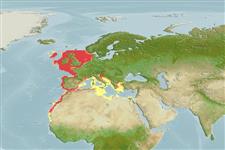
marino demersal; rango de profundidad 12 - 900 m (Ref. 106604), usually 20 - 250 m (Ref. 11284). Subtropical; 63°N - 15°N, 18°W - 36°E
Eastern Atlantic: Kattegat (Ref. 3167) and North Sea, around Great Britain, Ireland and the Mediterranean to Morocco and Senegal.
Length at first maturity / Tamaño / Peso / Age
Madurez: Lm 57.5, range 45 - 71.8 cm
Max length : 81.0 cm TL macho / no sexado; (Ref. 106604); 68.0 cm TL (female); common length : 40.0 cm TL macho / no sexado; (Ref. 3261)
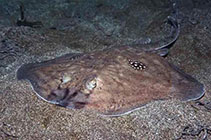
Espinas dorsales (total) : 0; Espinas anales: 0. Snout short; upper surface entirely spinulose, but centre of pectoral fins more or less bare in adults, underside smooth except for prickly front edges; generally 9-13 thorns in a complete row around inner margin of eye, and a large triangle of thorns on nape or shoulder region; two parallel rows of strong thorns on each side of midline along tail; upper surface ochre to light greyish-brown with a large roundish black eye-spot in middle of each pectoral fin, underside white (Ref. 3167)
Body shape (shape guide): other; Cross section: flattened.
Feed on all kinds of bottom animals (Ref. 3167). Maximum sizes of up to 106 cm, that are occasionally reported for specimens from the North Sea are probably erroneous (Ref. 131089). Oviparous. Distinct pairing with embrace. Young may tend to follow large objects, such as their mother (Ref. 205). Eggs are oblong capsules with stiff pointed horns at the corners deposited in sandy or muddy flats (Ref. 205). Egg capsules are 5.0-7.0 cm long and 3.1-3.9 cm wide (Ref. 41250). Around 70-150 eggs are laid per individual annually (Ref. 41250).
Oviparous, paired eggs are laid. Embryos feed solely on yolk (Ref. 50449). Distinct pairing with embrace. Young may tend to follow large objects, such as their mother (Ref. 205).
McEachran, J.D. and K.A. Dunn, 1998. Phylogenetic analysis of skates, a morphologically conservative clade of elasmobranchs (Chondrichthyes: Rajidae). Copeia 1998(2):271-290. (Ref. 27314)
IUCN Red List Status (Ref. 130435: Version 2025-1)
Threat to humans
Harmless
Human uses
Pesquerías: escaso valor comercial; Acuario: Acuarios públicos
Herramientas
Special reports
Download XML
Fuentes de Internet
Estimates based on models
Preferred temperature (Referencia
123201): 7.2 - 16.7, mean 10.5 °C (based on 1278 cells).
Phylogenetic diversity index (Referencia
82804): PD
50 = 0.5000 [Uniqueness, from 0.5 = low to 2.0 = high].
Bayesian length-weight: a=0.00245 (0.00210 - 0.00287), b=3.22 (3.18 - 3.26), in cm total length, based on LWR estimates for this species (Ref.
93245).
Nivel trófico (Referencia
69278): 4.2 ±0.3 se; based on diet studies.
Resiliencia (Referencia
120179): Bajo, población duplicada en un tiempo mínimo de 4.5-14 años (K=0.11-0.16; tm=8-9; tmax=28; Fec<100).
Prior r = 0.41, 95% CL = 0.27 - 0.61, Based on 1 full stock assessment.
Fishing Vulnerability (Ref.
59153): Moderate to high vulnerability (48 of 100).
🛈
Climate Vulnerability (Ref.
125649): Low to moderate vulnerability (35 of 100).
🛈
Nutrients (Ref.
124155): Calcium = 14 [2, 254] mg/100g; Iron = 0.805 [0.076, 9.895] mg/100g; Protein = 16.4 [14.4, 18.5] %; Omega3 = 0.488 [0.206, 1.165] g/100g; Selenium = 28.6 [5.5, 148.2] μg/100g; VitaminA = 8.99 [0.73, 103.53] μg/100g; Zinc = 0.415 [0.024, 4.858] mg/100g (wet weight);