This website uses cookies to enhance your browsing experience and ensure the functionality of our site. For more detailed information about the types of cookies we use and how we protect your privacy, please visit our Privacy Information page.
×
Cookie Settings
This website uses different types of cookies to enhance your experience. Please select your preferences below:
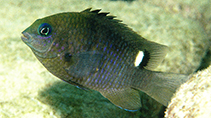
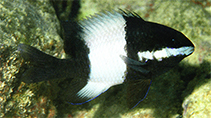
Épines dorsales (Total) : 12; Rayons mous dorsaux (Total) : 15 - 16; Épines anales: 2; Rayons mous anaux: 12 - 14. Diagnosis: Body dark brown to blackish; suborbital mostly blue with blue spots on side of head; most scales on side of body with blue transverse streak. Fins dark brown to blackish except pectorals which are translucent with dusky rays. Pectorals with scaly inner base and has pupil-sized black spot at the base of uppermost rays; a black spot (maybe bordered anteriorly with white) at base of posterior dorsal rays, slightly extending onto dorsal edge of caudal peduncle; with or without white bar across posterior half of body (Ref. 510). Body depth 1.8-2.1 in SL (Ref. 90102). Body shape (shape guide): short and / or deep; Cross section: oval.
A territorial herbivore. Adults inhabit reef flats, shallow lagoons, and semi-sheltered reef margins; common among patches of rubble or porous reef rock, surrounded by live coral, particularly in areas of mild surge (Ref. 1602). Also in high energy zones with mixed corals and short algae. They occur in small loose aggregations (Ref. 48636). Feeds on filamentous algae (Ref. 89972). Oviparous, distinct pairing during breeding (Ref. 205). Eggs are demersal and adhere to the substrate (Ref. 205). Males guard and aerate the eggs (Ref. 205).
Cycle de vie et comportement reproducteur Maturité | Reproduction | Frai | Œufs | Fécondité | Larves
Oviparous, distinct pairing during breeding (Ref. 205). Eggs are demersal and adhere to the substrate (Ref. 205). Males guard and aerate the eggs (Ref. 205).
Allen, G.R. and A.R. Emery, 1985. A review of the Pomacentrid fishes of the genus Stegastes from the Indo-Pacific, with descriptions of two new species. Indo-Pac. Fish. (3):31. (Ref. 510)
Statut dans la liste rouge de l'IUCN (Ref. 130435: Version 2025-2 (Global))
Cycle de vie Reproduction Maturité Maturité/épines rel. Fécondité Frai Agrégats de frai Œufs Développement de l'œuf Larves Dynamique des populations larvaires
Physiologie Composition corporelle Nutriments Consommation d'oxygène Type de natation Vitesse de nage Pigments visuels Son de poisson Maladies et parasites Toxicité (CL50)
Température préférée (Réf. 123201): 25.1 - 29.3, mean 28.3 °C (based on 2041 cells).
Indice de diversité phylogénétique (Réf. 82804): PD50 = 0.5000 [Uniqueness, from 0.5 = low to 2.0 = high].
Bayesian length-weight: a=0.02042 (0.01001 - 0.04166), b=2.98 (2.81 - 3.15), in cm total length, based on LWR estimates for this species & Genus-body shape (Ref. 93245).
Niveau trophique (Réf. 69278): 2.0 ±0.00 se; based on food items.
Résilience (Réf. 120179): Haut, temps minimum de doublement de population inférieur à 15 mois (Preliminary K or Fecundity.).
Vulnérabilité de la pêche (Ref. 59153): Low vulnerability (10 of 100). 🛈