



Cirripectes auritus Carlson, 1981
Blackflap blenny
Aggiungete la vostra osservazione in Fish Watcher
| Native range | All suitable habitat | Point map | Year 2050 |

|
| This map was computer-generated and has not yet been reviewed. |
| Cirripectes auritus AquaMaps Data sources: GBIF OBIS |
Carica il tuo foto e Video
Immagini | Google image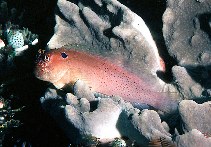 Cirripectes auritus
Immagine di Randall, J.E.
Immagini | Google image
Immagine di Randall, J.E.
Classificazione / Nomi Nomi Comuni | Sinonimi | Catalog of Fishes(Genere, Specie) | ITIS | CoL | WoRMS | Cloffa
> Blenniiformes (Blennies) > Blenniidae (Combtooth blennies) > Salariinae
Etymology: Cirripectes: Latin, cirrus = curl fringe + Greek, pektos, -e, -on = made of several parts solidly united (Ref. 45335); auritus: Name from Latin 'auritus', meaning 'eared', referring to the earlike nuchal flap on either side of the head.
Etymology: Cirripectes: Latin, cirrus = curl fringe + Greek, pektos, -e, -on = made of several parts solidly united (Ref. 45335); auritus: Name from Latin 'auritus', meaning 'eared', referring to the earlike nuchal flap on either side of the head.
Ambiente: milieu / zona climatica / distribuzione batimetrica / gamma di distribuzione Ecologia
marino associati a barriera corallina; distribuzione batimetrica 0 - 20 m (Ref. 630), usually 0 - 10 m (Ref. 529). Tropical; 20°N - 35°S
Distribuzione Territories | Aree FAO | Ecosistemi | Presenze | Mappa dei ritrovamenti | Introduzioni | Faunafri
Indo-West Pacific: Kenya to South Africa, then Similan Islands (Thailand), Philippines and the Line Islands.
Lunghezza alla prima maturità / Dimensione / Peso / Età
Breve descrizione Chiavi di identificazione | Morfologia | Morfometria
Spine dorsali (totale) : 12 - 13; Raggi dorsali molli (totale) : 15 - 17; Spine anali: 2; Raggi anali molli: 16 - 18; Vertebre: 31 - 33. Diagnosis: Dorsal fin XII-XIII, 15-17 (usually XII,17), entire, only slightly or not at all incised above last spine, first spine equal to second; anal fin II, 15-16; pectoral rays 14; pelvic fin I, 4; caudal fin procurrent rays 10-13. Body depth at anal-fin origin 4.8-5.1 in SL. Vertebrae 10 + 21-23; vertebral centrum, last pleural ribs 11-12, last epipleural rib 17-19. Without scales and scalelike flaps. LL tubes 7-12, series ends below dorsal fin rays 5-13. Lower lip smooth mesially, plicate laterally. Upper lip crenulae 34-39. Gill rakers 21-25. Cirri, nuchal 22-34, supraorbital 2-7, nasal 4-6. Nuchal cirri minute, 5-8 independently distributed, in 2 greatly expanded flaps on each side of nape. Nuchal flaps black. Inner ring of iris yellow, outer ring reddish brown. Body coloration of adults variable (varies in different areas and may also vary between sexes); may be pale, brown, or mottled pale and brown background but always with tiny dark spots on posterior 1/2 to 3/4 of the body and with pale spots or streaks from orbit to upper lip. Similan and Fanning Islands females head mottled strongly with reddish-brown and pinkish-white spots and streaks, body with broad irregular brown bars; in Fanning Islands the pale areas in the head are all faint pink and interspaces on body are cream or light brown instead of faint pink as in those from Similan Islands. Males in Fanning I. are also mottled but in Indian Ocean only females are mottled. Philippines female has uniformly dark brown color. South African males with darker cirri than those from other localities. Meristic and morphometric patterns does not vary geographically. Body depth at anal fin origin 4.8-5.1 in SL (Ref. 529, 90102). Ophioblennius stage overall cream; mouth area without spots; cirri and nuchal flap pale; fins transluscent (in alcohol); with 2 canines on each dentary, posteriorly (Ref. 529). (Ref. 529).
Body shape (shape guide): elongated; Cross section: oval.
Body shape (shape guide): elongated; Cross section: oval.
Facultative air-breathing in the genus (Ref. 126274); Found on coral rocks, some on sandy bottom in water about 5 m deep or on irregular rocky bottom with sparse live coral and no sand (Ref. 630). Also in shallow protected reefs with rich coral and algae growth, usually found at depths less than about 10 m; occasionally deeper. Usually seen solitary (Ref. 48636). One specimen taken from 20 m in the Comoro Island. Oviparous. Eggs are demersal and adhesive (Ref. 205), and are attached to the substrate via a filamentous, adhesive pad or pedestal (Ref. 94114). Larvae are planktonic, often found in shallow, coastal waters (Ref. 94114).
Ciclo vitale e comportamento di accoppiamento Maturità | Riproduzione | Deposizione | Uova | Fecondità | Larve
Oviparous, distinct pairing (Ref. 205). Urogenital orifice of male genital papilla located basally between 2 widely separated slender filaments on a fleshy swelling behind anus; testes bulbous with length equal to width (Ref. 529).
Riferimento principale
Caricare le referenze | Bibliografia | Coordinatore : Williams, Jeffrey T. | Collaboratori
Williams, J.T., 1988. Revision and phylogenetic relationships of the blenniid fish genus Cirripectes. Indo-Pac. Fish. (17):78 p. (Ref. 529)
Stato della Lista Rossa IUCN (Ref. 130435: Version 2025-2 (Global))
Least Concern (LC) ; Date assessed: 24 March 2009
CITES
Not Evaluated
Minaccia per l'uomo
Harmless
Usi umani
Pesca: di nessun interesse
FAO - Publication: search | FishSource |
Informazioni ulteriori
Ecologia trofica
Articoli alimentari (prede)
Alimentazione
Consumo di cibo
Razioni alimentari
Predatori
Articoli alimentari (prede)
Alimentazione
Consumo di cibo
Razioni alimentari
Predatori
Dinamica della popolazione
Parametri di crescita
Età massima / dimensioni massime
Rapporto lunghezza-peso.
Lunghezza-lunghezza rel.
Lunghezza-frequenze
Conversione di massa
Reclutamento
Abbondanza
Parametri di crescita
Età massima / dimensioni massime
Rapporto lunghezza-peso.
Lunghezza-lunghezza rel.
Lunghezza-frequenze
Conversione di massa
Reclutamento
Abbondanza
Ciclo di vita
Riproduzione
Maturità
Maturità/Gli occhielli sono relativi.
Fecondità
Deposizione
Aggregazioni riproduttive
Uova
Sviluppo delle uova
Larve
Dinamica popolazioni larvali
Riproduzione
Maturità
Maturità/Gli occhielli sono relativi.
Fecondità
Deposizione
Aggregazioni riproduttive
Uova
Sviluppo delle uova
Larve
Dinamica popolazioni larvali
Anatomia
Area branchiale
Cervello
Otolite
Area branchiale
Cervello
Otolite
Fisiologia
Composizione corporea
Nutrienti
Consumo di ossigeno
Tipo di nuoto
Velocità di nuoto
Pigmenti visivi
Suono del pesce
Malattie e parassiti
Tossicità (LC50)
Composizione corporea
Nutrienti
Consumo di ossigeno
Tipo di nuoto
Velocità di nuoto
Pigmenti visivi
Suono del pesce
Malattie e parassiti
Tossicità (LC50)
Legato all'uomo
Sistemi di acquacoltura
Profili di acquacoltura
Varietà
Casi di Ciguatera
Francobolli, monete, materiale vario.
Sistemi di acquacoltura
Profili di acquacoltura
Varietà
Casi di Ciguatera
Francobolli, monete, materiale vario.
Strumenti
Quiz organico | Libro elettronico | Giuda pratica | Chiavi di identificazione | Generatore frequenze di lunghezza | Strumento Parametri Biologici | Mappa dei ritrovamenti |
Cattura-MSY |
Rapporti speciali
Controllo della manutenzione dell'acquario | Verificare la presenza di schede informative sulle specie | Verifica delle schede informative sull'acquacoltura
Scarica XML
Fonti Internet
AFORO (otoliths) | Aquatic Commons | BHL | Cloffa | Websites from users | Check FishWatcher | CISTI | Catalog of Fishes: Genere, Specie | DiscoverLife | ECOTOX | FAO - Publication: search | Faunafri | Fishipedia | Fishtrace | GloBI | Google Books | Google Scholar | Google | IGFA World Record | Database Nazionali | OneZoom | Open Tree of Life | Otolith Atlas of Taiwan Fishes | PubMed | Reef Life Survey | Socotra Atlas | TreeBase | Tree of Life | Wikipedia: Go, ricerca | World Records Freshwater Fishing | Zoobank | Record zoologico
Stime basate su modelli
Temperatura preferita (Fonte Biblio. 123201): 25.4 - 29.3, mean 28.5 °C (based on 2513 cells).
Indice di diversità filogenetica (Fonte Biblio. 82804): PD50 = 0.5000 [Uniqueness, from 0.5 = low to 2.0 = high].
Bayesian length-weight: a=0.00776 (0.00354 - 0.01702), b=3.00 (2.81 - 3.19), in cm total length, based on LWR estimates for this (Sub)family-body shape (Ref. 93245).
Livello trofico (Fonte Biblio. 69278): 2.0 ±0.00 se; based on food items.
Resilienza (Fonte Biblio. 120179): Alto, tempo minimo di raddoppiamento della popolazione meno di 15 mesi (Preliminary K or Fecundity.).
Nutrienti (Ref. 124155): Calcium = 189 [90, 334] mg/100g; Iron = 0.92 [0.52, 1.66] mg/100g; Protein = 17.8 [16.5, 18.9] %; Omega3 = 0.0885 [, ] g/100g; Selenium = 23.9 [10.8, 56.6] μg/100g; VitaminA = 130 [31, 544] μg/100g; Zinc = 2.93 [1.88, 4.33] mg/100g (wet weight);