Argyrops spinifer, King soldierbream : fisheries

Argyrops spinifer (Forsskål, 1775)

King soldierbream
Masukkan pemerhatian anda di Fish Watcher
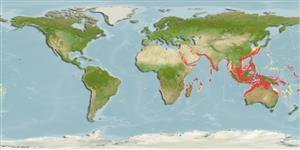
Native range | All suitable habitat | Point map | Year 2050
This map was computer-generated and has not yet been reviewed.
Argyrops spinifer   AquaMaps   Data sources: GBIF OBIS
muatnaik fotos/gambar dan video
Gambar | imej Google

klasifikasi / Nama Nama-nama umum | Sinonim (persamaan) | Catalog of Fishes(Marga, Jenis) | ITIS | CoL | WoRMS | Cloffa

> Eupercaria/misc (Various families in series Eupercaria) > Sparidae (Porgies)
Etymology: Argyrops: Greek, argyros = silver, silvered + Gree, ops = appearance (Ref. 45335).
More on author: Forsskål.

Lingkungan: lingkungan / zona iklim / kisaran kedalaman / jangkauan distribusi Ekologi

laut dasar (demersal); kisaran kedalaman 1 - 450 m (Ref. 100719), usually 5 - 100 m (Ref. 30573). Tropical; 34°N - 28°S

Penyebaran Wilayah | Daerah-daerah FAO | Ekosistem | Kemunculan | peta titik | Introduksi | Faunafri

Indian Ocean: including the Red Sea and Persian Gulf, to Singapore and southernmost end of the Malay Peninsula.

Panjang pada saat jatuh tempo pertama / Ukuran / Berat / umur

Kematangan: Lm 30.9  range ? - ? cm
Max length : 80.0 cm TL jantan/; (Ref. 124569); common length : 30.0 cm TL jantan/; (Ref. 3507)

deskripsi pendek Kunci identifiaksi (pengenalan) | Morfologi | Morfometrik

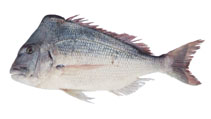
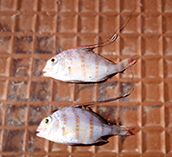
Duri punggung (Keseluruhan (total)) : 11 - 13; duri punggung lunak (Keseluruhan (total)) : 9 - 10; Duri dubur: 3; Sirip dubur lunak: 7 - 8; vertebrata, bertulang belakang: 24. This species is distinguished from all its congeners by the following set of characters: body deep and becoming compressed and less deep with growth; D XII,10, the first 2 dorsal-fin spines rudimentary (2 dorsal-fin spines on first dorsal pterygiophore); the dorsal-fin with two morpho types of configuration (Type I 'rigid type', fragile] as a rigid tapering spine and Type II ['flexible type', comparatively robust] as a flexible tapering spine in Group A - Red Sea, Group B - Gulf of Aden and eastern coast of Africa, and Group C - Persian Gulf, only Type II, is seen in both Group D - Madagascar to Sri Lanka and Group E - Eastern Indian Ocean, each Group is allopatric and is likely to have similar genetic structure (not analyzed in Group D or E). Colouration: body uniform pink with belly and lower jaw silvery, head red; spinous dorsal fin pink or red, other fins pink or pale pink; with pink tinge around eye; upper jaw often pinkish; anterior and posterior margins of the upper cheek scales nearly parallel just below rear edge of eye; orbit diameter is clearly less than suborbital depth (Ref. 124569).
Cross section: compressed.

Biologi     Daftar kata (contoh epibenthic)

Found in a wide range of bottoms. Young fish occur in very shallow waters of sheltered bays; larger individuals in deeper water. Feed on benthic invertebrates, mainly mollusks (Ref. 5213). Important food fish.

Siklus hidup dan perilaku kawin Kematangan | Reproduksi, perkembang biakan | Pemijahan | telur-telur | Fekunditas | Larva

rujukan utama Unggah referensi Anda | Acuan | Koordinator | mitra

Iwatsuki, Y. and P.C. Heemstra, 2018. Taxonomic review of the genus Argyrops (Perciformes; Sparidae) with three new species from the Indo-West Pacific. Zootaxa 4438(3):401-442. (Ref. 124569)

Status IUCN Red List (Ref. 130435: Version 2025-2 (Global))

  kurang bimbang (LC) ; Date assessed: 02 December 2009

CITES

Not Evaluated

CMS (Ref. 116361)

Not Evaluated

ancaman kepada manusia

  Harmless


penggunaan manusia

Perikanan: komersial
FAO - Perikanan: pendaratan; Publication: search | FishSource | Laut di Sekitar Kita

informasi lanjut

Ekologi trofik
Item makanan (mangsa)
Komposisi makanan
Konsumsi makanan
Ransum makanan
Pemangsa
Ekologi
Ekologi
Siklus hidup
Reproduksi, perkembang biakan
Kematangan
Kedewasaan / insang rel.
Fekunditas
Pemijahan
Agregasi pemijahan
telur-telur
pekembangan telor
Larva
Dinamika larva
Penyebaran
Wilayah
Daerah-daerah FAO
Ekosistem
Kemunculan
Introduksi
BRUVS - Video
Anatomi
Area insang
Otak
Otolith
Fisiologi
Komposisi tubuh
Nutrisi
Konsumsi oksigen
Jenis renang
Kecepatan berenang
Pigmen visual
Suara ikan
Penyakit & Parasit
Toksisitas (LC50)
Genetika
genom
Genetika
Heterozigositas
Diturunkan
Keanekaragaman Genetik
Yang berhubungan dengan manusia
Sistem akuakultur
profil budidaya air
Strain
Kasus Ciguatera
Perangko, koin, dll.
Penjangkauan
mitra
Acuan
Acuan

Alat, peralatan

laporan khas

muat turun XML

Sumber internet

AFORO (otoliths) | Aquatic Commons | BHL | Cloffa | Websites from users | semak peneliti ikan | CISTI | Catalog of Fishes: Marga, Jenis | DiscoverLife | ECOTOX | FAO - Perikanan: pendaratan; Publication: search | Faunafri | Fishipedia | Fishtrace | GloBI | Google Books | Google Scholar | Google | IGFA World Record | Pangkalan data nasional | OneZoom | Open Tree of Life | Otolith Atlas of Taiwan Fishes | PubMed | Reef Life Survey | Socotra Atlas | TreeBase | Tree of Life | Wikipedia: pergi, Cari | World Records Freshwater Fishing | Catatan Zoologi

Estimasi berdasarkan model

Suhu yang disukai (Acuan 123201): 23.4 - 29, mean 27.9 °C (based on 3786 cells).
Indeks keanekaragaman filogenetik (Acuan 82804):  PD50 = 0.5078   [Uniqueness, from 0.5 = low to 2.0 = high].
Bayesian length-weight: a=0.02188 (0.01857 - 0.02577), b=2.96 (2.92 - 3.00), in cm total length, based on LWR estimates for this species (Ref. 93245).
Tingkat Trofik (Acuan 69278):  3.7   ±0.38 se; based on food items.
Generation time: 7.3 (4.7 - 12.2) years. Estimated as median ln(3)/K based on 10 growth studies.
Daya lenting (Acuan 120179):  Rendah, Waktu penggandaan populasi minimum 4.5 - 14 tahun (K=0.08-0.21; tmax=25; tm=2; Fec = 47,000).
Kerentanan Penangkapan Ikan (Ref. 59153):  High vulnerability (55 of 100). 🛈
Kerentanan Iklim (Ref. 125649):  High vulnerability (61 of 100). 🛈
kategori harga (Ref. 80766):   High.
Nutrisi (Ref. 124155):  Calcium = 85.7 [37.7, 186.4] mg/100g; Iron = 1.02 [0.52, 2.18] mg/100g; Protein = 18.8 [17.4, 20.1] %; Omega3 = 0.234 [0.119, 0.453] g/100g; Selenium = 82.6 [34.7, 189.3] μg/100g; VitaminA = 16.6 [4.1, 69.2] μg/100g; Zinc = 0.607 [0.370, 0.930] mg/100g (wet weight);