>
Carangiformes (Jacks) >
Carangidae (Jacks and pompanos) > Caranginae
Etymology: Platycaranx: Name derived from Greek 'platys' meaning 'fat', and Caranx for the type genus of Carangidae, referring to the highly compressed body.
More on author: Cuvier.
Environment: milieu / climate zone / rango de profundidad / distribution range
Ecología
marino; salobre asociado a arrecife; rango de profundidad 10 - 90 m (Ref. 121771), usually 30 - 60 m (Ref. 121771). Tropical; 31°N - 41°S, 25°E - 177°W
Indo-Pacific: East Africa (Ref. 3287) to Fiji, north to Ryukyu Islands, south to New Zealand.
Tamaño / Peso / Age
Madurez: Lm ? range ? - ? cm
Max length : 72.0 cm FL macho / no sexado; (Ref. 40637); common length : 65.0 cm TL macho / no sexado; (Ref. 5450); peso máximo publicado: 4.4 kg (Ref. 40637)
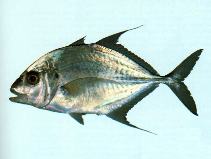
Espinas dorsales (total) : 9; Radios blandos dorsales (total) : 18 - 20; Espinas anales: 3; Radios blandos anales: 14 - 17. Color silvery, greenish above. Opercle with black spot. 20-37 weak scutes. Pectoral fins falcate. Scaleless breast to behind pelvic origin and laterally to pectoral base. Soft dorsal lobe falcate in young, becoming shorter than head in adults. First 2 anal spines detached.
Body shape (shape guide): short and / or deep; Cross section: compressed.
Adults inhabit open waters of coastal reefs (Ref. 9710). Juveniles occur in inshore areas, including estuaries (Ref. 3287). Usually in small groups (Ref. 48635).
Life cycle and mating behavior
Madurez | Reproducción | Puesta | Huevos | Fecundidad | Larva
Paxton, J.R., D.F. Hoese, G.R. Allen and J.E. Hanley, 1989. Pisces. Petromyzontidae to Carangidae. Zoological Catalogue of Australia, Vol. 7. Australian Government Publishing Service, Canberra, 665 p. (Ref. 7300)
IUCN Red List Status (Ref. 130435: Version 2025-1)
Threat to humans
Harmless
Human uses
Pesquerías: comercial; pesca deportiva: si
Herramientas
Special reports
Download XML
Fuentes de Internet
Estimates based on models
Preferred temperature (Referencia
123201): 23.6 - 28.6, mean 27.5 °C (based on 309 cells).
Phylogenetic diversity index (Referencia
82804): PD
50 = 0.6250 [Uniqueness, from 0.5 = low to 2.0 = high].
Bayesian length-weight: a=0.01862 (0.01170 - 0.02964), b=2.87 (2.74 - 3.00), in cm total length, based on LWR estimates for this species & (Sub)family-body (Ref.
93245).
Nivel trófico (Referencia
69278): 4.3 ±0.5 se; based on diet studies.
Resiliencia (Referencia
120179): Medio, población duplicada en un tiempo mínimo de 1.4-4.4 años (Preliminary K or Fecundity.).
Fishing Vulnerability (Ref.
59153): Moderate vulnerability (41 of 100).
🛈
Nutrients (Ref.
124155): Calcium = 24.8 [11.2, 55.5] mg/100g; Iron = 1.1 [0.5, 2.6] mg/100g; Protein = 19.9 [17.3, 22.2] %; Omega3 = 0.139 [0.070, 0.289] g/100g; Selenium = 10.9 [4.4, 28.0] μg/100g; VitaminA = 50.7 [7.6, 350.1] μg/100g; Zinc = 0.576 [0.296, 1.278] mg/100g (wet weight); based on
nutrient studies.