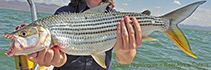
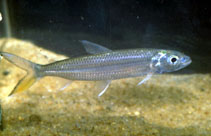
Hydrocynus forskahlii, Elongate tigerfish : fisheries, gamefish

You can sponsor this page

Hydrocynus forskahlii (Cuvier, 1819)

Elongate tigerfish
Hochladen Photos und videos
Bilder | Stamps, coins, misc. | Google Bild

Klassifizierung / Names Namen | Synonyme | Catalog of Fishes(Gattung, Arten) | ITIS | CoL | WoRMS | Cloffa

> Characiformes (Characins) > Alestidae (African tetras)
Etymology: Hydrocynus: Greek, hydr = water + Greek, kyon = dog (Ref. 45335).
Eponymy: Dr Peter Forsskål (1732–1763) was a Swedish explorer, orientalist, naturalist and a student of Linnaeus. [...] (Ref. 128868), visit book page.
More on author: Cuvier.

Issue
Affinities: H. vittatus (Ref. 2880, 80290).

Environment: milieu / climate zone / Tiefenbereich / distribution range Ökologie

; süßwasser pelagisch; potamodrom (Ref. 51243). Tropical (Ref. 5331)

Verbreitung Länder | FAO Gebiete | Ecosystems | Vorkommen | Punkt Karte | Einführungen | Faunafri

Africa: Cross, Wouri and Sanaga basin in Lower Guinea ichthyofaunal province (Ref. 80290). Also in Chad, Niger, Ogun, Ouémé, Mono, Volta, Comoé, Bandama, Sassandra, Nipoué, St. Paul, Mano, Little Scarcies, Gambia and Senegal basins in West Africa (Ref. 2880, 80290, 81279); Nile River, including Lake Albert (Ref. 4903, 5331); Lake Turkana and Omo River (Ref. 2880, 5331, 80290); and Congo River basin (Ref. 2880, 80290).

Length at first maturity / Size / Gewicht / Alter

Geschlechtsreife: Lm 20.0, range 21 - ? cm
Max length : 78.0 cm SL Männchen/unbestimmt; (Ref. 2880); max. veröff. Gewicht: 15.5 kg (Ref. 13337); max. veröff. Alter: 4 Jahre (Ref. 2757)

Kurzbeschreibung Bestimmungsschlüssel | Morphologie | Morphometrie

Diagnosis: 2 scale rows between lateral line and scaly process at pelvic-fin bases; eye <70% of interorbital space (Ref. 2880, 81279). Dorsal-fin uniformly greyish and its origin in front of pelvic fins; adipose fin greyish; caudal fin without black edge (Ref. 80290, 81279).
Body shape (shape guide): elongated.

Biologie     Fachlexikon (Englisch) (z.B. epibenthic)

Forms shoals; an open water predator often found near the water surface; feeds on fishes, preferring long bodied fish as they are easier to swallow and also takes insects, grass and snails; cannibalistic; preyed upon by fish eagle Haliaeetus vocifer; breeding migrations have been reported up several tributaries of Lake Kariba during the rains (Ref. 13337).

Life cycle and mating behavior Geschlechtsreife | Fortpflanzung | Ablaichen | Eier | Fecundity | Larven

Hauptreferenz Upload your references | Referenzen | Koordinator | Partner

Paugy, D. and S.A. Schaefer, 2007. Alestidae. p. 347-411. In M.L.J. Stiassny, G.G. Teugels and C.D. Hopkins (eds.) Poissons d'eaux douces et saumâtres de basse Guinée, ouest de l'Afrique centrale/The fresh and brackish water fishes of Lower Guinea, west-central Africa. Vol. 1. Coll. Faune et Flore tropicales 42. Istitut de recherche pour le développement, Paris, France, Muséum nationale d'histoire naturelle, Paris, France and Musée royale de l'Afrique centrale, Tervuren, Belgique. 800 p. (Ref. 80290)

IUCN Rote Liste Status (Ref. 130435: Version 2025-1)

  nicht bedroht (LC) ; Date assessed: 08 May 2019

CITES

Not Evaluated

CMS (Ref. 116361)

Not Evaluated

Bedrohung für Menschen

  Harmless


Nutzung durch Menschen

Fischereien: kommerziell; Sportfisch: ja
FAO - Publication: search | FishSource |

Mehr Information

Trophic ecology
Food items (preys)
Nahrungszusammensetzung
Nahrungsaufnahme
Food rations
Räuber
Ökologie
Ökologie
Home ranges
Population dynamics
Growth parameters
Max. ages / sizes
Length-weight rel.
Length-length rel.
Längenhäufigkeiten
Mass conversion
Rekrutierung
Dichte
Life cycle
Fortpflanzung
Geschlechtsreife
Maturity/Gills rel.
Fecundity
Ablaichen
Spawning aggregations
Eier
Eientwicklung
Larven
Larven Pop.Dyn.
Verbreitung
Länder
FAO Gebiete
Ecosystems
Vorkommen
Einführungen
BRUVS - Videos
Anatomy
Kiemenoberfläche
Brain
Otolith
Physiology
Body composition
Nutrients
Oxygen consumption
Swimming type
Swimming speed
Visual pigments
Fish sound
Diseases & Parasites
Toxicity (LC50s)
Genetik
Genom
Genetik
Heterozygosity
Vererbbarkeit
Human related
Aquaculture systems
Aquakultur Profile
Zuchtlinien
Ciguatera cases
Stamps, coins, misc.
Outreach
Partner
Referenzen
Referenzen

Tools

Zusatzinformationen

Download XML

Internet Quellen

AFORO (otoliths) | Aquatic Commons | BHL | Cloffa | Websites from users | FishWatcher Einträge suchen | CISTI | Catalog of Fishes: Gattung, Arten | DiscoverLife | ECOTOX | FAO - Publication: search | Faunafri | Fishipedia | Fishtrace | GloBI | Google Books | Google Scholar | Google | IGFA World Record | OneZoom | Open Tree of Life | Otolith Atlas of Taiwan Fishes | PubMed | Reef Life Survey | Socotra Atlas | TreeBase | Tree of Life | Wikipedia: Gehe zu, Suchen | Zoological Record

Estimates based on models

Phylogenetic diversity index (Ref. 82804):  PD50 = 0.5312   [Uniqueness, from 0.5 = low to 2.0 = high].
Bayesian length-weight: a=0.00631 (0.00441 - 0.00903), b=3.11 (3.01 - 3.21), in cm total length, based on LWR estimates for this species (Ref. 93245).
Trophic level (Ref. 69278):  4.0   ±0.75 se; based on food items.
Widerstandsfähigkeit (Ref. 120179):  mittel, Verdopplung der Population dauert 1,4 - 4,4 Jahre. (K=0.17-0.45; tmax=4).
Fishing Vulnerability (Ref. 59153):  Moderate vulnerability (39 of 100). 🛈
Preiskategorie (Ref. 80766):   Unknown.
Nutrients (Ref. 124155):  Calcium = 77.7 [34.3, 189.1] mg/100g; Iron = 1.64 [0.88, 3.93] mg/100g; Protein = 19 [17, 21] %; Omega3 = 0.309 [0.128, 0.777] g/100g; Selenium = 60.1 [24.5, 148.2] μg/100g; VitaminA = 40.5 [14.9, 108.0] μg/100g; Zinc = 1.2 [0.8, 1.7] mg/100g (wet weight);