>
Characiformes (Characins) >
Alestidae (African tetras)
Etymology: Hydrocynus: Greek, hydr = water + Greek, kyon = dog (Ref. 45335).
Eponymy: Dr Peter Forsskål (1732–1763) was a Swedish explorer, orientalist, naturalist and a student of Linnaeus. [...] (Ref. 128868), visit book page.
More on author: Cuvier.
Issue
Affinities: H. vittatus (Ref. 2880, 80290).
Environment: milieu / Zona climática / intervalo de profundidade / distribution range
Ecologia
; Água doce pelágico(a,os,as); potamódromo (Ref. 51243). Tropical (Ref. 5331)
Africa: Cross, Wouri and Sanaga basin in Lower Guinea ichthyofaunal province (Ref. 80290). Also in Chad, Niger, Ogun, Ouémé, Mono, Volta, Comoé, Bandama, Sassandra, Nipoué, St. Paul, Mano, Little Scarcies, Gambia and Senegal basins in West Africa (Ref. 2880, 80290, 81279); Nile River, including Lake Albert (Ref. 4903, 5331); Lake Turkana and Omo River (Ref. 2880, 5331, 80290); and Congo River basin (Ref. 2880, 80290).
Comprimento de primeira maturação / Tamanho / Peso / Idade
Maturidade: Lm 20.0, range 21 - ? cm
Max length : 78.0 cm SL macho/indeterminado; (Ref. 2880); peso máx. publicado: 15.5 kg (Ref. 13337); idade máx. registrada: 4 anos (Ref. 2757)
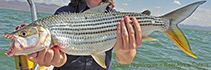
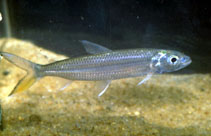
Diagnosis: 2 scale rows between lateral line and scaly process at pelvic-fin bases; eye <70% of interorbital space (Ref. 2880, 81279). Dorsal-fin uniformly greyish and its origin in front of pelvic fins; adipose fin greyish; caudal fin without black edge (Ref. 80290, 81279).
Body shape (shape guide): elongated.
Forms shoals; an open water predator often found near the water surface; feeds on fishes, preferring long bodied fish as they are easier to swallow and also takes insects, grass and snails; cannibalistic; preyed upon by fish eagle Haliaeetus vocifer; breeding migrations have been reported up several tributaries of Lake Kariba during the rains (Ref. 13337).
Ciclo de vida ou comportamento de acasalamento
Maturidade | Reprodução | Desova | Ovos | Fecundidade | Larvas
Paugy, D. and S.A. Schaefer, 2007. Alestidae. p. 347-411. In M.L.J. Stiassny, G.G. Teugels and C.D. Hopkins (eds.) Poissons d'eaux douces et saumâtres de basse Guinée, ouest de l'Afrique centrale/The fresh and brackish water fishes of Lower Guinea, west-central Africa. Vol. 1. Coll. Faune et Flore tropicales 42. Istitut de recherche pour le développement, Paris, France, Muséum nationale d'histoire naturelle, Paris, France and Musée royale de l'Afrique centrale, Tervuren, Belgique. 800 p. (Ref. 80290)
Status na Lista Vermelha da UICN (Ref. 130435: Version 2025-1)
Ameaça para os humanos
Harmless
Uso pelos humanos
Pescarias: espécies comerciais; peixe esportivo: sim
Ferramentas
Relatórios especiais
Baixar XML
Fontes da internet
Estimates based on models
Índice de diversidade filogenética (Ref.
82804): PD
50 = 0.5312 [Uniqueness, from 0.5 = low to 2.0 = high].
Bayesian length-weight: a=0.00631 (0.00441 - 0.00903), b=3.11 (3.01 - 3.21), in cm total length, based on LWR estimates for this species (Ref.
93245).
Nível Trófico (Ref.
69278): 4.0 ±0.75 se; based on food items.
Resiliência (Ref.
120179): médio(a), tempo mínimo de duplicação da população 1,4 - 4,4 anos (K=0.17-0.45; tmax=4).
Fishing Vulnerability (Ref.
59153): Moderate vulnerability (39 of 100).
🛈
Nutrients (Ref.
124155): Calcium = 77.7 [34.3, 189.1] mg/100g; Iron = 1.64 [0.88, 3.93] mg/100g; Protein = 19 [17, 21] %; Omega3 = 0.309 [0.128, 0.777] g/100g; Selenium = 60.1 [24.5, 148.2] μg/100g; VitaminA = 40.5 [14.9, 108.0] μg/100g; Zinc = 1.2 [0.8, 1.7] mg/100g (wet weight);