



Uploaden van uw Foto's en video's
Afbeeldingen | Google afbeelding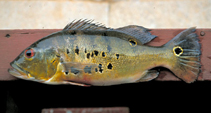 Cichla ocellaris
Female Afbeelding van Kullander, S.O.
Afbeeldingen | Google afbeelding
Female Afbeelding van Kullander, S.O.
Classificatie / Namen Lokale namen | Synoniemen | Catalog of Fishes(Genus, Soort(en)) | ITIS | CoL | WoRMS | Cloffa
> Cichliformes (Cichlids, convict blennies) > Cichlidae (Cichlids) > Cichlinae
Etymology: Cichla: Greek, kichle = wrasse (Ref. 45335).
More on authors: Bloch & Schneider.
Etymology: Cichla: Greek, kichle = wrasse (Ref. 45335).
More on authors: Bloch & Schneider.
Milieu: milieu / Klimaatzone / Diepte / verspreidingsgebied Ecologie
; zoet water; brak water benthopelagisch; standvastig (Ref. 126106); diepte 5 - ? m. Tropical; 24°C - 27°C (Ref. 2060); 26°N - 9°S
Verspreiding Gebieden | FAO regio's | Ecosystemen | Voorkomen | Verspreidingskaart | Introducties | Faunafri
South America: Marowijne drainage in Suriname and French Guiana to the Essequibo drainage in Guyana.
Lengte bij maturiteit / Grootte / Gewicht / Leeftijd
Maturiteit: Lm ?, range 32 - ? cm
Max length : 74.0 cm TL mannelijk / geslacht onbekend; (Ref. 40637); max. gepubliceerd gewicht: 6.8 kg (Ref. 40637)
Max length : 74.0 cm TL mannelijk / geslacht onbekend; (Ref. 40637); max. gepubliceerd gewicht: 6.8 kg (Ref. 40637)
Korte beschrijving Determinatiesleutels | Morfologie | Morfometrie
Diagnosis. Distinguished from all other species of Cichla except C. nigromaculata, C. intermedia, C. piquiti, and C. melaniae, by presence of bars 1a and 2a. Lateral band abbreviated in juveniles. Distinguished from its congeners with abbreviated lateral band by lateral line usually continuous (vs. discontinuous or nearly always discontinuous in orinocensis and nigromaculata; scales in E1 row (67-) 70-80 (-82) (vs. 84-93 in pleiozona); occipital bar absent or indistinct (vs. emphasized in adults of monoculus, kelberi, and pleiozona); abdominal blotches present (vs. absent in orinocensis); vertical bars present at adult size (vs. three midlateral ocellated blotches in orinocensis), except that an ocellated blotch consistently formed in dorsal portion of bar 3; absence of small black blotches on dorsum (vs. present in nigromaculata); vertical bars about equally wide across side (vs. wide, occasionally confluent dorsally, and tapering ventrad in nigromaculata, monoculus, kelberi, and pleiozona. Distinguished from C. intermedia, C. piquiti, and C. melaniae by abbreviated vs. complete juvenile lateral band, less scales in E1 row (67-82 vs. (78) 83-108), and presence of ocellated blotch in dorsal portion of bar 3 vs. absence (Ref. 57716).
Body shape (shape guide): fusiform / normal.
Body shape (shape guide): fusiform / normal.
Adults occur in the rapids, in quiet waters with medium depth and rocky substrates (Ref. 35237). They form schools (Ref. 9086). Food consists of only small fish, especially threadfin shad, mosquito fish, tilapia and bluegill. Not considered ideal for aquaculture due to its highly predatory habits (Ref. 1739). Reproduction occurs year-round, with a peak at the start of the rainy season. About 9,000 to 15,000 eggs per kg are released during spawning. Spawning takes place every two months on a flat stone in shallow water. The sticky eggs, measuring 1.4 mm in diameter, take 78 hours to hatch at 28°C.
Levenscyclus en paargedrag Maturiteit | Voortplanting | Paaien | Eieren | Fecunditeit | Larven
Spawning, with rare exceptions, takes place on a flat, horizontal surface which is either bare to begin with, or cleared of algae or other vegetation during the spawning activities. The female moves forward laying a single row of eggs and the male follows exuding sperm over each row. Once the eggs have hatched, the parents transport the larvae in their mouths to one of the depression nests.
Hoofdreferentie
Upload uw referenties | Referenties | Coördinator : Kullander, Sven O. | Medewerkers
Kullander, S.O. and H. Nijssen, 1989. The cichlids of Surinam: Teleostei, Labroidei. E.J. Brill, Leiden, The Netherlands. 256 p. (Ref. 26372)
Status op de Rode Lijst van het IUCN (Ref. 130435: Version 2025-2 (Global))
Niet bedreigd (LC) ; Date assessed: 05 November 2020
CITES
Not Evaluated
Gevaar voor de mens
Potential pest (Ref. 1739)
Gebruik door de mens
Visserij: van minder commercieel belang; Aquacultuur: commercieel; sportvis: ja; Aquarium: Commercieel
FAO - visserij: aanvoer; Publication: search | FishSource |
Meer informatie
Trofische ecologie
Voedsel (prooien)
Dieetsamenstelling
Voedselconsumptie
Voedselrantsoenen
Predatoren
Voedsel (prooien)
Dieetsamenstelling
Voedselconsumptie
Voedselrantsoenen
Predatoren
Populatiedynamica
Groeiparameters
Max. leeftijden / maten
Lengte-gewicht rel.
Lengte-lengte rel.
Lengtefrequenties
Massaconversie
Rekrutering
Abundantie
Groeiparameters
Max. leeftijden / maten
Lengte-gewicht rel.
Lengte-lengte rel.
Lengtefrequenties
Massaconversie
Rekrutering
Abundantie
Levenscyclus
Voortplanting
Maturiteit
Rijpheid/kieuwen rel.
Fecunditeit
Paaien
Paaibestanden
Eieren
Ontwikkeling van de eieren
Larven
Larvale populatiedynamiek
Voortplanting
Maturiteit
Rijpheid/kieuwen rel.
Fecunditeit
Paaien
Paaibestanden
Eieren
Ontwikkeling van de eieren
Larven
Larvale populatiedynamiek
Anatomie
Kieuwoppervlak
Hersenen
Otoliet
Kieuwoppervlak
Hersenen
Otoliet
Fysiologie
Lichaamssamenstelling
Voedingsstoffen
Zuurstofverbruik
Type zwemmen
Zwemsnelheid
Visuele pigmenten
Vis geluid
Ziekten en parasieten
Toxiciteit (LC50)
Lichaamssamenstelling
Voedingsstoffen
Zuurstofverbruik
Type zwemmen
Zwemsnelheid
Visuele pigmenten
Vis geluid
Ziekten en parasieten
Toxiciteit (LC50)
Menselijk gerelateerd
Aquacultuursystemen
Aquacultuurprofielen
Kweeklijnen
Ciguatera gevallen
Postzegels, munten, diversen.
Aquacultuursystemen
Aquacultuurprofielen
Kweeklijnen
Ciguatera gevallen
Postzegels, munten, diversen.
Tools
Biologische quiz | E-boek | Veldgids | Determinatiesleutels | Lengtefrequentie Tool | Levenscyclus tool | Verspreidingskaart |
Vangst-MSY |
Speciale rapporten
Bekijk gegevens voor het houden in een aquarium | Bekijk Fact Sheets voor de soort | Bekijk Aquacultuur Fact Sheets
Download XML
Internetbronnen
AFORO (otoliths) | Exoten/Invasieve soorten database | Aquatic Commons | BHL | Cloffa | Websites from users | Bekijk FishWatcher | CISTI | Catalog of Fishes: Genus, Soort(en) | DiscoverLife | ECOTOX | FAO - visserij: aanvoer; Publication: search | Faunafri | Fishipedia | Fishtrace | GloBI | Google Books | Google Scholar | Google | IGFA World Record | OneZoom | Open Tree of Life | Otolith Atlas of Taiwan Fishes | Publieke aquaria | PubMed | Reef Life Survey | Socotra Atlas | TreeBase | Tree of Life | Wikipedia: ga naar, zoek | World Records Freshwater Fishing | Zoobank | Zoological Record
Schattingen op basis van modellen
Fylogenetische diversiteitsindex (Ref. 82804): PD50 = 0.5000 [Uniqueness, from 0.5 = low to 2.0 = high].
Bayesian length-weight: a=0.01148 (0.00696 - 0.01895), b=3.07 (2.93 - 3.21), in cm total length, based on LWR estimates for this species & Genus-body shape (Ref. 93245).
Trofisch niveau (Ref. 69278): 4.5 ±0.80 se; based on food items.
Weerstandsvermogen (Ref. 120179): Hoog, minimale populatieverdubbelingstijd minder dan 15 maanden (Assuming tm=1; multiple spawning per year; Fec=9,000-15,000).