>
Dactylopteriformes (Flying gurnards) >
Pegasidae (Seamoths)
Etymology: Pegasus: Named after the winged horse sprung from the blood of Medusa (Ref. 1418); volitans: From the Latin word 'volitans' meaning to fly.
More on author: Linnaeus.
Environment: milieu / climate zone / distribuzione batimetrica / distribution range
Ecologia
marino; salmastro demersale; distribuzione batimetrica 1 - 73 m (Ref. 11441), usually 9 - 27 m (Ref. 1418). Tropical; 36°N - 37°S
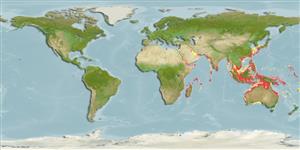
Indo-West Pacific: Delagoa Bay, Mozambique to Saudi Arabia (Persian Gulf) and throughout Gulf of Manaar to Bay of Bengal; along the east coast of Myanmar; north to Japan, south to tropical Australia (Ref. 1418) and Papua New Guinea (Ref. 6192).
Size / Peso / Age
Maturità: Lm ? range ? - ? cm
Max length : 20.0 cm TL maschio/sesso non determinato; (Ref. 90102)
Short description
Chiavi di identificazione | Morfologia | Morfometria
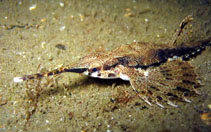
Spine dorsali (totale) : 0; Raggi dorsali molli (totale) : 5; Spine anali: 0; Raggi anali molli: 5; Vertebre: 21. Body light brown or olive to dark brown-black dorsally and laterally, lighter ventrally. Tubercles absent on surface of carapace; no scales on orbit; distal margin of dorsal and anal fins perpendicular to horizontal axis of body. 4 pairs of dorsolateral body plates; 5 pairs of ventrolateral body plates; tail rings 12, anteriormost 9 mobile, last 3 fused; a lateral pair of posteriorly directed spines on terminal tail rings; suborbital shelf convex obscuring eye from ventral view; deep pits absent. Rostrum monomorphic and spatulate.
Body shape (shape guide): other; Cross section: flattened.
A rare species (Ref. 4264) collected from muddy and sandy bottoms of estuaries and bays. Known to 'walk' over the bottom using its tentacular pelvic fins. Juveniles expatriate to tropical regions; adults mainly found in muddy estuaries where they pair. Sometimes they are seen partly buried but also feed during the day. Sometimes found floating on the surface (Ref. 48635). Sometimes occurs in seagrass areas (Ref 90102). Feeds on small benthic organisms (Ref. 68964).
Life cycle and mating behavior
Maturità | Riproduzione | Deposizione | Uova | Fecundity | Larve
Palsson, W.A. and T.W. Pietsch, 1989. Revision of the Acanthopterygian fish Family Pegasidae (Order Gasterosteiformes). Indo-Pac. Fish. (18):38 p. (Ref. 1418)
IUCN Red List Status (Ref. 130435: Version 2025-1)
Threat to humans
Harmless
Human uses
Pesca: commerciale
Strumenti
Special reports
Download XML
Fonti Internet
Estimates based on models
Preferred temperature (Fonte Biblio.
123201): 23.8 - 29.1, mean 28.1 °C (based on 1202 cells).
Phylogenetic diversity index (Fonte Biblio.
82804): PD
50 = 0.5391 [Uniqueness, from 0.5 = low to 2.0 = high].
Bayesian length-weight: a=0.01000 (0.00244 - 0.04107), b=3.04 (2.81 - 3.27), in cm total length, based on all LWR estimates for this body shape (Ref.
93245).
Trophic level (Fonte Biblio.
69278): 3.5 ±0.37 se; based on food items.
Fishing Vulnerability (Ref.
59153): Low vulnerability (10 of 100).
🛈