Environment: milieu / climate zone / пределы глубины / distribution range
экология
морской ассоциированный с рифами; пределы глубины 5 - 100 m (Ref. 79889). Tropical
Western Indian Ocean.
Size / Вес / Возраст
половая зрелость: Lm ? range ? - ? cm
Max length : 20.0 cm TL самец/пол неопределен; (Ref. 11441)
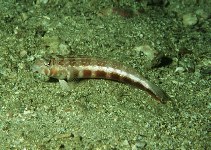
колючие лучи спинного плавника (общее число) : 5; членистые (мягкие) лучи спинного плавника (общее число) : 21; колючие лучи анального плавника: 1; членистые (мягкие) лучи анального плавника: 17; позвонки: 30. This species is distinguished by the following characters: body color in life light brown dorsally, center of scales whitish, 6 irregular, semicircular brown blotches along back that link narrowly to large dark brown spots on about lower 2/3 of body, with the spots vertically elongate anteriorly, horizontally elongate and darker posteriorly; head orangish brown with small dark brown spots dorsally on snout and nape, 7 narrow bluish white bars (3 on opercle and preopercle, 4 radiating from ventral and anterior part of eye); dorsal and anal fins are translucent whitish, the spinous dorsal with a large black basal spot mainly between the 3rd and 5th spines; rows or round orange spots on soft dorsal fin; small irregular white spots on anal fin; dark brown about lower third of caudal fin with small whitish spots along rays, the rest of the fin light grey with small white and orange spots along rays; D V,21, all rays branched; A I,17 all rays branched; pectoral rays 16-17, branched except uppermost; 57-58 lateral line scales; gill rakers 4-6 + 8-10; lower jaw projecting, 3 pairs of canine teeth anteriorly in jaws; palatine teeth absent; vomerine teeth in a chevron-shaped patch of 3-4 rows; greatest body depth 5.05-6 in SL; head length (HL) 3.5-3.9 in SL; orbit diameter 3.6-4.4 in HL; preopercle's posterior margin with widely spaced, small, blunt serrae; opercle scales ctenoid, cheek scales weakly ctenoid dorsally, becoming cycloid, progressively smaller, nonimbricate ventrally; fourth dorsal spine is the longest, 3.1-3.8 in HL; caudal fin emarginate on dorsal half, often with protruding upper lobe, becoming rounded on ventral half; pectoral fins 5.1-5.4 in SL; pelvic fins just reaching anus (Ref. 79876).
Body shape (shape guide): elongated.
Coastal species found in shallow estuaries and protected coastal bays to depths of about 25 m (Ref. 48636). Inhabit sand bottoms solitarily (Ref. 90102). Minimum depth reported from Ref. 48636.
Life cycle and mating behavior
половая зрелость | размножение | нерест | икра | Fecundity | личинки
Randall, J.E., 2008. Six new sandperches of the genus Parapercis from the Western Pacific, with description of a neotype for P. maculata (bloch and Schneider). The Raffles Bull. Zool. 19:159-178. (Ref. 79876)
Статус Красного Списка МСОП (Ref. 130435: Version 2025-1)
Угроза для людей
Harmless
Использование человеком
дополнительная информация
инструменты
Специальные отчеты
Скачать в формате XML
ресурсы в Интернет
Estimates based on models
Preferred temperature (ссылка
123201): 26.3 - 29.3, mean 28.3 °C (based on 1011 cells).
Phylogenetic diversity index (ссылка
82804): PD
50 = 0.5000 [Uniqueness, from 0.5 = low to 2.0 = high].
Bayesian length-weight: a=0.00692 (0.00314 - 0.01524), b=3.06 (2.88 - 3.24), in cm total length, based on LWR estimates for this Genus-body shape (Ref.
93245).
Trophic level (ссылка
69278): 3.5 ±0.4 se; based on size and trophs of closest relatives
устойчивость к внешним воздействиям (ссылка
120179): высокий, минимальное время удвоения популяции до 15 месяцев (Preliminary K or Fecundity.).
Fishing Vulnerability (Ref.
59153): Low vulnerability (10 of 100).
🛈