



Pseudorasbora parva (Temminck & Schlegel, 1846)
Stone moroko
上传你的 图片 和 影像
照片 | 谷歌图片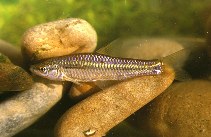 Pseudorasbora parva
图片提供人 Lorenzoni, M.
照片 | 谷歌图片
图片提供人 Lorenzoni, M.
分类 / 名称 俗名 | 同种异名 | Catalog of Fishes(属, 种) | ITIS | CoL | WoRMS | Cloffa
Teleostei > Cypriniformes (Carps) > Gobionidae (Gudgeons)
Etymology: Pseudorasbora: Greek, pseudes = false + Rasbora, an Indian word for a fish, also used in Malay peninsula.
More on authors: Temminck & Schlegel.
Etymology: Pseudorasbora: Greek, pseudes = false + Rasbora, an Indian word for a fish, also used in Malay peninsula.
More on authors: Temminck & Schlegel.
环境:氛围 / 气候带 / 深度上下限 / 分布范围 生态学
; 淡水; 半咸淡水 底中水层性; pH range: ? - 7.0; dH range: ? - 15. 溫帶; 5°C - 22°C (Ref. 2060); 54°N - 22°N, 110°E - 141°E
分布 领土 | FAO区域 | 生态系 | 标本纪录 | 分布图 | 简介 | Faunafri
Asia: Amur to Zhujiang [Pearl River] drainages in Siberia, Korea and China (Ref. 59043). Introduced to various areas in Europe and Asia. Several countries report adverse ecological impact after introduction (Ref. 1739).
亞洲: 日本南部與中部,台灣,韓國,中國,阿穆爾河流域。 引進了歐洲各地與亞洲 (參考文獻 1739) 而且現在出現於聶伯河,第聶伯河,多瑙河流域,斯庫台利湖與普雷帕斯湖與希臘的 Aliakmon 河中。 (參考文獻 26334) 引入後的一些國家報告不利的生態衝擊。 也在伊朗與土庫曼引入。 (參考文獻 39702)
亞洲: 日本南部與中部,台灣,韓國,中國,阿穆爾河流域。 引進了歐洲各地與亞洲 (參考文獻 1739) 而且現在出現於聶伯河,第聶伯河,多瑙河流域,斯庫台利湖與普雷帕斯湖與希臘的 Aliakmon 河中。 (參考文獻 26334) 引入後的一些國家報告不利的生態衝擊。 也在伊朗與土庫曼引入。 (參考文獻 39702)
首次成熟时的长度 / 大小 / 重量 / 年龄
成熟度: Lm 3.0 range ? - ? cm
Max length : 12.5 cm TL 雄鱼/尚未辨别雌雄; (Ref. 88166); common length : 8.0 cm TL 雄鱼/尚未辨别雌雄; (Ref. 1441); 最大年龄: 5 年 (Ref. 56557)
Max length : 12.5 cm TL 雄鱼/尚未辨别雌雄; (Ref. 88166); common length : 8.0 cm TL 雄鱼/尚未辨别雌雄; (Ref. 1441); 最大年龄: 5 年 (Ref. 56557)
简单描述 检索表 | 型态特徵 | 形态测量图
背棘 (总数) : 3; 背的软条 (总数) : 7; 臀棘: 3; 臀鳍软条: 6. Mouth superior and transverse; 6 branched anal rays; barbels absent; distal margin of dorsal convex; large adults with sexually dimorphic coloration (Ref. 43281).
Body shape (shape guide): fusiform / normal.
嘴上位且横向; 6个分枝的臀鳍鳍条; 触须不存在; 背部凸状的末梢部边缘; 大的成鱼有性别双型性颜色。 (参考文献 43281)
Body shape (shape guide): fusiform / normal.
嘴上位且横向; 6个分枝的臀鳍鳍条; 触须不存在; 背部凸状的末梢部边缘; 大的成鱼有性别双型性颜色。 (参考文献 43281)
Found in a wide variety of habitats, most abundantly in well vegetated small channels, ponds and small lakes (Ref. 59043). Adults occur in cool running water. Feed on small insects, fish and fish eggs (Ref. 30578), and plant material (Ref. 59043). Usually breed in habitats with still or very slow-flowing water (Ref. 59043). Females spawn 3-4 times in a season (Ref. 59043). Males clear the surface of the spawning site and guard the eggs until they hatch (Ref. 59043). Regarded as pest which competes with the fry of other species due to its high reproductive rate (Ref. 1739).
出现于冷的流动水。 吃小的昆虫,鱼与鱼卵。 (参考文献 30578) 被认为与其他种的鱼苗竞争的一个有害之物了由于它的生殖率高.(参考文献 1739)
出现于冷的流动水。 吃小的昆虫,鱼与鱼卵。 (参考文献 30578) 被认为与其他种的鱼苗竞争的一个有害之物了由于它的生殖率高.(参考文献 1739)
生命周期和交配行为 成熟度 | 繁殖 | 产卵场 | 卵 | 孕卵数 | 仔鱼
Nests under stones and the male cleans the cavity with its pearl organs. Eggs adhere to the ceiling of the cavity. The male leaves the nest before the eggs hatch. Females spawn 3-4 times during a season (Ref. 59043).亞洲: 日本南部與中部,台灣,韓國,中國,阿穆爾河流域。 引進了歐洲各地與亞洲 (參考文獻 1739) 而且現在出現於聶伯河,第聶伯河,多瑙河流域,斯庫台利湖與普雷帕斯湖與希臘的 Aliakmon 河中。 (參考文獻 26334) 引入後的一些國家報告不利的生態衝擊。 也在伊朗與土庫曼引入。 (參考文獻 39702)
主要参考文献
上传您的参考资料 | 参考文献 | 合作者 | 合作者
Kottelat, M. and J. Freyhof, 2007. Handbook of European freshwater fishes. Publications Kottelat, Cornol and Freyhof, Berlin. 646 pp. (Ref. 59043)
CITES
Not Evaluated
对人类的威胁
潜能有害之物
人类利用
渔业: 没有兴趣; 水族馆: 商业性
FAO - Publication: search | FishSource |
更多信息
工具
特别资料
下载 XML
网络资源
AFORO (otoliths) | Alien/Invasive Species database | Aquatic Commons | BHL | Cloffa | Websites from users | 核实 FishWatcher | CISTI | Catalog of Fishes: 属, 种 | DiscoverLife | ECOTOX | FAO - Publication: search | Faunafri | Fishipedia | Fishtrace | GloBI | Google Books | Google Scholar | Google | IGFA World Record | 国家资料库 | OneZoom | Open Tree of Life | Otolith Atlas of Taiwan Fishes | 公众的水族馆 | PubMed | Reef Life Survey | Socotra Atlas | TreeBase | 树状分类阶层 | Wikipedia: 转至, 搜寻 | World Records Freshwater Fishing | 动物学的记录
基于模型的估算
系统发育多样性指数 (参考文献 82804): PD50 = 0.5312 [Uniqueness, from 0.5 = low to 2.0 = high].
Bayesian length-weight: a=0.00776 (0.00666 - 0.00905), b=3.13 (3.09 - 3.17), in cm total length, based on LWR estimates for this species (Ref. 93245).
营养阶层 (参考文献 69278): 3.1 ±0.1 se; based on diet studies.
Generation time: 4.5 ( na - na) years. Estimated as median ln(3)/K based on 2 growth studies.
回复力 (参考文献 120179): 中等的, 族群倍增时间最少 1.4 - 4.4年 (tm=1; tmax=5; K=0.24; Fec=1,000).