



Aggiungete la vostra osservazione in Fish Watcher
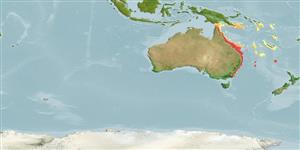
| Native range | All suitable habitat | Point map | Year 2050 |
|
| This map was computer-generated and has not yet been reviewed. |
| Sillago ciliata AquaMaps Data sources: GBIF OBIS |
Carica il tuo foto e Video
Immagini | Video | Google image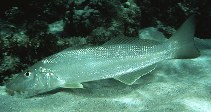 Sillago ciliata
Immagine di Randall, J.E.
Immagini | Video | Google image
Immagine di Randall, J.E.
Classificazione / Nomi Nomi Comuni | Sinonimi | Catalog of Fishes(Genere, Specie) | ITIS | CoL | WoRMS | Cloffa
> Eupercaria/misc (Various families in series Eupercaria) > Sillaginidae (Smelt-whitings)
Etymology: Sillago: From a locality in Australia.
More on author: Cuvier.
Etymology: Sillago: From a locality in Australia.
More on author: Cuvier.
Ambiente: milieu / zona climatica / distribuzione batimetrica / gamma di distribuzione Ecologia
marino; salmastro demersale; non migratori; distribuzione batimetrica 0 - 46 m (Ref. 6335), usually 20 - 22 m. Tropical; 9°S - 45°S, 142°E - 170°E (Ref. 6205)
Distribuzione Territories | Aree FAO | Ecosistemi | Presenze | Mappa dei ritrovamenti | Introduzioni | Faunafri
Western Pacific: east coast of Australia from Cape York (rare) and the Great Barrier Reef, Queensland to eastern Victoria, Ulverstone on northeast coast of Tasmania; Lord Howe Island, New Caledonia, Woodlark Islands, and Papua New Guinea. Bleeker's records (Ref. 1502, 1843) from Batavia and Java were in error (Ref. 4899).
Lunghezza alla prima maturità / Dimensione / Peso / Età
Maturità: Lm 24.0 range ? - ? cm
Max length : 51.0 cm TL maschio/sesso non determinato; (Ref. 6205); peso massimo pubblicato: 1.4 kg (Ref. 6390); Età massima riportata: 22 anni (Ref. 1254)
Max length : 51.0 cm TL maschio/sesso non determinato; (Ref. 6205); peso massimo pubblicato: 1.4 kg (Ref. 6390); Età massima riportata: 22 anni (Ref. 1254)
Breve descrizione Chiavi di identificazione | Morfologia | Morfometria
Spine dorsali (totale) : 12; Raggi dorsali molli (totale) : 16 - 18; Spine anali: 2; Raggi anali molli: 15 - 17; Vertebre: 32 - 34. The shape of the swim bladder is not distinguishable from that of S. analis. Anterior part of the swim bladder with rudimentary tubules projecting anteriorly and a series laterally that diminish in size and become sawtooth-like posteriorly. The coloration of adult specimens is uniform, without darker bars or blotches. A dark spot is present at the base of the pectoral fin in younger individuals.
Body shape (shape guide): fusiform / normal; Cross section: circular.
Body shape (shape guide): fusiform / normal; Cross section: circular.
An onshore schooling species occurring on coastal beaches, sandbars, and surf zones as well as open bays, estuaries, coastal lakes (Ref. 6205), and rivers as far as tidal limits (Ref. 6390). Keep away from shore when older. Live almost exclusively on sandy ground. Juveniles and adolescents are abundant in shallow waters of rivers and creeks, over seagrass beds and in mangroves (Ref. 6223), although they tend to move into deeper water as they grow older (Ref. 6390). Larvae are present in river mouths and mangrove areas most of the year (Ref. 27634). Oviparous (Ref. 205). Feed mostly on polychaetes and crustaceans. Also caught using tunnel nets (Ref. 6205).
Ciclo vitale e comportamento di accoppiamento Maturità | Riproduzione | Deposizione | Uova | Fecondità | Larve
Sand whiting probably spawn twice each season (Ref. 1254, 27633). Spawning occurs at peak high tide, at night, and 1-2 days before the new moon (Ref. 6390).
Riferimento principale
Caricare le referenze | Bibliografia | Coordinatore | Collaboratori
McKay, R.J., 1992. FAO Species Catalogue. Vol. 14. Sillaginid fishes of the world (family Sillaginidae). An annotated and illustrated catalogue of the sillago, smelt or Indo-Pacific whiting species known to date. Rome: FAO. FAO Fish. Synop. 125(14):87p. (Ref. 6205)
Stato della Lista Rossa IUCN (Ref. 130435: Version 2025-2 (Global))
Least Concern (LC) ; Date assessed: 05 March 2015
CITES
Not Evaluated
Minaccia per l'uomo
Harmless
Usi umani
Pesca: elevato interesse commerciale; Acquacoltura: sperimentale; Pesce da pesca sportiva: si; Acquario: Acquari pubblici
FAO - Publication: search | FishSource |
Informazioni ulteriori
Ecologia trofica
Articoli alimentari (prede)
Alimentazione
Consumo di cibo
Razioni alimentari
Predatori
Articoli alimentari (prede)
Alimentazione
Consumo di cibo
Razioni alimentari
Predatori
Dinamica della popolazione
Parametri di crescita
Età massima / dimensioni massime
Rapporto lunghezza-peso.
Lunghezza-lunghezza rel.
Lunghezza-frequenze
Conversione di massa
Reclutamento
Abbondanza
Parametri di crescita
Età massima / dimensioni massime
Rapporto lunghezza-peso.
Lunghezza-lunghezza rel.
Lunghezza-frequenze
Conversione di massa
Reclutamento
Abbondanza
Ciclo di vita
Riproduzione
Maturità
Maturità/Gli occhielli sono relativi.
Fecondità
Deposizione
Aggregazioni riproduttive
Uova
Sviluppo delle uova
Larve
Dinamica popolazioni larvali
Riproduzione
Maturità
Maturità/Gli occhielli sono relativi.
Fecondità
Deposizione
Aggregazioni riproduttive
Uova
Sviluppo delle uova
Larve
Dinamica popolazioni larvali
Fisiologia
Composizione corporea
Nutrienti
Consumo di ossigeno
Tipo di nuoto
Velocità di nuoto
Pigmenti visivi
Suono del pesce
Malattie e parassiti
Tossicità (LC50)
Composizione corporea
Nutrienti
Consumo di ossigeno
Tipo di nuoto
Velocità di nuoto
Pigmenti visivi
Suono del pesce
Malattie e parassiti
Tossicità (LC50)
Genetica
Genome
Genetica
Eterozigosi
Ereditarietà
Diversità genetica
Genome
Genetica
Eterozigosi
Ereditarietà
Diversità genetica
Legato all'uomo
Sistemi di acquacoltura
Profili di acquacoltura
Varietà
Casi di Ciguatera
Francobolli, monete, materiale vario.
Sistemi di acquacoltura
Profili di acquacoltura
Varietà
Casi di Ciguatera
Francobolli, monete, materiale vario.
Strumenti
Quiz organico | Libro elettronico | Giuda pratica | Chiavi di identificazione | Generatore frequenze di lunghezza | Strumento Parametri Biologici | Mappa dei ritrovamenti |
Cattura-MSY |
Rapporti speciali
Controllo della manutenzione dell'acquario | Verificare la presenza di schede informative sulle specie | Verifica delle schede informative sull'acquacoltura
Scarica XML
Fonti Internet
AFORO (otoliths) | Aquatic Commons | BHL | Cloffa | Websites from users | Check FishWatcher | CISTI | Catalog of Fishes: Genere, Specie | DiscoverLife | ECOTOX | FAO - Publication: search | Faunafri | Fishipedia | Fishtrace | GloBI | Google Books | Google Scholar | Google | IGFA World Record | OneZoom | Open Tree of Life | Otolith Atlas of Taiwan Fishes | PubMed | Reef Life Survey | Socotra Atlas | TreeBase | Tree of Life | Wikipedia: Go, ricerca | World Records Freshwater Fishing | Zoobank | Record zoologico
Stime basate su modelli
Temperatura preferita (Fonte Biblio. 123201): 21.2 - 27.4, mean 25.4 °C (based on 182 cells).
Indice di diversità filogenetica (Fonte Biblio. 82804): PD50 = 0.5000 [Uniqueness, from 0.5 = low to 2.0 = high].
Bayesian length-weight: a=0.00617 (0.00344 - 0.01104), b=3.13 (2.97 - 3.29), in cm total length, based on LWR estimates for this species & (Sub)family-body (Ref. 93245).
Livello trofico (Fonte Biblio. 69278): 3.2 ±0.2 se; based on diet studies.
Resilienza (Fonte Biblio. 120179): Medio, tempo minimo di raddoppiamento della popolazione 1.4 - 4.4 anni (K=0.39; tm=2-3; tmax=22; Fec=31,000).
Nutrienti (Ref. 124155): Calcium = 348 [82, 932] mg/100g; Iron = 1.22 [0.47, 3.13] mg/100g; Protein = 20.8 [18.0, 23.0] %; Omega3 = 0.221 [0.099, 0.482] g/100g; Selenium = 43.2 [14.8, 143.3] μg/100g; VitaminA = 27.7 [5.9, 122.3] μg/100g; Zinc = 1.25 [0.65, 3.06] mg/100g (wet weight);