



Acipenser gueldenstaedtii Brandt & Ratzeburg, 1833
Danube sturgeon
Aggiungete la vostra osservazione in Fish Watcher
| Native range | All suitable habitat | Point map | Year 2050 |

|
| This map was computer-generated and has not yet been reviewed. |
| Acipenser gueldenstaedtii AquaMaps Data sources: GBIF OBIS |
Carica il tuo foto e Video
Immagini | Video | Francobolli, monete, materiale vario. | Google image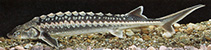 Acipenser gueldenstaedtii
Immagine di Hartl, A.
Immagini | Video | Francobolli, monete, materiale vario. | Google image
Immagine di Hartl, A.
Classificazione / Nomi Nomi Comuni | Sinonimi | Catalog of Fishes(Genere, Specie) | ITIS | CoL | WoRMS | Cloffa
> Acipenseriformes (Sturgeons and paddlefishes) > Acipenseridae (Sturgeons)
Etymology: Acipenser: Latin, acipenser = sturgeon, 1853 (Ref. 45335); gueldenstaedtii: Named for Johann Anton Güldenstädt (1745-1781).
Eponymy: Professor Johann Anton Gueldenstaedt (or Güldenstädt) (1745–1781) was a Baltic-German, born in Riga (Latvia), then part of the Russian Empire. [...] (Ref. 128868), visit book page.
Etymology: Acipenser: Latin, acipenser = sturgeon, 1853 (Ref. 45335); gueldenstaedtii: Named for Johann Anton Güldenstädt (1745-1781).
Eponymy: Professor Johann Anton Gueldenstaedt (or Güldenstädt) (1745–1781) was a Baltic-German, born in Riga (Latvia), then part of the Russian Empire. [...] (Ref. 128868), visit book page.
Taxonomic Remarks
Acipenser colchicus was described as a subspecies of A. gueldenstaedti, then considered as a subspecies of A. persicus, and is now recognized as a species by some works. On the other end, other works suggest that A. persicus, which is similar to A. gueldenstaedti, is a synonym of the latter. We will wait that the taxonomoic situation gets more clarity before changing the list of valid species, which follows the World Sturgeon Conservation Society one. Check ECoF, IUCN and FAO for more details. Anyway in FishBase, it is possible to retrieve the information under the name that was used as valid in each publication.
Ambiente: milieu / zona climatica / distribuzione batimetrica / gamma di distribuzione Ecologia
marino; acqua dolce; salmastro demersale; anadromo (Ref. 138126); distribuzione batimetrica 2 - 100 m, usually 10 - 25 m. Temperate; 10°C - 20°C (Ref. 2059); 61°N - 35°N, 26°E - 54°E
Distribuzione Territories | Aree FAO | Ecosistemi | Presenze | Mappa dei ritrovamenti | Introduzioni | Faunafri
Eurasia: Black Sea and Caspian Sea.
Lunghezza alla prima maturità / Dimensione / Peso / Età
Maturità: Lm ? range ? - ? cm
Max length : 236 cm TL maschio/sesso non determinato; (Ref. 59043); common length : 145 cm TL maschio/sesso non determinato; (Ref. 3561); peso massimo pubblicato: 115.0 kg (Ref. 6866); Età massima riportata: 46 anni (Ref. 3561)
Max length : 236 cm TL maschio/sesso non determinato; (Ref. 59043); common length : 145 cm TL maschio/sesso non determinato; (Ref. 3561); peso massimo pubblicato: 115.0 kg (Ref. 6866); Età massima riportata: 46 anni (Ref. 3561)
Breve descrizione Chiavi di identificazione | Morfologia | Morfometria
Spine dorsali (totale) : 0; Raggi dorsali molli (totale) : 27 - 48; Raggi anali molli: 16 - 35. Under the name A. g. colchicus. Lower lip not continuous, interrupted at center. Five rows of scutes: dorsal 7-19, lateral 24-44 on each side, ventral 6-13 on each side, with lines of smaller stellate bony plates between the dorsal and ventral rows. Color of back olivaceous grey, flanks lighter, and belly white.
Body shape (shape guide): elongated; Cross section: circular.
Body shape (shape guide): elongated; Cross section: circular.
Anadromous and freshwater populations exist (Refs. 9953, 131118). At the sea, it occurs in shallow coastal and estuarine zones. In freshwaters, it inhabits deep parts of large rivers with moderate to swift current (Ref. 59043). Found mainly near the shore over sand and mud. Usually solitary, but swarms when hibernating or during spawning migrations. Occasionally forms schools (Ref. 3241). Feeds on benthic molluscs, crustaceans and small fishes. Spawns on stone or gravel bottom in large and deep rivers with strong current, 1-1.5 m/s (Ref. 59043). Mainly propagated through artificial reproduction.
Ciclo vitale e comportamento di accoppiamento Maturità | Riproduzione | Deposizione | Uova | Fecondità | Larve
Under the name A. g. colchicus. Spawns in rivers. Natural spawning not extensive, maintained chiefly by artificial propagation. Enters rivers from April to June (a few in autumn).
Riferimento principale
Caricare le referenze | Bibliografia | Coordinatore | Collaboratori
Sokolov, L.I. and L.S. Berdicheskii, 1989. Acipenseridae. p. 150-153. In J. Holcík (ed.) The freshwater fishes of Europe. Vol. 1, Part II. General introduction to fishes Acipenseriformes. AULA-Verlag Wiesbaden. 469 p. (Ref. 9953)
Stato della Lista Rossa IUCN (Ref. 130435: Version 2025-2 (Global))
Critically Endangered (CR) (A2bcde); Date assessed: 14 September 2019
Minaccia per l'uomo
Harmless
Usi umani
Pesca: commerciale; Acquacoltura: commerciale; Acquario: Acquari pubblici
FAO - Sistemi di acquacoltura: produzione; pesca: sbarchi, profilo della specie; Publication: search | FishSource | Sea Around Us
Informazioni ulteriori
Ecologia trofica
Articoli alimentari (prede)
Alimentazione
Consumo di cibo
Razioni alimentari
Predatori
Articoli alimentari (prede)
Alimentazione
Consumo di cibo
Razioni alimentari
Predatori
Dinamica della popolazione
Parametri di crescita
Età massima / dimensioni massime
Rapporto lunghezza-peso.
Lunghezza-lunghezza rel.
Lunghezza-frequenze
Conversione di massa
Reclutamento
Abbondanza
Parametri di crescita
Età massima / dimensioni massime
Rapporto lunghezza-peso.
Lunghezza-lunghezza rel.
Lunghezza-frequenze
Conversione di massa
Reclutamento
Abbondanza
Ciclo di vita
Riproduzione
Maturità
Maturità/Gli occhielli sono relativi.
Fecondità
Deposizione
Aggregazioni riproduttive
Uova
Sviluppo delle uova
Larve
Dinamica popolazioni larvali
Riproduzione
Maturità
Maturità/Gli occhielli sono relativi.
Fecondità
Deposizione
Aggregazioni riproduttive
Uova
Sviluppo delle uova
Larve
Dinamica popolazioni larvali
Anatomia
Area branchiale
Cervello
Otolite
Area branchiale
Cervello
Otolite
Fisiologia
Composizione corporea
Nutrienti
Consumo di ossigeno
Tipo di nuoto
Velocità di nuoto
Pigmenti visivi
Suono del pesce
Malattie e parassiti
Tossicità (LC50)
Composizione corporea
Nutrienti
Consumo di ossigeno
Tipo di nuoto
Velocità di nuoto
Pigmenti visivi
Suono del pesce
Malattie e parassiti
Tossicità (LC50)
Legato all'uomo
Sistemi di acquacoltura
Profili di acquacoltura
Varietà
Casi di Ciguatera
Francobolli, monete, materiale vario.
Sistemi di acquacoltura
Profili di acquacoltura
Varietà
Casi di Ciguatera
Francobolli, monete, materiale vario.
Strumenti
Quiz organico | Libro elettronico | Giuda pratica | Chiavi di identificazione | Generatore frequenze di lunghezza | Strumento Parametri Biologici | Mappa dei ritrovamenti |
Cattura-MSY |
Rapporti speciali
Controllo della manutenzione dell'acquario | Verificare la presenza di schede informative sulle specie | Verifica delle schede informative sull'acquacoltura
Scarica XML
Fonti Internet
AFORO (otoliths) | Alien/Invasive Species database | Aquatic Commons | BHL | Cloffa | Websites from users | Check FishWatcher | CISTI | Catalog of Fishes: Genere, Specie | DiscoverLife | ECOTOX | FAO - Sistemi di acquacoltura: produzione; pesca: sbarchi, profilo della specie; Publication: search | Faunafri | Fishipedia | Fishtrace | GloBI | Google Books | Google Scholar | Google | IGFA World Record | Database Nazionali | OneZoom | Open Tree of Life | Otolith Atlas of Taiwan Fishes | Acquari pubblici | PubMed | Reef Life Survey | Socotra Atlas | TreeBase | Tree of Life | Wikipedia: Go, ricerca | World Records Freshwater Fishing | Zoobank | Record zoologico
Stime basate su modelli
Temperatura preferita (Fonte Biblio. 123201): 10.7 - 15.9, mean 13.8 °C (based on 32 cells).
Indice di diversità filogenetica (Fonte Biblio. 82804): PD50 = 0.5000 [Uniqueness, from 0.5 = low to 2.0 = high].
Bayesian length-weight: a=0.00417 (0.00258 - 0.00673), b=3.12 (2.99 - 3.25), in cm total length, based on LWR estimates for this species & Genus-body shape (Ref. 93245).
Livello trofico (Fonte Biblio. 69278): 3.3 ±0.1 se; based on diet studies.
Resilienza (Fonte Biblio. 120179): Molto basso, tempo minimo di raddoppiamento della popolazione più di 14 anni (tm=11; tmax=46; Fec = 26,000).
Nutrienti (Ref. 124155): Calcium = 14.6 [8.4, 25.7] mg/100g; Iron = 0.247 [0.150, 0.396] mg/100g; Protein = 17.4 [14.9, 20.1] %; Omega3 = 0.342 [0.189, 0.611] g/100g; Selenium = 23.6 [12.0, 45.3] μg/100g; VitaminA = 5.63 [1.97, 16.00] μg/100g; Zinc = 0.512 [0.365, 0.722] mg/100g (wet weight);