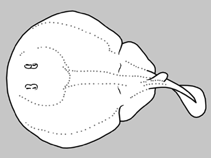
Heteronarce mollis, Soft electric ray

You can sponsor this page

Heteronarce mollis (Lloyd, 1907)

Soft electric ray
muatnaik fotos/gambar dan video
imej Google
Image of Heteronarce mollis (Soft electric ray)
No image available for this species;
drawing shows typical species in Narkidae.

klasifikasi / Names Nama-nama umum | Sinonim (persamaan) | Catalog of Fishes(Marga, Jenis) | ITIS | CoL | WoRMS | Cloffa

Ikan bertulang rawan (sharks and rays) > Torpediniformes (Electric rays) > Narkidae (Sleeper rays)
Etymology: Heteronarce: Greek, heteros = other + Greek, narke = numbness (Ref. 45335).
Eponymy: Captain Dr Richard E Lloyd MB DSc (d: 1875) was a physician in the Indian Medical Service and was Surgeon Naturalist of the Marine Survey of India. [...] (Ref. 128868), visit book page.

Environment: milieu / climate zone / kisaran kedalaman / distribution range Ekologi

laut dasar (demersal); kisaran kedalaman 73 - 346 m (Ref. 26165). Tropical; 14°N - 3°N, 45°E - 76°E (Ref. 114953)

Penyebaran Negara-negara | Daerah-daerah FAO | Ecosystems | Kemunculan | peta titik | Introduksi | Faunafri

Western Indian Ocean: Somalia, Socotra, Gulf of Aden to India, Arabian Sea.

Size / Weight / umur

Kematangan: Lm ?  range ? - ? cm
Max length : 22.5 cm SL jantan/; (Ref. 26165); 19.5 cm (female)

Biologi     Daftar kata (contoh epibenthic)

Found in deep waters (Ref. 26165). Known from few specimens. Size presumably exceeds 30 cm TL. Males reaches maturity at ca. 20 cm TL. Biology and reproduction unknown (Ref. 114953).

Life cycle and mating behavior Kematangan | Reproduksi, perkembang biakan | Pemijahan | telur-telur | Fecundity | Larva

rujukan utama Upload your references | Acuan | Koordinator : Carvalho, Marcelo | mitra

Weitkamp, D.E. and R.D. Sullivan, 2003. Gas bubble disease in resident fish of the lower Clark Fork River. Trans. Am. Fish. Soc. 132(5):865-876. (Ref. 26165)

Status IUCN Red List (Ref. 130435: Version 2025-1)

  kekurangan data (DD) ; Date assessed: 09 February 2017

CITES

Not Evaluated

CMS (Ref. 116361)

Not Evaluated

ancaman kepada manusia

  Harmless


penggunaan manusia

Perikanan: tidak ada kepentingan
FAO - Publication: search | FishSource |

informasi lanjut

Trophic ecology
Food items (preys)
Komposisi makanan
Konsumsi makanan
Food rations
Pemangsa
Ekologi
Ekologi
Home ranges
Population dynamics
Growth parameters
Max. ages / sizes
Length-weight rel.
Length-length rel.
ukuran frekuensi
Mass conversion
pemulihan
Kelimpahan
Life cycle
Reproduksi, perkembang biakan
Kematangan
Maturity/Gills rel.
Fecundity
Pemijahan
Spawning aggregations
telur-telur
pekembangan telor
Larva
Dinamika larva
Penyebaran
Negara-negara
Daerah-daerah FAO
Ecosystems
Kemunculan
Introduksi
BRUVS - Videos
Anatomy
Area insang
Brain
Otolith
Physiology
Body composition
Nutrients
Oxygen consumption
Swimming type
Swimming speed
Visual pigments
Fish sound
Diseases & Parasites
Toxicity (LC50s)
Genetika
genom
Genetika
Heterozygosity
Diturunkan
Human related
Aquaculture systems
profil budidaya air
Strain
Ciguatera cases
Stamps, coins, misc.
Outreach
mitra
Taxonomy
Nama-nama umum
Sinonim (persamaan)
Morfologi
Morfometrik
Gambar
Acuan
Acuan

Alat, peralatan

laporan khas

muat turun XML

Sumber internet

AFORO (otoliths) | Aquatic Commons | BHL | Cloffa | Websites from users | semak peneliti ikan | CISTI | Catalog of Fishes: Marga, Jenis | DiscoverLife | ECOTOX | FAO - Publication: search | Faunafri | Fishipedia | Fishtrace | GloBI | Google Books | Google Scholar | Google | IGFA World Record | OneZoom | Open Tree of Life | Otolith Atlas of Taiwan Fishes | PubMed | Reef Life Survey | Socotra Atlas | TreeBase | Tree of Life | Wikipedia: pergi, Cari | Zoological Record

Estimates based on models

Phylogenetic diversity index (Acuan 82804):  PD50 = 0.5627   [Uniqueness, from 0.5 = low to 2.0 = high].
Bayesian length-weight: a=0.01000 (0.00244 - 0.04107), b=3.04 (2.81 - 3.27), in cm total length, based on all LWR estimates for this body shape (Ref. 93245).
Trophic level (Acuan 69278):  3.2   ±0.3 se; based on size and trophs of closest relatives
Daya lenting (Acuan 120179):  Rendah, Waktu penggandaan populasi minimum 4.5 - 14 tahun (Assuming fecundity<100).
Fishing Vulnerability (Ref. 59153):  Low vulnerability (15 of 100). 🛈