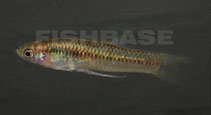
Poeciliopsis balsas, Balsas livebearer

You can sponsor this page

Poeciliopsis balsas Hubbs, 1926

Balsas livebearer
Upload your photos and videos
तस्वीरे | Google image
Image of Poeciliopsis balsas (Balsas livebearer)
Poeciliopsis balsas
Male Picture by Artigas Azas, J.M.

Classification / Names आम नाम | उपशब्द | Catalog of Fishes(वर्ग, प्रजाति) | ITIS | CoL | WoRMS | Cloffa

> Cyprinodontiformes (Rivulines, killifishes and live bearers) > Poeciliidae (Poeciliids) > Poeciliinae
Etymology: Poeciliopsis: Greek, poikilos = with a lot of colours + Greek, opsis = appearance (Ref. 45335).
More on author: Hubbs.

Environment: milieu / climate zone / गहराई सीमा / distribution range पारिस्थितिकी

; स्वच्छ जल, अलवण जल बेनथोपिलाजिक; pH range: 7.0 - 7.5; dH range: 5 - 10. Tropical; 24°C - 27°C (Ref. 26130)

वितरण देश | ऐफ ऐ ओ क्षेत्र | Ecosystems | संयोग | बिन्दु नक्शा | भूमिका | Faunafri

Central America: Rio Balsas basin, Rio Arteaga and Rio Aguililla in Michoacan, Mexico.

आकार / वज़न / Age

परिपक्व अवधि: Lm ?  range ? - ? cm
Max length : 3.5 cm TL पुल्लिंग / अलिंग; (Ref. 26130); 6.5 cm (female)

जीवविज्ञान     शब्द संग्रह (उदाहरणार्थ epibenthic)

Life cycle and mating behavior परिपक्व अवधि | पुनरुत्पत्ति | मछलीऔ का अंडे देना | अंडे | Fecundity | लार्वा

Produces 10 to 50 young after 28 days gestation.

Main reference Upload your references | संदर्भ | संयोजक | सहयोगीयो

Wischnath, L., 1993. Atlas of livebearers of the world. T.F.H. Publications, Inc., United States of America. 336 p. (Ref. 26130)

IUCN Red List Status (Ref. 130435: Version 2025-1)

  Data deficient (DD) ; Date assessed: 12 March 2018

CITES

Not Evaluated

CMS (Ref. 116361)

Not Evaluated

Threat to humans

  Harmless


Human uses

FAO - Publication: search | FishSource |

अधिक जानकारी

Trophic ecology
Food items (preys)
संघटक आहार
आहार खपत
Food rations
परभक्षी
पारिस्थितिकी
पारिस्थितिकी
Home ranges
Population dynamics
Growth parameters
Max. ages / sizes
Length-weight rel.
Length-length rel.
Length-frequencies
Mass conversion
भर्ती
बहुतायत
Life cycle
पुनरुत्पत्ति
परिपक्व अवधि
Maturity/Gills rel.
Fecundity
मछलीऔ का अंडे देना
Spawning aggregations
अंडे
Egg development
लार्वा
लारवल गतिकी
वितरण
देश
ऐफ ऐ ओ क्षेत्र
Ecosystems
संयोग
भूमिका
BRUVS - Videos
Anatomy
गिल क्षेत्र
Brain
Otolith
Physiology
Body composition
Nutrients
Oxygen consumption
Swimming type
Swimming speed
Visual pigments
Fish sound
Diseases & Parasites
Toxicity (LC50s)
आनुवंशिकी
Genome
आनुवंशिकी
Heterozygosity
हैरेटिबिलटी
Human related
Aquaculture systems
जलीयकृषि रूपरेखाऐ
खींच
Ciguatera cases
Stamps, coins, misc.
संदर्भ
संदर्भ

साधन

Special reports

Download XML

इंटरनेट स्रोत

AFORO (otoliths) | Aquatic Commons | BHL | Cloffa | Websites from users | Check FishWatcher | CISTI | Catalog of Fishes: वर्ग, प्रजाति | DiscoverLife | ECOTOX | FAO - Publication: search | Faunafri | Fishipedia | Fishtrace | GloBI | Google Books | Google Scholar | Google | IGFA World Record | OneZoom | Open Tree of Life | Otolith Atlas of Taiwan Fishes | PubMed | Reef Life Survey | Socotra Atlas | TreeBase | Tree of Life | Wikipedia: Go, खोज | Zoobank | Zoological Record

Estimates based on models

Phylogenetic diversity index (संदर्भ 82804):  PD50 = 0.5000   [Uniqueness, from 0.5 = low to 2.0 = high].
Bayesian length-weight: a=0.01023 (0.00454 - 0.02306), b=3.14 (2.95 - 3.33), in cm total length, based on LWR estimates for this (Sub)family-body shape (Ref. 93245).
लौटाव (संदर्भ 120179):  ऊंचा, न्यूनतम जनसंख्या दुगनी समय अवलागत 15 महीने। (Preliminary K or Fecundity.).
Fishing Vulnerability (Ref. 59153):  Low vulnerability (10 of 100). 🛈