>
Acanthuriformes (Surgeonfishes) >
Acanthuridae (Surgeonfishes, tangs, unicornfishes) > Acanthurinae
Etymology: Acanthurus: Greek, akantha = thorn + Greek, oura = tail (Ref. 45335).
Eponymy: Marcus Élieser Bloch (1723–1799) was a German physician and naturalist specialising in ichthyology. [...] (Ref. 128868), visit book page.
More on author: Valenciennes.
Environment: milieu / climate zone / Tiefenbereich / distribution range
Ökologie
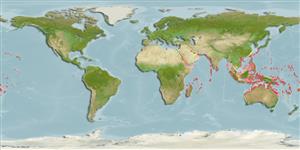
seewasser riff-verbunden; tiefenbereich 2 - 15 m (Ref. 90102). Tropical; 31°N - 34°S, 25°E - 156°W
Indo-Pacific: East Africa, including the Mascarene Islands (Ref. 37792) to the Hawaiian and Society islands, north to Ryukyu Islands, south to Lord Howe Island.
Size / Gewicht / Alter
Geschlechtsreife: Lm ? range ? - ? cm
Max length : 45.0 cm SL Männchen/unbestimmt; (Ref. 48637); max. veröff. Alter: 35 Jahre (Ref. 52229)
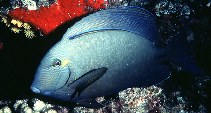
Rückenflossenstacheln (insgesamt) : 9; Rückenflossenweichstrahlen (insgesamt) : 25 - 27; Afterflossenstacheln: 3; Afterflossenweichstrahlen: 24 - 25. Color in life bluish grey with numerous yellowish brown spots which tend to form irregular longitudinal lines; head with narrow irregular stripes; behind eye a yellow spot; brown pectoral fins; base of caudal fin with white bar. Caudal spine large, 3 - 4.4 in head. Stomach gizzard-like. Differs from A. dussumieri by having vertical stripes instead of spots on the blue central area of the caudal fin, from A. mata by having a lunate caudal fin, and from A. xanthopterus by having plain brown to blue-grey pectoral fins (Ref. 1602). The white ring around the base of the tail varies in intensity and may occasionally be absent (Ref. 1602).
Body shape (shape guide): short and / or deep; Cross section: compressed.
Adults occur in outer lagoon and seaward reefs, usually seen in small groups and school in some oceanic locations (Ref. 48637). Benthopelagic (Ref. 58302). They feed primarily on the algal film covering compacted sand, ingesting the usual component of sand which probably aids in the trituration of the algal food in the thick-walled stomach, also feed on diatoms and detritus (Ref. 3921).
Life cycle and mating behavior
Geschlechtsreife | Fortpflanzung | Ablaichen | Eier | Fecundity | Larven
Randall, J.E., 1987. Three nomenclatorial changes in Indo-Pacific surgeonfishes (Acanthurinae). Pac. Sci. 41(1-4):54-61. (Ref. 1921)
IUCN Rote Liste Status (Ref. 130435: Version 2025-1)
Bedrohung für Menschen
Harmless
Nutzung durch Menschen
Fischereien: kommerziell; Aquarium: Kommerziell
Tools
Zusatzinformationen
Download XML
Internet Quellen
Estimates based on models
Preferred temperature (Ref.
123201): 24.9 - 28.8, mean 27.8 °C (based on 1800 cells).
Phylogenetic diversity index (Ref.
82804): PD
50 = 0.5000 [Uniqueness, from 0.5 = low to 2.0 = high].
Bayesian length-weight: a=0.02089 (0.01363 - 0.03203), b=2.99 (2.87 - 3.11), in cm total length, based on LWR estimates for this species & Genus-body shape (Ref.
93245).
Trophic level (Ref.
69278): 2.0 ±0.00 se; based on food items.
Generation time: 4.4 ( na - na) years. Estimated as median ln(3)/K based on 1
growth studies.
Widerstandsfähigkeit (Ref.
120179): niedrig, Verdopplung der Population dauert 4,5 - 14 Jahre. (tmax=35; K=0.25).
Fishing Vulnerability (Ref.
59153): Moderate vulnerability (38 of 100).
🛈
Nutrients (Ref.
124155): Calcium = 47.6 [20.1, 143.2] mg/100g; Iron = 0.664 [0.254, 1.601] mg/100g; Protein = 18.2 [16.9, 19.5] %; Omega3 = 0.0856 [, ] g/100g; Selenium = 15.5 [5.3, 43.3] μg/100g; VitaminA = 40.4 [9.0, 161.5] μg/100g; Zinc = 2.73 [0.85, 5.09] mg/100g (wet weight);