This website uses cookies to enhance your browsing experience and ensure the functionality of our site. For more detailed information about the types of cookies we use and how we protect your privacy, please visit our Privacy Information page.
×
Cookie Settings
This website uses different types of cookies to enhance your experience. Please select your preferences below:
> Cypriniformes (Carps) > Leuciscidae (Minnows) > Leuciscinae
Etymology: Leucaspius:Greek, leukaspis, leukaspidis = armed with a white shield (Ref. 45335). More on author: Heckel.
Entorno: milieu / zona climática / rango de profundidad / gama de distribución Ecología
; agua dulce; salobre pelágico; pH range: 6.0 - 10.0; dH range: ? - 15; potamodromo (Ref. 51243); rango de profundidad 0 - 1 m (Ref. 27368). Temperate; 2°C - 32°C (Ref. 41592); 64°N - 38°N, 1°E - 60°E
Europe and Asia: From Lower Rhine and northern Germany eastward to southern Baltic basin; Black Se basin south to Rioni drainage, northern and western Caspian basin (south to Kura drainage); Aegean Sea basin (from Maritsa to Nestos). Absent in Italy, Adriatic basin, Great Britain and Scandinavia (except southernmost Sweden). Widely introduced in France, upper Rhine drainage and locally in Great Britain and Swiitzerland.
Tamaño / Peso / Edad
Madurez: Lm? range ? - ? cm Max length : 9.0 cm SL macho / no sexado; (Ref. 59043); common length : 6.0 cm TL macho / no sexado; (Ref. 556); edad máxima reportada: 2.00 años (Ref. 556)
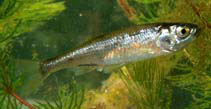
Espinas dorsales (total) : 2 - 3; Radios blandos dorsales (total) : 7 - 9; Espinas anales: 3; Radios blandos anales: 10 - 13; Vértebra: 36 - 42. Diagnosed from other cyprinids in central and eastern Europe by having incomplete lateral line with about 8-12 pored scales, keel covered by scales between pelvic origin and anus, mouth superior, and 11-13½ branched anal rays (Ref. 59043). A small fish with large silvery scales and an inconspicuous intense silvery band along each side. Lateral line incomplete, sometimes absent, with perforated scales. Anal fin longer than dorsal fin. Mouth turns upwards. The lower edge of the body between the pelvic fins and the vent forms a sharp keel. The scales are very loosely attached and fall away if the fish is handled. Also Ref. 40476. Body shape (shape guide): fusiform / normal; Cross section: oval.
Inhabits lowland riverine habitats especially oxbows and other water bodies only connected to rivers during floods. Often encountered in ponds, steppe lakes and small water bodies not connected to rivers (Ref. 59043). Occurs in large schools which are most numerous in autumn. Found between weeds in shallow pools and creeks, shallow lakes, peat and clay excavations and canals. It is exposed to the stormy flow of water (in spring, autumn and winter), but usually choose quite places like small bays, plots behind bottom stones extending out of water and concrete foundations of bridges. In autumn, the schools of fish keep to the surface and rarely go to the pelagic zone. Towards winter, the schools break up and the number of fish per unit of river square decreases rapidly (Ref. 27674); they spend the winter in deeper waters (Ref. 41592). Feeds on phytoplankton and zooplankton and on flying insects (Ref. 27368). Spawns among vegetation (Ref. 30578). Aquarium keeping: at least 10 individuals; minimum aquarium size 100 cm; not recommended for home aquariums (Ref. 51539). Scales were utilized for production of Essence d'Orient, which was used for coating artificial pearls. Locally threatened due to draining of wetlands. Reaches up to about 9 cm SL (Ref. 59043).
Territorial males clean the spawning sites and guard the eggs which are attached in strings around roots, reeds, aquatic vegetation or any material drifting on the water surface (Ref. 59043). When males tend the clutch, which is usually located on the stem of a water plant, they provide the clutch with fresh water by nudging the water plant. In addition, they spread an anti-bacterial fluid over the eggs (Ref. 1672). If possible, some fish will enter streams for spawning.
Kottelat, M., 1997. European freshwater fishes. An heuristic checklist of the freshwater fishes of Europe (exclusive of former USSR), with an introduction for non-systematists and comments on nomenclature and conservation. Biologia, Bratislava, 52/Suppl. 5:1-271. (Ref. 13696)
Situación en la Lista Roja de la UICN (Ref. 130435: Version 2025-2 (Global))
Fisiología Composición corporal Nutrientes Consumo del oxígeno Tipo de natación Velocidad de natación Pigmentos visuales Sonido de peces Enfermedades y parásitos Toxicidad (CL50)
Índice de diversidad filogenética (Referencia 82804): PD50 = 1.0000 [Uniqueness, from 0.5 = low to 2.0 = high].
Bayesian length-weight: a=0.00724 (0.00457 - 0.01148), b=3.13 (3.00 - 3.26), in cm total length, based on LWR estimates for this species & (Sub)family-body (Ref. 93245).
Nivel trófico (Referencia 69278): 3.2 ±0.4 se; based on diet studies.
Generation time: 4.4 ( na - na) years. Estimated as median ln(3)/K based on 2 growth studies.
Resiliencia (Referencia 120179): Medio, población duplicada en un tiempo mínimo de 1.4-4.4 años (K=0.248; tmax=2.0; Fec=500).
Vulnerabilidad pesquera (Ref. 59153): Low to moderate vulnerability (29 of 100). 🛈