>
Perciformes/Gasterosteoidei (Sticklebacks) >
Gasterosteidae (Sticklebacks and tubesnouts)
Etymology: Pungitius: Name meaning one that pricks; laevis: Name in Latin 'laevis' meaning smooth, referring to the absence of keel on the caudal peduncle.
More on author: Cuvier.
Issue
Often misidentified as Pungitius pungitius (Linnaeus, 1758) that it replaces in northwesternmost Europe..
Environment: milieu / climate zone / пределы глубины / distribution range
экология
морской; пресноводный; солоноватоводный донно-пелагический. Temperate
Euorope: coastal areas of western Europe from Netherlands to the Garonne drainage (France), Ireland and southern Great Britain.
Size / Вес / Возраст
половая зрелость: Lm ? range ? - ? cm
Max length : 8.0 cm SL самец/пол неопределен; (Ref. 59043)
Краткое описание
определительные ключи | морфология | морфометрия
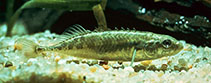
колючие лучи спинного плавника (общее число) : 9. This species is redescribed and is distinguished from congeners by the absence of keel as the only diagnostic character; with lower number of dorsal spines 9 (vs. 10 in P. pungitius); head rounded with a concave snout (specimens longer than 35 mm SL) accentuating the impression of fleshy lips; dorsal spines 8-9; anal soft rays 7-11; scutes on the caudal peduncle 0-4; pectoral-fin rays 10-11. Colouration: body generally bright green with dark tints, covered by blackish blotches, which are absent on the pectoral and abdominal regions (Ref. 125067).
Body shape (shape guide): elongated; Cross section: compressed.
Adults inhabit shallow still water with dense vegetation. Feed predominantly on zooplankton, small crustaceans and benthic insects. Spawn for the first time at 1 year of age. Spawning takes place in April-June (Ref. 59043). Males build, guard and aerate the nest where the eggs are deposited (Ref. 205).
"Males build a nest hanging to aquatic vegetation and take care of eggs and larvae. Eggs hatch in 10-20 days. Dies at end of spawning season" (Ref. 59043).
Kottelat, M. and J. Freyhof, 2007. Handbook of European freshwater fishes. Publications Kottelat, Cornol and Freyhof, Berlin. 646 pp. (Ref. 59043)
Статус Красного Списка МСОП (Ref. 130435: Version 2025-1)
Угроза для людей
Harmless
Использование человеком
дополнительная информация
инструменты
Специальные отчеты
Скачать в формате XML
ресурсы в Интернет
Estimates based on models
Phylogenetic diversity index (ссылка
82804): PD
50 = 0.5005 [Uniqueness, from 0.5 = low to 2.0 = high].
Bayesian length-weight: a=0.00501 (0.00250 - 0.01004), b=3.01 (2.82 - 3.20), in cm total length, based on LWR estimates for this species & (Sub)family-body (Ref.
93245).
Trophic level (ссылка
69278): 3.5 ±0.2 se; based on size and trophs of closest relatives
устойчивость к внешним воздействиям (ссылка
120179): средний (среднего размера), минимальное время удвоения популяции 1.4-4.4 года (Assuming Fec < 1,000).
Fishing Vulnerability (Ref.
59153): Low vulnerability (10 of 100).
🛈