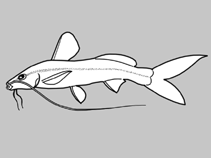
>
Siluriformes (Catfishes) >
Heptapteridae (Three-barbeled catfishes)
Etymology: Pimelodella: Diminutive latinized of greek, pimele = fat + Greek, odous, odella = little teeth (Ref. 45335).
Eponymy: John Diederich Haseman (1882–1969) was a zoologist and ichthyologist. [...] (Ref. 128868), visit book page.
More on author: Eigenmann.
Environment: milieu / climate zone / rango de profundidad / distribution range
Ecología
; agua dulce demersal. Tropical
South America: Madeira River basin, Brazil.
Tamaño / Peso / Age
Madurez: Lm ? range ? - ? cm
Max length : 8.1 cm TL macho / no sexado; (Ref. 36914)
Commonly found over sand and mud bottoms devoid of vegetation, although they occur over rock and gravel bottoms as well. Stomach contents include insects and their larvae, fish scales, and gastropods (Ref. 6868).
Life cycle and mating behavior
Madurez | Reproducción | Puesta | Huevos | Fecundidad | Larva
Reproductive mode and guild assumed to be the same as congeners (Ref. 56810).
Bockmann, F.A. and G.M. Guazzelli, 2003. Heptapteridae (Heptapterids). p. 406-431. In R.E. Reis, S.O. Kullander and C.J. Ferraris, Jr. (eds.) Checklist of the Freshwater Fishes of South and Central America. Porto Alegre: EDIPUCRS, Brasil. (Ref. 36914)
IUCN Red List Status (Ref. 130435: Version 2025-1)
Threat to humans
Harmless
Human uses
Herramientas
Special reports
Download XML
Fuentes de Internet
Estimates based on models
Phylogenetic diversity index (Referencia
82804): PD
50 = 0.5000 [Uniqueness, from 0.5 = low to 2.0 = high].
Bayesian length-weight: a=0.01122 (0.00397 - 0.03168), b=2.97 (2.73 - 3.21), in cm total length, based on LWR estimates for this (Sub)family-body shape (Ref.
93245).
Nivel trófico (Referencia
69278): 3.5 ±0.56 se; based on food items.
Fishing Vulnerability (Ref.
59153): Low vulnerability (10 of 100).
🛈