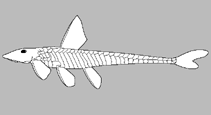
Classification / Names
Noms communs | Synonymes | Catalog of Fishes(Genre, Espèce) | ITIS | CoL | WoRMS | Cloffa
>
Siluriformes (Catfishes) >
Loricariidae (Armored catfishes) > Hypoptopomatinae
Etymology: Pareiorhaphis: Greek, pareia = jaw + Greek, rhaphis = needle (Ref. 45335).
Eponymy: Miguel Calmon du Pin e Almedia (1879–1935) was a Brazilian engineer and politician (see Calmon, above). [...] (Ref. 128868), visit book page.
More on author: Steindachner.
Issue
New combination in Steindachner (1907b:475). Type locality restricted by Steindachner (1907b:481) and relocated by Lucena and Lucena (1990:100).
Environment: milieu / climate zone / profondeur / distribution range
Écologie
; eau douce benthopélagique. Tropical
South America: drainages of the Cubataõ, Tubarao and Ararangua rivers; all coastal streams of Santa Catarina, Brazil.
Taille / Poids / Âge
Maturité: Lm ? range ? - ? cm
Max length : 17.0 cm TL mâle / non sexé; (Ref. 36817)
Rayons mous dorsaux (Total) : 7; Rayons mous anaux: 6. Pectoral fin overlapping half the length of pelvic fin when adpressed; absence of a skin flap on dorsal margin of the pectoral-fin spine; nuptial males with pectoral-fin spines thick, straight and richly ornamented with short hypertrophied odontodes (Ref. 42856).
Body shape (shape guide): elongated.
Facultative air-breathing in the genus (Ref. 126274)
Life cycle and mating behavior
Maturité | Reproduction | Frai | Œufs | Fécondité | Larves
Ferraris, C.J. Jr., 2007. Checklist of catfishes, recent and fossil (Osteichthyes: Siluriformes), and catalogue of siluriform primary types. Zootaxa 1418:1-628. (Ref. 58032)
Statut dans la liste rouge de l'IUCN (Ref. 130435: Version 2025-1)
Menace pour l'homme
Harmless
Utilisations par l'homme
Outils
Articles particuliers
Télécharger en XML
Sources Internet
Estimates based on models
Phylogenetic diversity index (Réf.
82804): PD
50 = 0.5000 [Uniqueness, from 0.5 = low to 2.0 = high].
Bayesian length-weight: a=0.00851 (0.00374 - 0.01935), b=3.09 (2.90 - 3.28), in cm total length, based on LWR estimates for this (Sub)family-body shape (Ref.
93245).
Résilience (Réf.
120179): Milieu, temps minimum de doublement de population : 1,4 à 4,4 années (Preliminary K or Fecundity.).
Fishing Vulnerability (Ref.
59153): Low vulnerability (10 of 100).
🛈