



Eptatretus strahani McMillan & Wisner, 1984
Carica il tuo foto e Video
Google image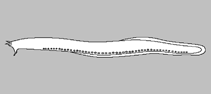 No image available for this species;
drawing shows typical species in Myxinidae.
Google image
drawing shows typical species in Myxinidae.
Classificazione / Nomi Nomi Comuni | Sinonimi | Catalog of Fishes(Genere, Specie) | ITIS | CoL | WoRMS | Cloffa
Mixini (Missine) (hagfishes) > Myxiniformes (Hagfishes) > Myxinidae (Hagfishes) > Eptatretinae
Etymology: Eptatretus: hepta (Gr.), seven; tretos (Gr.), perforated (i.e., with holes), referring to seven gill apertures on what would later be described as Homea banksii (=E. cirrhatus) [range within genus is 6-14 pairs of gill apertures] (See ETYFish); strahani: In honor of Australian zoologist Ronald Strahan (1922-2010), for “important” contributions to the study of hagfishes (See ETYFish).
Eponymy: Dr Ronald Strahan (1922–2010) was an Australian zoologist, ichthyologist and research scientist who was Director of Taronga Park Zoo, Sydney (1967–1974) when the carpetshark was described; the holotype had been swimming in the zoo’s aquarium since [...] (Ref. 128868), visit book page.
Etymology: Eptatretus: hepta (Gr.), seven; tretos (Gr.), perforated (i.e., with holes), referring to seven gill apertures on what would later be described as Homea banksii (=E. cirrhatus) [range within genus is 6-14 pairs of gill apertures] (See ETYFish); strahani: In honor of Australian zoologist Ronald Strahan (1922-2010), for “important” contributions to the study of hagfishes (See ETYFish).
Eponymy: Dr Ronald Strahan (1922–2010) was an Australian zoologist, ichthyologist and research scientist who was Director of Taronga Park Zoo, Sydney (1967–1974) when the carpetshark was described; the holotype had been swimming in the zoo’s aquarium since [...] (Ref. 128868), visit book page.
Ambiente: milieu / zona climatica / distribuzione batimetrica / gamma di distribuzione Ecologia
marino batidemersale; non migratori; distribuzione batimetrica 189 - ? m (Ref. 26665). Tropical
Distribuzione Territories | Aree FAO | Ecosistemi | Presenze | Mappa dei ritrovamenti | Introduzioni | Faunafri
Western Central Pacific: Philippines and Australia; probably occurs along other western central Pacific islands.
Dimensione / Peso / Età
Maturità: Lm ? range ? - ? cm
Max length : 62.0 cm TL maschio/sesso non determinato; (Ref. 85052); 52.0 cm TL (female)
Max length : 62.0 cm TL maschio/sesso non determinato; (Ref. 85052); 52.0 cm TL (female)
Breve descrizione Chiavi di identificazione | Morfologia | Morfometria
Spine dorsali (totale) : 0; Raggi dorsali molli (totale) : 0; Spine anali: 0; Raggi anali molli: 0. Median fins without rays (Ref. 9841). Body brown. Eyespots absent. Gill pouches and apertures 7. Ventral finfold well developed. Fused cusps 3/3, total cusps 47-52. Total slime pores 76-80 (Ref. 51420).
Body shape (shape guide): eel-like.
Body shape (shape guide): eel-like.
Minimum depth from Ref. 58018.
Ciclo vitale e comportamento di accoppiamento Maturità | Riproduzione | Deposizione | Uova | Fecondità | Larve
Copulatory organ absent. The gonads of hagfishes are situated in the peritoneal cavity. The ovary is found in the anterior portion of the gonad, and the testis is found in the posterior part. The animal becomes female if the cranial part of the gonad develops or male if the caudal part undergoes differentiation. If none develops, then the animal becomes sterile. If both anterior and posterior parts develop, then the animal becomes a functional hermaphrodite. However, hermaphroditism being characterised as functional needs to be validated by more reproduction studies (Ref. 51361 ).
Riferimento principale
Caricare le referenze | Bibliografia | Coordinatore | Collaboratori
Fernholm, B., 1998. Hagfish systematics. p. 33-44. In J.M. Jørgensen, J.P. Lomholt, R.E. Weber and H. Malte (eds.) The biology of hagfishes. Chapman & Hall, London. 578 p. (Ref. 31276)
Stato della Lista Rossa IUCN (Ref. 130435: Version 2025-2 (Global))
Data deficient (DD) ; Date assessed: 11 November 2009
CITES
Not Evaluated
Minaccia per l'uomo
Harmless
Usi umani
Pesca: di nessun interesse
FAO - Publication: search | FishSource |
Informazioni ulteriori
Ecologia trofica
Articoli alimentari (prede)
Alimentazione
Consumo di cibo
Razioni alimentari
Predatori
Articoli alimentari (prede)
Alimentazione
Consumo di cibo
Razioni alimentari
Predatori
Ecologia
Ecologia
Ecologia
Dinamica della popolazione
Parametri di crescita
Età massima / dimensioni massime
Rapporto lunghezza-peso.
Lunghezza-lunghezza rel.
Lunghezza-frequenze
Conversione di massa
Reclutamento
Abbondanza
Parametri di crescita
Età massima / dimensioni massime
Rapporto lunghezza-peso.
Lunghezza-lunghezza rel.
Lunghezza-frequenze
Conversione di massa
Reclutamento
Abbondanza
Ciclo di vita
Riproduzione
Maturità
Maturità/Gli occhielli sono relativi.
Fecondità
Deposizione
Aggregazioni riproduttive
Uova
Sviluppo delle uova
Larve
Dinamica popolazioni larvali
Riproduzione
Maturità
Maturità/Gli occhielli sono relativi.
Fecondità
Deposizione
Aggregazioni riproduttive
Uova
Sviluppo delle uova
Larve
Dinamica popolazioni larvali
Anatomia
Area branchiale
Cervello
Otolite
Area branchiale
Cervello
Otolite
Fisiologia
Composizione corporea
Nutrienti
Consumo di ossigeno
Tipo di nuoto
Velocità di nuoto
Pigmenti visivi
Suono del pesce
Malattie e parassiti
Tossicità (LC50)
Composizione corporea
Nutrienti
Consumo di ossigeno
Tipo di nuoto
Velocità di nuoto
Pigmenti visivi
Suono del pesce
Malattie e parassiti
Tossicità (LC50)
Genetica
Genome
Genetica
Eterozigosi
Ereditarietà
Diversità genetica
Genome
Genetica
Eterozigosi
Ereditarietà
Diversità genetica
Legato all'uomo
Sistemi di acquacoltura
Profili di acquacoltura
Varietà
Casi di Ciguatera
Francobolli, monete, materiale vario.
Sistemi di acquacoltura
Profili di acquacoltura
Varietà
Casi di Ciguatera
Francobolli, monete, materiale vario.
Strumenti
Libro elettronico | Giuda pratica | Generatore frequenze di lunghezza | Strumento Parametri Biologici | Mappa dei ritrovamenti |
Cattura-MSY |
Rapporti speciali
Controllo della manutenzione dell'acquario | Verificare la presenza di schede informative sulle specie | Verifica delle schede informative sull'acquacoltura
Scarica XML
Fonti Internet
AFORO (otoliths) | Aquatic Commons | BHL | Cloffa | Websites from users | Check FishWatcher | CISTI | Catalog of Fishes: Genere, Specie | DiscoverLife | ECOTOX | FAO - Publication: search | Faunafri | Fishipedia | Fishtrace | GloBI | Google Books | Google Scholar | Google | IGFA World Record | OneZoom | Open Tree of Life | Otolith Atlas of Taiwan Fishes | PubMed | Reef Life Survey | Socotra Atlas | TreeBase | Tree of Life | Wikipedia: Go, ricerca | | Zoobank | Record zoologico
Stime basate su modelli
|
Indice di diversità filogenetica (Fonte Biblio. 82804) |
PD50 = 0.5000 [Uniqueness, from 0.5 = low to 2.0 = high]. |
| Bayesian length-weight | a=0.00204 (0.00095 - 0.00440), b=2.93 (2.74 - 3.12), in cm total length, based on LWR estimates for this (Sub)family-body shape (Ref. 93245). |
|
Livello trofico (Fonte Biblio. 69278) |
4.2 ±0.7 se; based on size and trophs of closest relatives |
|
Resilienza (Fonte Biblio. 120179) |
Basso, tempo minimo di raddoppiamento della popolazione 4.5 - 14 anni (Fec assumed to be <100). |
|
Vulnerabilità della pesca (Ref. 59153) |
Moderate vulnerability (44 of 100). 🛈 |