This website uses cookies to enhance your browsing experience and ensure the functionality of our site. For more detailed information about the types of cookies we use and how we protect your privacy, please visit our Privacy Information page.
×
Cookie Settings
This website uses different types of cookies to enhance your experience. Please select your preferences below:
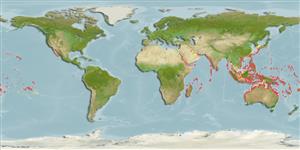
Indo-West Pacific: Red Sea and South Africa, including the southeast coast (Ref. 4392) to Easter Island, north to Japan (Ref. 38029), south to Australia. Not found in the Hawaiian Islands, but replaced by the closely related Anampses cuvier.
Μέγεθος / Βάρος / Ηλικία
Γεννητική Ωρίμανση: Lm? range ? - ? cm Max length : 42.0 cm TL αρσενικό/απροσδιόριστο; (Ref. 30573)
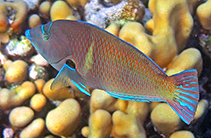
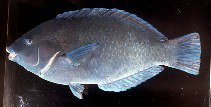
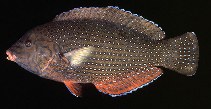
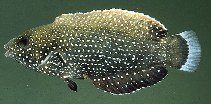
Ραχιαίες άκανθες (συνολικά) : 9; Μαλακές ραχιαίες ακτίνες (συνολικά) : 11 - 13; Εδρικές άκανθες: 3; Μαλακές εδρικές ακτίνες: 11 - 13. This species is distinguished by the following characters: 27 lateral-line scales; 18-25 gill rakers; mid-dorsal region of nape is naked or with small deeply embedded scales continuous across the dorsal part of nape (more apparent in dried specimens); relatively elongate body with depth 2.3-3.2 in SL; body width 2.2-2.7 in depth; head length (HL) 2.6-3.1 in SL; snout 2.3-2.7 in HL; eye 2.6-3.7 in snout; flexible dorsal spines; caudal fin truncate to slightly rounded; pectoral fins 1.6-1.9 in HL; pelvic fins 2.1-2.5 in HL. Body colour of Initial Phase (IP): brown to orange-brown, a dark edged pale blue spot on each scale; head reddish-brown to orange-brown, with dark-edged narrow blue bands; dorsal fin brown to brownish-red with small dark-edged blue spots, a narrow blue margin and black submarginal line; anal fin brownish-red to red and 2 or 3 rows of small dark-edged blue spots, a narrow blue margin, and black submarginal line; caudal peduncle with reddish hue on upper and lower margins; caudal fin brown to reddish-brown with small dark-edged blue spots and blue margins; pectoral base with a dusky orange-red bar, edged in blue, the upper portion blackish. Colour of Terminal Phase (TP): each scale of body olive with a dark-edged blue vertical line (except on thorax, abdomen, and nape where the blue segments are shorter and variously oriented); head with irregular, narrow, dark edged, blue bands, a broad blue band across anterior interorbital space; most individuals with a broad light green bar on side centered on sixth dorsal spine, the area anterior to this and the region of the nape coloured reddish to reddish-brown; dorsal and anal fins reddish with broad margins and basal stripes of bright blue, dorsal with a median band of small dark-edged blue spots and the anal with one or two blue stripes in middle of fin; reddish caudal fin with prominent blue margins and blue stripes along rays, but with an upper and lower zone of fin largely free of blue; pectoral base with an orange or orange-brown blue-edged bar, the upper portion of which is blackish. It has been reported that during courtship, the blue band between the eyes and around the mouth, and the single light green bar on the body of the male became brighter (Ref. 94255). Body shape (shape guide): fusiform / normal; Cross section: compressed.
Adults are found on the surge zone of coral reefs or rocky coasts (Ref. 9710, 58534). They occur singly or in pairs (Ref. 9710). Tiny juveniles swim with head towards the bottom and slowly undulate the body, looking like a floating leaf in the current (Ref. 48636). Young feed primarily on small crustaceans and polychaetes, adults switch to larger crustaceans and mollusks as well as polychaetes (Ref. 1602). They bury at night (Ref. 9710). Oviparous, distinct pairing during breeding (Ref. 205). Occasionally trawled (Ref. 30573). Not common in fish markets. Minimum depth reported taken from Ref. 30874.
Κύκλος ζωής και συμπεριφορά ζευγαρώματος Γεννητική Ωρίμανση | Αναπαραγωγή | Γεννοβολία | Αβγά | Γονιμότητα | Προνύμφες
Oviparous, distinct pairing during breeding (Ref. 205).
Westneat, M.W., 2001. Labridae. Wrasses, hogfishes, razorfishes, corises, tuskfishes. p. 3381-3467. In K.E. Carpenter and V. Niem (eds.) FAO species identification guide for fishery purposes. The living marine resources of the Western Central Pacific. Vol. 6. Bony fishes part 4 (Labridae to Latimeriidae), estuarine crocodiles. FAO, Rome. (Ref. 9823)
Κατάσταση Κόκκινου Καταλόγου IUCN (Ref. 130435: Version 2025-2 (Global))
Προτιμώμενη θερμοκρασία (Αναφ. 123201): 24.7 - 29.3, mean 28.2 °C (based on 2920 cells).
Δείκτης φυλογενετικής ποικιλότητας (Αναφ. 82804): PD50 = 0.5002 [Uniqueness, from 0.5 = low to 2.0 = high].
Bayesian length-weight: a=0.00977 (0.00468 - 0.02039), b=3.07 (2.90 - 3.24), in cm total length, based on LWR estimates for this (Sub)family-body shape (Ref. 93245).
Τροφικό Επίπεδο (Αναφ. 69278): 3.4 ±0.42 se; based on food items.
Ελαστικότητα (Αναφ. 120179): Μεσαίο(α), ελάχιστος χρόνος για διπλασιασμό πληθυσμού 1,4 - 4,4 έτη (Preliminary K or Fecundity.).
Ευπάθεια στην αλιεία (Ref. 59153): Low to moderate vulnerability (32 of 100). 🛈