>
Siluriformes (Catfishes) >
Loricariidae (Armored catfishes) > Hypostominae
Etymology: Peckoltia: Because of Gustavo Peckolt,member of the Natural History Commission of Rondon (Ref. 45335).
Eponymy: Gustavo Peckolt (1861–1923) was a Brazilian-born German botanist and pharmacist. [...] (Ref. 128868), visit book page.
More on author: Boulenger.
Environment: milieu / climate zone / intervalo de profundidade / distribution range
Ecologia
; Água doce demersal. Tropical
South America: throughout the upper Amazon and its tributaries in Brazil, Colombia, Ecuador, and Peru. A single specimen collected from the Río Meta system near Villavicencio, Colombia seems questionable since no other specimens have been collected in the Orinoco basin.
Tamanho / Peso / Idade
Maturidade: Lm ? range ? - ? cm
Max length : 14.0 cm TL macho/indeterminado; (Ref. 36713)
Descrição breve
Chaves de identificação | Morfologia | Morfometria
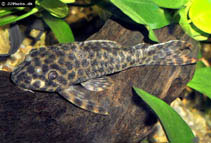
Espinhos dorsais (total) : 2; Raios dorsais moles (total) : 7; Espinhos anais: 1; Raios anais moles: 4. Can be distinguished by its one unique characteristic in having deep pockets ventrally on the pelvic girdle for the insertion of hypertrophied pelvic adductor muscles. In whole specimens, pelvic fins fold ventrally such that the pelvic-fin spines run parallel with the ventral surface body. Can be further diagnosed from all congeners by having the following characters: presence of widened pelvic-fin spines; enlarged plates on the abdomen; eye low on the head; and opercle generally with a patch of odontodes at all ages (vs. opercle maximally with a single row of odontodes with odontodes disappearing with size). Differs also from all other congeners except Peckoltia caemosa by being mottled (vs. the presence of dorsal saddles or spots), and can be separated from Peckoltia caenosa by having diffuse, large spots on the head and the abdomen without markings (vs. head and abdomen with vermiculations) (Ref. 77026).
Body shape (shape guide): elongated.
Facultative air-breathing in the genus (Ref. 126274); Occurs at the edge of medium to large rivers among submerged twigs and grasses, usually in flow (Ref. 77026).
Life cycle and mating behavior
Maturidade | Reprodução | Desova | Ovos | Fecundidade | Larvas
Armbruster, J.W., 2008. The genus Peckoltia with the description of two new species and a reanalysis of the phylogeny of the genera of the Hypostominae (Siluriformes: Loricariidae). Zootaxa 1822:1-76. (Ref. 77026)
Categoria na Lista Vermelha da IUCN (Ref. 130435: Version 2025-1)
Ameaça para o homem
Harmless
Utilização humana
Ferramentas
Relatórios especiais
Descarregue XML
Fontes da internet
Estimates based on models
Phylogenetic diversity index (Ref.
82804): PD
50 = 0.5000 [Uniqueness, from 0.5 = low to 2.0 = high].
Bayesian length-weight: a=0.01549 (0.00719 - 0.03336), b=2.98 (2.81 - 3.15), in cm total length, based on LWR estimates for this (Sub)family-body shape (Ref.
93245).
Resiliência (Ref.
120179): Elevada, tempo mínimo de duplicação da população menor que 15 meses (Preliminary K or Fecundity.).
Fishing Vulnerability (Ref.
59153): Low vulnerability (10 of 100).
🛈