Klassifizierung / Names
Namen | Synonyme | Catalog of Fishes(Gattung, Arten) | ITIS | CoL | WoRMS | Cloffa
>
Stomiiformes (Lightfishes and dragonfishes) >
Stomiidae (Barbeled dragonfishes) > Astronesthinae
Etymology: Astronesthes: Greek, astra = ray + Greek, esthes, -es = suit, something used to wrap (Ref. 45335).
More on author: Richardson.
Environment: milieu / climate zone / Tiefenbereich / distribution range
Ökologie
seewasser bathypelagisch; tiefenbereich 0 - ? m (Ref. 5951). Deep-water; 43°N - 36°S
Atlantic Ocean: through most of the Atlantic, from about 43°N to 36°S, but absent in the west from 5°N to 20°S. Elsewhere, Indian Ocean.
Size / Gewicht / Alter
Geschlechtsreife: Lm ? range ? - ? cm
Max length : 16.0 cm SL Männchen/unbestimmt; (Ref. 4465)
Kurzbeschreibung
Bestimmungsschlüssel | Morphologie | Morphometrie
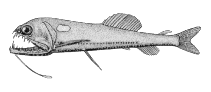
Rückenflossenstacheln (insgesamt) : 0; Rückenflossenweichstrahlen (insgesamt) : 14 - 17; Afterflossenstacheln: 0; Afterflossenweichstrahlen: 12 - 16. Black in color, pale luminous patches on middle of snout and along front of upper jaw (Ref. 3982). Pale luminous patches develop with growth on shoulder and on lower sides between pectoral and pelvic fins below dorsal (Ref. 3982). Body moderately elongate and slender, maxillary teeth comblike. Serial photophores are not broken into small groups (Ref. 37039).
Body shape (shape guide): elongated.
An oceanic and mesopelagic species usually found deeper than 500 m during the day. Feeds on midwater fishes and crustaceans. Most common species taken in surface nets at night (Ref. 2802).
Life cycle and mating behavior
Geschlechtsreife | Fortpflanzung | Ablaichen | Eier | Fecundity | Larven
Gibbs, R.H. Jr., 1990. Astronesthidae. p. 300-307. In J.C. Quero, J.C. Hureau, C. Karrer, A. Post and L. Saldanha (eds.) Check-list of the fishes of the eastern tropical Atlantic (CLOFETA). JNICT, Lisbon; SEI, Paris and UNESCO, Paris. Vol. 1. (Ref. 4465)
IUCN Rote Liste Status (Ref. 130435: Version 2025-1)
Bedrohung für Menschen
Harmless
Nutzung durch Menschen
Tools
Zusatzinformationen
Download XML
Internet Quellen
Estimates based on models
Preferred temperature (Ref.
123201): 9.2 - 20.6, mean 14.2 °C (based on 612 cells).
Phylogenetic diversity index (Ref.
82804): PD
50 = 0.5000 [Uniqueness, from 0.5 = low to 2.0 = high].
Bayesian length-weight: a=0.00417 (0.00171 - 0.01014), b=3.05 (2.84 - 3.26), in cm total length, based on LWR estimates for this (Sub)family-body shape (Ref.
93245).
Trophic level (Ref.
69278): 3.8 ±0.62 se; based on food items.
Widerstandsfähigkeit (Ref.
120179): mittel, Verdopplung der Population dauert 1,4 - 4,4 Jahre. (Assuming tmax>3).
Fishing Vulnerability (Ref.
59153): Low vulnerability (10 of 100).
🛈