>
Characiformes (Characins) >
Lebiasinidae (Pencilfishes) > Lebiasininae
Eponymy: Dr Enrico Luigi Festa (1868–1939) was an Italian naturalist who worked for the Zoological Museum of the University of Turin (1899–1923), first as Deputy Assistant Professor and retiring as Honorary Vice Director. [...] (Ref. 128868), visit book page.
More on author: Boulenger.
Issue
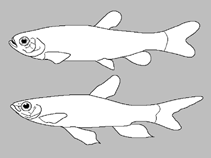
There are two species of Piabucina in the region, P. festae and P. panamensis. Graham, Kramer and Pineda (1978) used the two species in their study of the comparative respiration of an air-breathing characoid fish (P. festae) and a non-air-breathing one (P. panamensis). They report that the first species has its gas bladder modified with a specialized region in the posterior chamber while the second has no respiratory specializations. These authors report that the first is found in lowland streams and swamps, while the latter occurs in small, rocky forest streams. P. festae has a stocky body shape with the dark midbody stripe common to most species limited to a narrow dark wedge across the caudal peduncle. Graham, Kramer and Pineda (1978), Eschmeyer, 1998:576.
Environment: milieu / climate zone / distribuzione batimetrica / distribution range
Ecologia
; acqua dolce demersale. Tropical
Central and South America: Pacific drainage Panama and Colombia.
Size / Peso / Age
Maturità: Lm ? range ? - ? cm
Max length : 13.5 cm SL maschio/sesso non determinato; (Ref. 37104)
Facultative air-breathing (Ref. 126274)
Life cycle and mating behavior
Maturità | Riproduzione | Deposizione | Uova | Fecundity | Larve
Géry, J., 1977. Characoids of the world. Neptune City ; Reigate : T.F.H. [etc.]; 672 p. : ill. (chiefly col.) ; 23 cm. (Ref. 598)
IUCN Red List Status (Ref. 130435: Version 2025-1)
Threat to humans
Harmless
Human uses
Strumenti
Special reports
Download XML
Fonti Internet
Estimates based on models
Phylogenetic diversity index (Fonte Biblio.
82804): PD
50 = 0.5020 [Uniqueness, from 0.5 = low to 2.0 = high].
Bayesian length-weight: a=0.00692 (0.00273 - 0.01753), b=3.05 (2.83 - 3.27), in cm total length, based on LWR estimates for this (Sub)family-body shape (Ref.
93245).
Trophic level (Fonte Biblio.
69278): 3.6 ±0.4 se; based on size and trophs of closest relatives
Fishing Vulnerability (Ref.
59153): Low vulnerability (10 of 100).
🛈