



Hochladen Photos und videos
Bilder | Google Bild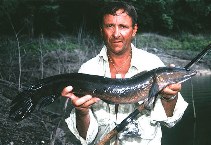 Channa marulius
Photo von Jean-Francois Helias / Fishing Adventures Thailand
Bilder | Google Bild
Photo von Jean-Francois Helias / Fishing Adventures Thailand
Klassifizierung / Names Namen | Synonyme | Catalog of Fishes(Gattung, Arten) | ITIS | CoL | WoRMS | Cloffa
> Anabantiformes (Gouramies, snakeheads) > Channidae (Snakeheads)
Etymology: Channa: Greek, channe, -es = an anchovy (Ref. 45335).
More on author: Hamilton.
Etymology: Channa: Greek, channe, -es = an anchovy (Ref. 45335).
More on author: Hamilton.
Umwelt: Milieu / Klimazone / Tiefenbereich / Verbreitungsgebiet Ökologie
Verbreitung Territorien | FAO Gebiete | Ökosysteme | Vorkommen | Punkt Karte | Einführungen | Faunafri
Größe / Gewicht / Alter
Geschlechtsreife: Lm ? range ? - ? cm
Max length : 183 cm TL Männchen/unbestimmt; (Ref. 6351); common length : 46.0 cm TL Männchen/unbestimmt; (Ref. 4833); max. veröff. Gewicht: 30.0 kg (Ref. 4833)
Max length : 183 cm TL Männchen/unbestimmt; (Ref. 6351); common length : 46.0 cm TL Männchen/unbestimmt; (Ref. 4833); max. veröff. Gewicht: 30.0 kg (Ref. 4833)
Kurzbeschreibung Bestimmungsschlüssel | Morphologie | Morphometrie
Body shape (shape guide): elongated.
Obligate air-breathing (Ref. 126274); Adults occur in sluggish or standing water in canals, lakes, and swamps (Ref. 12693). Theyinhabit waters with submerged aquatic vegetation (Ref. 12693). Usually found only in deep pools in rivers and occasionally in lakes. They enter flooded forest (Ref. 9497). Carnivorous and subsist on fish, frogs, snakes, insects, earthworms and tadpoles (Ref. 1479). There are reports of this species taking water birds, snakes, and rodents. Males are territorial. May bite when caught (Elliot Bligh, pers. comm., 2001).
Lebenszyklus und Paarungsverhalten Geschlechtsreife | Fortpflanzung | Ablaichen | Eier | Fruchtbarkeit | Larven
Builds floating nest of weeds and leaves where the orange-yellow eggs are deposited. Eggs hatch in 36 to 48 hours and fry remain in the nest for about 10 days after hatching. Parents guards the fry for about a month.
Hauptreferenz
Laden Sie Ihre Referenzen hoch | Referenzen | Koordinator | Partner
Kottelat, M., 2013. The fishes of the inland waters of Southeast Asia: a catalogue and core bibliography of the fishes known to occur in freshwaters, mangroves and estuaries. The Raffles Bulletin of Zoology 2013 (Suppl. 27):1-663. (Ref. 94476)
IUCN Rote Liste Status (Ref. 130435: Version 2025-2 (Global))
nicht bedroht (LC) ; Date assessed: 06 October 2009
CITES
Not Evaluated
Bedrohung für Menschen
Traumatogenic
Nutzung durch Menschen
Fischereien: kommerziell; Aquakultur: kommerziell; Sportfisch: ja; Aquarium: Öffentliche Aquarien
FAO - Publication: search | FishSource |
Mehr Information
Trophische Ökologie
Lebensmittel (Beutetiere)
Nahrungszusammensetzung
Nahrungsaufnahme
Lebensmittelrationen
Räuber
Lebensmittel (Beutetiere)
Nahrungszusammensetzung
Nahrungsaufnahme
Lebensmittelrationen
Räuber
Populationsdynamik
Wachstumsparameter
Max. Alter/Größen
Länge-Gewicht-Rel.
Länge-Länge-Verhältnis.
Längenhäufigkeiten
Massenkonvertierung
Rekrutierung
Dichte
Wachstumsparameter
Max. Alter/Größen
Länge-Gewicht-Rel.
Länge-Länge-Verhältnis.
Längenhäufigkeiten
Massenkonvertierung
Rekrutierung
Dichte
Lebenszyklus
Fortpflanzung
Geschlechtsreife
Reifung/Kiemen rel.
Fruchtbarkeit
Ablaichen
Laichaggregationen
Eier
Eientwicklung
Larven
Larven Pop.Dyn.
Fortpflanzung
Geschlechtsreife
Reifung/Kiemen rel.
Fruchtbarkeit
Ablaichen
Laichaggregationen
Eier
Eientwicklung
Larven
Larven Pop.Dyn.
Anatomie
Kiemenoberfläche
Gehirn
Otolith
Kiemenoberfläche
Gehirn
Otolith
Physiologie
Körperliche Zusammensetzung
Nährstoffe
Sauerstoffverbrauch
Schwimmart
Schwimmgeschwindigkeit
Visuelle Pigmente
Fischgeräusche
Krankheiten und Parasiten
Toxizität (LC50s)
Körperliche Zusammensetzung
Nährstoffe
Sauerstoffverbrauch
Schwimmart
Schwimmgeschwindigkeit
Visuelle Pigmente
Fischgeräusche
Krankheiten und Parasiten
Toxizität (LC50s)
Menschenbezogen
Aquakultur-Systeme
Aquakultur Profile
Zuchtlinien
Ciguatera-Fälle
Briefmarken, Münzen, Verschiedenes.
Aquakultur-Systeme
Aquakultur Profile
Zuchtlinien
Ciguatera-Fälle
Briefmarken, Münzen, Verschiedenes.
Tools
Bio-Quiz | E-Book | Feldführer | Längenhäufigkeits Tool | Lebensdaten Tool | Punkt Karte |
Catch-MSY |
Zusatzinformationen
Download XML
Zusammenfassung | Punktdaten | Namen | Photos
Internet Quellen
AFORO (otoliths) | Alien/Invasive Species database | Aquatic Commons | BHL | Cloffa | Websites from users | FishWatcher Einträge suchen | CISTI | Catalog of Fishes: Gattung, Arten | DiscoverLife | ECOTOX | FAO - Publication: search | Faunafri | Fishipedia | Fishtrace | GloBI | Google Books | Google Scholar | Google | IGFA World Record | OneZoom | Open Tree of Life | Otolith Atlas of Taiwan Fishes | PubMed | Reef Life Survey | Socotra Atlas | TreeBase | Tree of Life | Wikipedia: Gehe zu, Suchen | World Records Freshwater Fishing | Zoologischer Rekord
Schätzungen auf der Grundlage von Modellen
Phylogenetischer Diversitätsindex (Ref. 82804): PD50 = 0.5000 [Uniqueness, from 0.5 = low to 2.0 = high].
Bayesian length-weight: a=0.00708 (0.00435 - 0.01153), b=2.92 (2.78 - 3.06), in cm total length, based on LWR estimates for this species & Genus-body shape (Ref. 93245).
Trophische Ebene (Ref. 69278): 4.5 ±0.80 se; based on food items.
Generation time: 4.8 ( na - na) years. Estimated as median ln(3)/K based on 1 growth studies.
Widerstandsfähigkeit (Ref. 120179): mittel, Verdopplung der Population dauert 1,4 - 4,4 Jahre. (K=0.23).
Nährstoffe (Ref. 124155): Calcium = 34 [15, 87] mg/100g; Iron = 0.767 [0.514, 1.242] mg/100g; Protein = 18.3 [17.3, 19.4] %; Omega3 = 0.198 [0.080, 0.492] g/100g; Selenium = 54.1 [21.9, 128.7] μg/100g; VitaminA = 55.8 [20.4, 150.1] μg/100g; Zinc = 0.697 [0.481, 1.074] mg/100g (wet weight); based on nutrient studies.