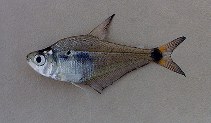
Classification / Names
आम नाम | उपशब्द | Catalog of Fishes(वर्ग, प्रजाति) | ITIS | CoL | WoRMS | Cloffa
>
Characiformes (Characins) >
Characidae (Characins; tetras) > Characinae
Etymology: Roeboides: Latin, rubus, ruber, reddish.
More on author: Fowler.
Issue
See Hahn et al. (2000) for dental development and ontogenetic diet shifts.
Environment: milieu / climate zone / गहराई सीमा / distribution range
पारिस्थितिकी
; स्वच्छ जल, अलवण जल बेनथोपिलाजिक; pH range: 5.8 - 6.8; dH range: ? - 8. Subtropical; 22°C - 26°C (Ref. 2059)
South America: Paraguay and lower Paraná River basins.
Length at first maturity / आकार / वज़न / Age
परिपक्व अवधि: Lm 43.0 range ? - ? cm
Max length : 8.9 cm SL पुल्लिंग / अलिंग; (Ref. 36811)
Found in inlets and backwaters of rivers and streams. Forages mostly at twilight, stalking larger fishes to feed on their scales. Approaches its intended prey stealthily and usually aims at its flank. Strikes mostly with its mouth closed, dislodging the scales with its stout, external and forward-directed teeth. The jarring strike dislodges a few scales which are swallowed immediately if taken in the mouth, or gathered as they sink. Also feeds on aquatic insects (Ref. 40383).
Life cycle and mating behavior
परिपक्व अवधि | पुनरुत्पत्ति | मछलीऔ का अंडे देना | अंडे | Fecundity | लार्वा
Lucena, C.A.S. de, 2007. Revisão taxonômica das espéces do gênero Roeboides grupo-affinis (Ostariophysi, Characiformes, Characidae). Iheringia, Ser. Zool., Porto Alegre 97(2):117-136. (Ref. 75795)
IUCN Red List Status (Ref. 130435: Version 2025-1)
Threat to humans
Harmless
Human uses
साधन
Special reports
Download XML
इंटरनेट स्रोत
Estimates based on models
Phylogenetic diversity index (संदर्भ
82804): PD
50 = 0.5000 [Uniqueness, from 0.5 = low to 2.0 = high].
Bayesian length-weight: a=0.01000 (0.00442 - 0.02263), b=3.09 (2.89 - 3.29), in cm total length, based on LWR estimates for this (Sub)family-body shape (Ref.
93245).
Trophic level (संदर्भ
69278): 3.3 ±0.46 se; based on food items.
Fishing Vulnerability (Ref.
59153): Low vulnerability (10 of 100).
🛈