



Phractolaemus ansorgii Boulenger, 1901
Hingemouth
Tải lên của bạn hình ảnh Và Video
Các tranh (Ảnh) | Google image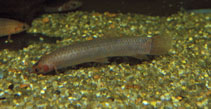 Phractolaemus ansorgii
Hình ảnh của Sazima, I.
Các tranh (Ảnh) | Google image
Hình ảnh của Sazima, I.
Phân loại / Tên Tên thường gặp | Các synonym ( Các tên trùng) | Catalog of Fishes(Giống, Các loài) | ITIS | CoL | WoRMS | Cloffa
> Gonorynchiformes (Milkfishes) > Phractolaemidae (Hingemouths)
Etymology: Phractolaemus: Greek, phraktos = fence + Greek, laimos = throttle (Ref. 45335).
Eponymy: Dr William John Ansorge (1850–1913) was an English explorer and collector who was active in Africa in the second half of the 19th century. [...] (Ref. 128868), visit book page.
More on author: Boulenger.
Etymology: Phractolaemus: Greek, phraktos = fence + Greek, laimos = throttle (Ref. 45335).
Eponymy: Dr William John Ansorge (1850–1913) was an English explorer and collector who was active in Africa in the second half of the 19th century. [...] (Ref. 128868), visit book page.
More on author: Boulenger.
Môi trường: môi trường / vùng khí hậu / Mức độ sâu / phạm vi phân phối Sinh thái học
; nước ngọt sống nổi và đáy; pH range: 6.0 - 8.0; dH range: ? - 25. Tropical; 25°C - 30°C (Ref. 13371)
Sự phân bố Lãnh thổ | Các khu vực của FAO | Các hệ sinh thái | Những lần xuất hiện | Bản đồ điểm | Những chỉ dẫn | Faunafri
Africa: in West Africa from Lake Nokoué (Ouémé River, Benin) (Ref. 81277) to Cross River (Cameroon) (Ref. 52397), including Ogun, Osse and Niger Delta (Ref. 81277). Also in the middle Congo River basin (Ref. 93183) in Republic of Congo and Democratic Republic of the Congo.
Bộ gần gũi / Khối lượng (Trọng lượng) / Tuổi
Chín muồi sinh dục: Lm ? range ? - ? cm
Max length : 25.0 cm TL con đực/không giới tính; (Ref. 93183)
Max length : 25.0 cm TL con đực/không giới tính; (Ref. 93183)
Mô tả ngắn gọn Khóa để định loại | Hình thái học | Sinh trắc học
Các tia vây lưng cứng (tổng cộng) : 0; Các vây lưng mềm (tổng cộng) : 6; Tia cứng vây hậu môn: 0; Tia mềm vây hậu môn: 6; Động vật có xương sống: 34 - 38. Diagnosis: head depressed and strongly ossified; anterior nostril elongate, forming an oblique, forward-pointing tube; posterior nostril crescent-shaped, located just behind the narial tube (Ref. 2913, 81277). Mouth small, protrusible (Ref. 245, 31256, 81277), placed at tip of a proboscis and opening upwards between the narial tubes (Ref. 2913, 81277), on upper surface of snout (Ref. 245, 31256). Narrow gill opening, but opercles very well developed, covering also the underside of the head where they overlap (Ref. 2913, 81277, 93183).
Body shape (shape guide): elongated; Cross section: circular.
Body shape (shape guide): elongated; Cross section: circular.
Facultative or obligate air-breathing (Ref. 126274); Lives in forest pools and swamps (Ref. 41580). Microphagous (Ref. 4910, 41580, 45483), especially phytophagous (epiphytes), and detritiphagous (Ref. 41580). Swim bladder entirely alveolar, functioning like a lung; this adaptation to aerial breathing allows the fish to survive under poor oxygenation conditions (Ref. 2913, 81277); recorded from nearly deoxygenated lungfish nest in Pool Malebo, Congo DR (Ref. 41585). Gonads, which are largely fused, are situated ventrally, not dorsally, in abdominal cavity (Ref. 41580). Mouth can be projected as a small trunk (Ref. 2913). Eggs transparent, yellow-greenish, 1.5-1.7mm diameter; large females may have several thousands of eggs (Ref. 41580). Particular blood system, with dark coloured and an abundant amouth of blood (Ref. 4910).
Vòng đời và hành vi giao phối Chín muồi sinh dục | Sự tái sinh sản | Đẻ trứng | Các trứng | Sự sinh sản | Ấu trùng
Males and females have lateral tubercles on their body which probably aid in maintaining contact during spawning (Ref. 38266).
Tài liệu tham khảo chính
Tải lên tài liệu tham khảo của bạn | Các tài liệu tham khảo | Người điều phối | Người cộng tác
Lévêque, C., 1990. Phractolaemidae. p. 189-191. In C. Lévêque, D. Paugy and G.G. Teugels (eds.) Faune des poissons d'eaux douces et saumâtres d'Afrique de l'Ouest. Tome I. Coll. Faune Tropicale n° XXVIII. Musée Royal de l'Afrique Centrale, Tervuren, and O.R.S.T.O.M.,Paris, 384 p. (Ref. 2913)
Tình trạng Sách đỏ IUCN (Ref. 130435: Version 2025-2 (Global))
Least Concern (LC) ; Date assessed: 05 June 2019
CITES
Not Evaluated
Mối đe dọa đối với con người
Harmless
Sử dụng của con người
FAO - Publication: search | FishSource |
Thêm thông tin
Sinh thái dinh dưỡng
Thức ăn (con mồi)
Thành phần thức ăn
Thành phần thức ăn
Khẩu phần ăn
Các động vật ăn mồi
Thức ăn (con mồi)
Thành phần thức ăn
Thành phần thức ăn
Khẩu phần ăn
Các động vật ăn mồi
Biến động dân số
Các thông số tăng trưởng
Độ tuổi / kích thước tối đa
Chiều dài-trọng lượng tương đối
Chiều dài-chiều dài tương đối.
Chiều dài-tần số
Chuyển đổi khối lượng
Bổ xung
Sự phong phú
Các thông số tăng trưởng
Độ tuổi / kích thước tối đa
Chiều dài-trọng lượng tương đối
Chiều dài-chiều dài tương đối.
Chiều dài-tần số
Chuyển đổi khối lượng
Bổ xung
Sự phong phú
Vòng đời
Sự tái sinh sản
Chín muồi sinh dục
Độ trưởng thành/Mang liên quan
Sự sinh sản
Đẻ trứng
Tập hợp sinh sản
Các trứng
Sự phát triển của trứng
Ấu trùng
Sự biến động ấu trùng
Sự tái sinh sản
Chín muồi sinh dục
Độ trưởng thành/Mang liên quan
Sự sinh sản
Đẻ trứng
Tập hợp sinh sản
Các trứng
Sự phát triển của trứng
Ấu trùng
Sự biến động ấu trùng
Sự phân bố
Lãnh thổ
Các khu vực của FAO
Các hệ sinh thái
Những lần xuất hiện
Những chỉ dẫn
BRUVS - Video
Lãnh thổ
Các khu vực của FAO
Các hệ sinh thái
Những lần xuất hiện
Những chỉ dẫn
BRUVS - Video
Giải phẫu
Vùng mang
Não
sỏi tai
Vùng mang
Não
sỏi tai
Sinh lý học
Thành phần cơ thể
Chất dinh dưỡng
Thành phần ô-xy
Kiểu bơi
Tốc độ bơi
Sắc tố thị giác
Tiếng cá
Bệnh tật & Ký sinh trùng
Độc tính (LC50)
Thành phần cơ thể
Chất dinh dưỡng
Thành phần ô-xy
Kiểu bơi
Tốc độ bơi
Sắc tố thị giác
Tiếng cá
Bệnh tật & Ký sinh trùng
Độc tính (LC50)
Liên quan đến con người
Hệ thống nuôi trồng thủy sản
Các tổng quan nuôi trồng thủy sản
Các giống
Các trường hợp ngộ độc Ciguatera
Tem, tiền xu, v.v.
Hệ thống nuôi trồng thủy sản
Các tổng quan nuôi trồng thủy sản
Các giống
Các trường hợp ngộ độc Ciguatera
Tem, tiền xu, v.v.
Các công cụ
Trắc nghiệm sinh học | Sách điện tử | Hướng dẫn hiện trường | Tần suất chiều dài Wizard | Công cụ của vòng đời | Bản đồ điểm |
Bắt-MSY |
Báo cáo đặc biệt
Kiểm tra bảo trì bể cá | Kiểm tra các tờ thông tin về loài | Kiểm tra các tờ thông tin về nuôi trồng thủy sản
Tải xuống XML
Các nguồn internet
AFORO (otoliths) | Aquatic Commons | BHL | Cloffa | Websites from users | Check FishWatcher | CISTI | Catalog of Fishes: Giống, Các loài | DiscoverLife | ECOTOX | FAO - Publication: search | Faunafri | Fishipedia | Fishtrace | GloBI | Google Books | Google Scholar | Google | IGFA World Record | OneZoom | Open Tree of Life | Otolith Atlas of Taiwan Fishes | PubMed | Reef Life Survey | Socotra Atlas | TreeBase | Cây Đời sống | Wikipedia: Go, tìm | World Records Freshwater Fishing | Zoobank | Tạp chí Zoological Record
Ước tính dựa trên mô hình
Chỉ số đa dạng phát sinh loài (Tài liệu tham khảo 82804): PD50 = 1.5000 [Uniqueness, from 0.5 = low to 2.0 = high].
Bayesian length-weight: a=0.00437 (0.00168 - 0.01136), b=3.13 (2.90 - 3.36), in cm total length, based on LWR estimates for this (Sub)family-body shape (Ref. 93245).
Mức dinh dưỡng (Tài liệu tham khảo 69278): 2.3 ±0.1 se; based on diet studies.