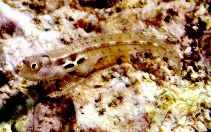
Alloblennius pictus

You can sponsor this page

Alloblennius pictus (Lotan, 1970)

Add your observation in Fish Watcher
Native range | All suitable habitat | Point map | Year 2050
This map was computer-generated and has not yet been reviewed.
Alloblennius pictus   AquaMaps   Data sources: GBIF OBIS
Upload your photos and videos
รูปภาพหลายรูป | Google image
Image of Alloblennius pictus
Alloblennius pictus
Picture by Field, R.

Classification / Names ชื่อสามัญ | ชื่อพ้อง | Catalog of Fishes(สกุล, ชนิด) | ITIS | CoL | WoRMS | Cloffa

> Blenniiformes (Blennies) > Blenniidae (Combtooth blennies) > Salariinae
Etymology: Alloblennius: Greek, allos = other + Greek, blennios = mucus (Ref. 45335).

Environment: milieu / climate zone / ระดับความลึก / distribution range นิเวศวิทยา

เกี่ยวกับทะเล,น้ำเค็ม สัตว์น้ำหน้าดิน. Tropical

การแพร่กระจาย ประเทศต่างๆ | พื้นที่จำแนกตาม FAO | ระบบนิเวศหลายระบบ | การปรากฏขึ้น,การเกิดขึ้น,พบ | ตำแหน่งบนแผนที่ | การแนะนำ | Faunafri

Western Indian Ocean: Gulf of Aqaba, the Red Sea, and Djibouti, Gulf of Tadjoura.

ขนาด / น้ำหนัก / Age

วัยเจริญพันธุ์: Lm ?  range ? - ? cm
Max length : 2.6 cm SL เพศผู้/กระเทย; (Ref. 27664)

ชีววิทยา     ภาคผนวก (เช่น epibenthic)

Oviparous. Eggs are demersal and adhesive (Ref. 205), and are attached to the substrate via a filamentous, adhesive pad or pedestal (Ref. 94114). Larvae are planktonic, often found in shallow, coastal waters (Ref. 94114).

Life cycle and mating behavior วัยเจริญพันธุ์ | การสืบพันธุ์ | การวางไข่ | เซลสืบพันธ์ของเพศเมีย(ไข่) | ความดกของไข่ | ตัวอ่อน

Oviparous, distinct pairing (Ref. 205).

Main reference Upload your references | อ้างอิง | ผู้ประสานงาน : Williams, Jeffrey T. | ผู้ร่วมมือ

Springer, V.G., H. Bath and J.E. Randall, 1998. Remarks on the species of the Indian Ocean fish genus Alloblennius Smith-Vaniz & Springer 1971, (Blennidae). aqua, J. Ichthyol. Aquat. Biol. 3(1):19-24. (Ref. 27664)

IUCN Red List Status (Ref. 130435: Version 2025-1)

  Least Concern (LC) ; Date assessed: 23 March 2009

CITES

Not Evaluated

CMS (Ref. 116361)

Not Evaluated

Threat to humans

  Harmless


Human uses

FAO - Publication: search | FishSource |

ข้อมูลเพิ่มเติม

นิเวศวิทยาเขตร้อน
Food items (preys)
องค์ประอบของอาหาร
การบริโภคอาหาร
Food rations
ผู้ล่า
นิเวศวิทยา
นิเวศวิทยา
Home ranges
Population dynamics
Growth parameters
Max. ages / sizes
Length-weight rel.
Length-length rel.
Length-frequencies
Mass conversion
การทดแทนที่
อุดมสมบรูณ์
Life cycle
การสืบพันธุ์
วัยเจริญพันธุ์
Maturity/Gills rel.
ความดกของไข่
การวางไข่
Spawning aggregations
เซลสืบพันธ์ของเพศเมีย(ไข่)
Egg development
ตัวอ่อน
พลวัตของสัตว์น้ำวัยอ่อน
การแพร่กระจาย
ประเทศต่างๆ
พื้นที่จำแนกตาม FAO
ระบบนิเวศหลายระบบ
การปรากฏขึ้น,การเกิดขึ้น,พบ
การแนะนำ
BRUVS - Videos
Anatomy
พื้นที่เหงือก
Brain
Otolith
Physiology
Body composition
Nutrients
การใช้ออกซิเจน
รูปแบบการว่ายน้ำ
ระดับความเร็วในการว่ายน้ำ
Visual pigments
Fish sound
Diseases & Parasites
Toxicity (LC50s)
พันธุศาสตร์
Genome
พันธุศาสตร์
Heterozygosity
อัตราพันธุกรรม
Human related
Aquaculture systems
ประวัติการเพาะเลี้ยงสัตว์น้ำ
สายพันธุ์
Ciguatera cases
Stamps, coins, misc.
อ้างอิง
อ้างอิง

เครื่องมือ

Special reports

Download XML

แหล่งที่มาจากอินเตอร์เน็ต

Estimates based on models

Preferred temperature (อ้างอิง 123201): 24.7 - 29.4, mean 28.5 °C (based on 134 cells).
Phylogenetic diversity index (อ้างอิง 82804):  PD50 = 0.5312   [Uniqueness, from 0.5 = low to 2.0 = high].
Bayesian length-weight: a=0.00832 (0.00448 - 0.01544), b=3.00 (2.84 - 3.16), in cm total length, based on LWR estimates for this species & (Sub)family-body (Ref. 93245).
ความสามารถในการกลับคืนสู่ปกติ (อ้างอิง 120179):  ความสูง, เวลาต่ำสุดที่จะทำให้ประชากรเพิ่มขึ้นเป็น 2 เท่าใช้เวลาน้อยกว่า 15 เดือน (Preliminary K or Fecundity.).
Fishing Vulnerability (Ref. 59153):  Low vulnerability (10 of 100). 🛈