>
Ovalentaria/misc (Various families in series Ovalentaria) >
Grammatidae (Basslets)
Etymology: Gramma: Greek, gramma, atos = signal, mark (Ref. 45335).
Eponymy: Señorita Loreto Martínez caught the type specimen while fishing in the bay at Matanzas, Cuba. [...] (Ref. 128868), visit book page.
More on author: Poey.
Environment: milieu / climate zone / Tiefenbereich / distribution range
Ökologie
seewasser riff-verbunden; tiefenbereich 1 - 60 m (Ref. 9710), usually 1 - 40 m (Ref. 27115). Tropical; 22°C - 27°C (Ref. 27115)
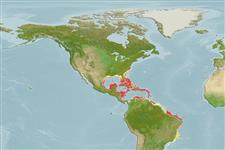
Western Central Atlantic: Bermuda, Bahamas, and Central America to northern South America.
Length at first maturity / Size / Gewicht / Alter
Geschlechtsreife: Lm ?, range 3 - ? cm
Max length : 8.0 cm TL Männchen/unbestimmt; (Ref. 7251)
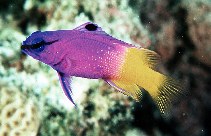
Rückenflossenstacheln (insgesamt) : 12; Rückenflossenweichstrahlen (insgesamt) : 10. Bicolored: purple (appearing blue underwater) in front, bight orange-yellow behind (Ref. 26938).
Body shape (shape guide): fusiform / normal.
Often found in caves or under ledges. Swim with belly toward substratum, thus under ledges seen upside down. Feed on ectoparasites of other fishes (Ref. 5521). Males show various types of nest care behavior (Ref. 35580). Retreat into recesses when alarmed (Ref. 9710). Have been reared in captivity (Ref. 35420).
Mouthbrooding in this specimen has not been supported by any evidence (Ref. 35580). Prior to spawning, some males established nest sites, using small holes and crevices in the substratum. Females traveled to male nests for egg deposition around dawn. Eggs deposited within the nests were tended by males that established the nests. Males display four types of nest care behaviour: guarding, nest maintenance, detritus clearing,and simple nest entering (Ref. 35580).
Asoh, K. and T. Yoshikawa, 1996. Nesting behavior, male parental care, and embryonic development in the fairy basslet, Gramma loreto. Copeia 1996(1):1-8. (Ref. 35580)
IUCN Rote Liste Status (Ref. 130435: Version 2025-1)
Bedrohung für Menschen
Harmless
Nutzung durch Menschen
Fischereien: kommerziell; Aquarium: Kommerziell
Tools
Zusatzinformationen
Download XML
Internet Quellen
Estimates based on models
Preferred temperature (Ref.
123201): 25.1 - 28, mean 27.1 °C (based on 436 cells).
Phylogenetic diversity index (Ref.
82804): PD
50 = 0.5313 [Uniqueness, from 0.5 = low to 2.0 = high].
Bayesian length-weight: a=0.01122 (0.00514 - 0.02450), b=3.04 (2.87 - 3.21), in cm total length, based on all LWR estimates for this body shape (Ref.
93245).
Trophic level (Ref.
69278): 3.3 ±0.41 se; based on food items.
Fishing Vulnerability (Ref.
59153): Low vulnerability (10 of 100).
🛈
Nutrients (Ref.
124155): Calcium = 115 [64, 202] mg/100g; Iron = 0.81 [0.50, 1.29] mg/100g; Protein = 18.6 [17.5, 19.6] %; Omega3 = 0.173 [0.105, 0.280] g/100g; Selenium = 25.4 [12.9, 46.5] μg/100g; VitaminA = 184 [63, 540] μg/100g; Zinc = 2.18 [1.51, 3.03] mg/100g (wet weight);