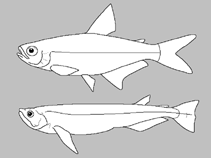
Classification / Names
Noms communs | Synonymes | Catalog of Fishes(Genre, Espèce) | ITIS | CoL | WoRMS | Cloffa
>
Characiformes (Characins) >
Characidae (Characins; tetras) > Aphyocharacinae
Etymology: Amazonichthys: Name from the Greek 'Amazon' (a race of warrior women) and 'ichthys' for fishes; referring to the indigenous Icamiabas that battled against Spanish troops led by Francisco Orellana in 1542 (who led an aggressive expedition into the Amazon region). The Icamiabas resembled the Amazons from Greek mythology, fighting with bows and arrows and forbidding the presence
of men inside their tribe (Medina, 1894).
Eponymy: Mrs Linde Geisler collected the holotype with her husband, German biologist and aquarist Rolf Geisler (q.v.). (Ref. 128868), visit book page.
More on author: Géry.
Environment: milieu / climate zone / profondeur / distribution range
Écologie
; eau douce benthopélagique. Tropical
South America: Brazil.
Taille / Poids / Âge
Maturité: Lm ? range ? - ? cm
Max length : 2.5 cm SL mâle / non sexé; (Ref. 130247)
Description synthétique
Clés d'identification | Morphologie | Morphométrie
This species is distinguished from A. camelierae by having the anterior midlateral stripe reaching dorsal-fin region (vs. stripe reaching caudal peduncle blotch), second unbranched dorsal-fin ray hyaline (vs. proximal half of second unbranched dorsal-fin ray densely pigmented), caudal peduncle blotch triangular (vs. roundish), lateral line incomplete (vs. complete), longitudinal scales 31-33 (vs. 37-39), ventral margin of third infraorbital bone usually reaching anterodorsal margin of preopercle (vs. surpassing that point), and precaudal vertebrae 12 (vs. 13); differs from A. lu distinguished by the dense concentration of dark brown chromatophores over the first unbranched dorsal and all unbranched anal-fin rays (vs. dorsal and anal unbranched fin rays are poorly pigmented), with two symmetrical conspicuous small dark blotches at the base of the caudal-fin rays (vs. usually absent, very diffuse when present), pectoral-fin rays i9-10 (vs. i8), and with just one unilateral hook at the medial region of each ray segment (vs. one to two (Ref. 130247).
Cross section: compressed.
Life cycle and mating behavior
Maturité | Reproduction | Frai | Œufs | Fécondité | Larves
Esguícero, A.L.H. and M.B. Mendonça, 2023. A new genus and two new species of tetras (Characiformes: Characidae), with a redescription and generic reassignment of Axelrodia lindeae Géry. Ichthyology & Herpetology 111(3):426-447. (Ref. 130247)
Statut dans la liste rouge de l'IUCN (Ref. 130435: Version 2025-1)
Menace pour l'homme
Harmless
Utilisations par l'homme
Pêcheries: sans intérêt
Outils
Articles particuliers
Télécharger en XML
Sources Internet
Estimates based on models
Phylogenetic diversity index (Réf.
82804): PD
50 = 0.6250 [Uniqueness, from 0.5 = low to 2.0 = high].
Bayesian length-weight: a=0.00661 (0.00301 - 0.01449), b=3.11 (2.93 - 3.29), in cm total length, based on LWR estimates for this (Sub)family-body shape (Ref.
93245).
Niveau trophique (Réf.
69278): 3.1 ±0.4 se; based on size and trophs of closest relatives
Fishing Vulnerability (Ref.
59153): Low vulnerability (10 of 100).
🛈