Classification / Names
Noms communs | Synonymes | Catalog of Fishes(Genre, Espèce) | ITIS | CoL | WoRMS | Cloffa
Issue
See Géry, 1977:579 for comments and Bizerril, 1994:65 for key.
Environment: milieu / climate zone / profondeur / distribution range
Écologie
; eau douce benthopélagique. Tropical
South America: coastal basins of southeastern Brazil.
Taille / Poids / Âge
Maturité: Lm ? range ? - ? cm
Max length : 8.1 cm SL mâle / non sexé; (Ref. 38376); 10.4 cm SL (female)
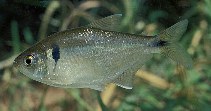
Inhabits streams and rivers with sandy to muddy bottom. Forages during the day mingling with schools of similarly sized and looking prey types, such as tetras of the genus Astyanax, and feeds on their scales. The resemblance of this scale-eater with its habitual prey is an example of aggressive mimicry (Ref. 40388). The fish follows closely the intended prey by placing itself obliquely to its rear; strikes at prey's flank with its mouth widely open, the scales being removed during a quick bite. Removed scales are swallowed immediately and the predator resumes schooling with its prey. The fourth dentary teeth, the most important one for scale removal, is already differentiated in juveniles at 1.9 SL. The scale-eating habit may have a primarily social origin through inter-specific aggression. Besides scales, it occasionally takes insects, tiny crustaceans and plant material (Ref. 28733).
Life cycle and mating behavior
Maturité | Reproduction | Frai | Œufs | Fécondité | Larves
Terán, G.E., M.F. Benitez and J.M. Mirande, 2020. Opening the Trojan house: phylogeny of Astyanax, two genera and resurrection of Psalidodon (Teleostei: Characidae). Zool. J. Lin. Soc. 190(4):1217-1234. (Ref. 123753)
Statut dans la liste rouge de l'IUCN (Ref. 130435: Version 2025-1)
Menace pour l'homme
Harmless
Utilisations par l'homme
Outils
Articles particuliers
Télécharger en XML
Sources Internet
Estimates based on models
Phylogenetic diversity index (Réf.
82804): PD
50 = 0.5000 [Uniqueness, from 0.5 = low to 2.0 = high].
Bayesian length-weight: a=0.01096 (0.00498 - 0.02415), b=3.09 (2.92 - 3.26), in cm total length, based on LWR estimates for this Genus-body shape (Ref.
93245).
Niveau trophique (Réf.
69278): 3.2 ±0.49 se; based on food items.
Résilience (Réf.
120179): Haut, temps minimum de doublement de population inférieur à 15 mois (Preliminary K or Fecundity.).
Fishing Vulnerability (Ref.
59153): Low vulnerability (10 of 100).
🛈