This website uses cookies to enhance your browsing experience and ensure the functionality of our site. For more detailed information about the types of cookies we use and how we protect your privacy, please visit our Privacy Information page.
×
Cookie Settings
This website uses different types of cookies to enhance your experience. Please select your preferences below:
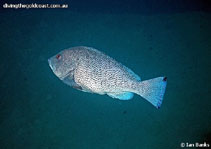
Epinephelus cyanopodus, Speckled blue grouper : fisheries, aquarium
Western Pacific: southern Japan to southern Queensland and east to Fiji and the islands of Micronesia. Recently recorded from Tonga (Ref. 53797). Record from Western Australia in the Indian Ocean is dubious. Replaced by Epinephelus flavocaeruleus in the Indian Ocean (Ref. 37816).
Lunghezza alla prima maturità / Dimensione / Peso / Età
Maturità: Lm?, range 64 - ? cm Max length : 122 cm TL maschio/sesso non determinato; (Ref. 4787); peso massimo pubblicato: 17.3 kg (Ref. 40637)
Spine dorsali (totale) : 11; Raggi dorsali molli (totale) : 16 - 17; Spine anali: 3; Raggi anali molli: 8. Juveniles are mostly yellow becoming gray with dark spots anteriorly. The gray area increases with increasing size until only the fins remain yellow on individuals of 15 to 20 cm (Ref. 37816).
Body shape (shape guide): fusiform / normal; Cross section: compressed.
Usually found around isolated coral heads in lagoons or bays, but also caught on outer reef area. According to Myers (1989, Ref. 4538) it usually swims out in the open, several meters above the bottom. It is readily caught by anglers at night. Feeds mainly on sand-dwelling fishes and crustaceans such as snake eels and box crabs. In Hong Kong live fish markets (Ref. 27253).
Ciclo vitale e comportamento di accoppiamento Maturità | Riproduzione | Deposizione | Uova | Fecondità | Larve
Heemstra, P.C. and J.E. Randall, 1993. FAO Species Catalogue. Vol. 16. Groupers of the world (family Serranidae, subfamily Epinephelinae). An annotated and illustrated catalogue of the grouper, rockcod, hind, coral grouper and lyretail species known to date. Rome: FAO. FAO Fish. Synop. 125(16):382 p. (Ref. 5222)
Stato della Lista Rossa IUCN (Ref. 130435: Version 2025-2 (Global))
Ciclo di vita Riproduzione Maturità Maturità/Gli occhielli sono relativi. Fecondità Deposizione Aggregazioni riproduttive Uova Sviluppo delle uova Larve Dinamica popolazioni larvali
Fisiologia Composizione corporea Nutrienti Consumo di ossigeno Tipo di nuoto Velocità di nuoto Pigmenti visivi Suono del pesce Malattie e parassiti Tossicità (LC50)
Temperatura preferita (Fonte Biblio. 123201): 22.5 - 29, mean 27.8 °C (based on 1250 cells).
Indice di diversità filogenetica (Fonte Biblio. 82804): PD50 = 0.5000 [Uniqueness, from 0.5 = low to 2.0 = high].
Bayesian length-weight: a=0.01096 (0.00686 - 0.01753), b=3.05 (2.92 - 3.18), in cm total length, based on LWR estimates for this species & Genus-body shape (Ref. 93245).
Livello trofico (Fonte Biblio. 69278): 4.1 ±0.5 se; based on diet studies.
Resilienza (Fonte Biblio. 120179): Molto basso, tempo minimo di raddoppiamento della popolazione più di 14 anni (Preliminary K or Fecundity.).
Vulnerabilità della pesca (Ref. 59153): High to very high vulnerability (73 of 100). 🛈