>
Anguilliformes (Eels and morays) >
Ophichthidae (Snake eels) > Ophichthinae
Etymology: Paraletharchus: Greek, para = the side of + Greek, lethargia = lethargy + Greek, archos = anus (Ref. 45335).
More on authors: Myers & Wade.
Environment: milieu / climate zone / profondeur / distribution range
Écologie
marin démersal. Tropical
Southeast Pacific: Galapagos Islands.
Taille / Poids / Âge
Maturité: Lm ? range ? - ? cm
Max length : 64.3 cm TL mâle / non sexé; (Ref. 31241)
Description synthétique
Clés d'identification | Morphologie | Morphométrie
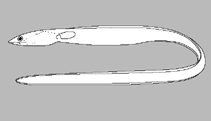
Vertèbres: 170 - 180. Body cream to tan; with numerous brown spots. Spotted head and dorsal fin. Tubular anterior nostril. Suborbital pores three. Anal fin present. (Ref. 27478).
Body shape (shape guide): eel-like.
Life cycle and mating behavior
Maturité | Reproduction | Frai | Œufs | Fécondité | Larves
McCosker, J.E., 1974. A revision of the ophichthid eel genus Letharcus. Copeia 1974(3):619-628. (Ref. 31241)
Statut dans la liste rouge de l'IUCN (Ref. 130435: Version 2025-1)
Menace pour l'homme
Harmless
Utilisations par l'homme
Outils
Articles particuliers
Télécharger en XML
Sources Internet
Estimates based on models
Phylogenetic diversity index (Réf.
82804): PD
50 = 0.7500 [Uniqueness, from 0.5 = low to 2.0 = high].
Bayesian length-weight: a=0.00091 (0.00039 - 0.00215), b=2.99 (2.79 - 3.19), in cm total length, based on LWR estimates for this (Sub)family-body shape (Ref.
93245).
Niveau trophique (Réf.
69278): 3.8 ±0.6 se; based on size and trophs of closest relatives
Résilience (Réf.
120179): Milieu, temps minimum de doublement de population : 1,4 à 4,4 années (Preliminary K or Fecundity.).
Fishing Vulnerability (Ref.
59153): Moderate to high vulnerability (46 of 100).
🛈