>
Trachichthyiformes (Roughies) >
Anomalopidae (Lanterneye fishes)
Etymology: Protoblepharon: Greek, protos = the first + Greek, blepharos = eyelash.
Eponymy: Dr Richard Heinrich ‘Dick’ Rosenblatt (1930–2014) was an American ichthyologist and oceanographer. [...] (Ref. 128868), visit book page.
Environment: milieu / climate zone / profondeur / distribution range
Écologie
marin démersal; profondeur ? - 274 m (Ref. 26282). Tropical
Eastern Central Pacific: Cook Islands.
Taille / Poids / Âge
Maturité: Lm ? range ? - ? cm
Max length : 22.0 cm SL mâle / non sexé; (Ref. 91770)
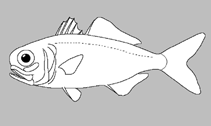
Épines dorsales (Total) : 7; Rayons mous dorsaux (Total) : 14; Épines anales: 2; Rayons mous anaux: 11; Vertèbres: 30. This species is distinguished from it s congener P mccoskeri in having the following characters: body depth 2.8 in SL (vs. 2.3 in SL); pelvic fin origin posterior to (vs. anterior to) vertical through origin of dorsal fin; pectoral fin when appressed reaching (vs. falling short of) lateral line; pelvic fin when appressed reaching well beyond (vs. falling short of) midpoint between pelvic and anal fin origins; eye and light organ bigger; seventh dorsal-fin spine longer; pseudobranch filaments ca 27 (vs. 38); scale rows along vertical between origin of dorsal fin and lateral line ca. 18 (vs. ca. 30); scale rows along body axis ca. 145 (vs. over 260); enlarged scales 21 at anal fin base (vs. 37 surrounding anal fin base 37); 2-3 rows of irregularly shaped plate-like cycloid scales along outer margin of gill chamber (vs. single row of enlarged cycloid, plate-like scales); 97 (52 on right + 45 at left) enlarged scales along dorsal-fin base and 22 (11 at each side) along anal-fin base; a third row of flat, tooth-plate type gill rakers between the other two rows on each lower limb of second and third arches; number of abdominal scutes 13 (with the 7th not clearly defined); 14 abdominal and 16 caudal vertebrae, including second ural centrum; dorsal fin supported by 21anteroposteriorly expanded pterygiophores (7 spinous, 14 soft ray); one supraneural anterior to the first and second neural spines; supraneural and pterygiophore insertion formula 0/0/1+1/1/1/1/1/1/0/1/1/1/1/1/2/3/3; anal fin supported by 12 anteroposteriorly expanded pterygiophores, first 3 inserting anterior to haemal spine of first caudal (15th) vertebra (Ref. 91770).
Body shape (shape guide): fusiform / normal; Cross section: compressed.
Minimum depth from Ref. 58018.
Life cycle and mating behavior
Maturité | Reproduction | Frai | Œufs | Fécondité | Larves
Ho, H.-C. and G.D. Johnson, 2012. Protoblepharon mccoskeri, a new flashlight fish from eastern Taiwan (Teleostei: Anomalopidae). Zootaxa 3479:77-87. (Ref. 91770)
Statut dans la liste rouge de l'IUCN (Ref. 130435: Version 2025-1)
Menace pour l'homme
Harmless
Utilisations par l'homme
Outils
Articles particuliers
Télécharger en XML
Sources Internet
Estimates based on models
Phylogenetic diversity index (Réf.
82804): PD
50 = 0.7520 [Uniqueness, from 0.5 = low to 2.0 = high].
Bayesian length-weight: a=0.01122 (0.00514 - 0.02450), b=3.04 (2.87 - 3.21), in cm total length, based on all LWR estimates for this body shape (Ref.
93245).
Niveau trophique (Réf.
69278): 3.7 ±0.6 se; based on size and trophs of closest relatives
Fishing Vulnerability (Ref.
59153): Low vulnerability (17 of 100).
🛈