



Nothobranchius vosseleri Ahl, 1924
Pangani nothobranch
Uploaden van uw Foto's en video's
Afbeeldingen | Google afbeelding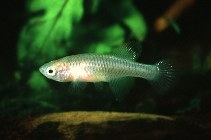 Nothobranchius vosseleri
Female Afbeelding van Seegers, L.
Afbeeldingen | Google afbeelding
Female Afbeelding van Seegers, L.
Classificatie / Namen Lokale namen | Synoniemen | Catalog of Fishes(Genus, Soort(en)) | ITIS | CoL | WoRMS | Cloffa
> Cyprinodontiformes (Rivulines, killifishes and live bearers) > Nothobranchiidae (African rivulines)
Etymology: Nothobranchius: Greek, nothos = false + Greek, brangchia = gill (Ref. 45335).
Eponymy: Dr Julius Vosseler (1861–1933) was a German zoologist. [...] (Ref. 128868), visit book page.
More on author: Ahl.
Etymology: Nothobranchius: Greek, nothos = false + Greek, brangchia = gill (Ref. 45335).
Eponymy: Dr Julius Vosseler (1861–1933) was a German zoologist. [...] (Ref. 128868), visit book page.
More on author: Ahl.
Milieu: milieu / Klimaatzone / Diepte / verspreidingsgebied Ecologie
; zoet water benthopelagisch; pH range: 7.5 - 8.3; standvastig. Tropical; 23°C - 31°C (Ref. 96650)
Verspreiding Gebieden | FAO regio's | Ecosystemen | Voorkomen | Verspreidingskaart | Introducties | Faunafri
Africa: Pangani River basin, Tanzania (Ref. 96650).
Grootte / Gewicht / Leeftijd
Korte beschrijving Determinatiesleutels | Morfologie | Morfometrie
Dorsale stekels (totaal) : 0; Dorsale zachte stralen (totaal) : 14 - 16; Anale stekels: 0; Anale zachte stralen: 15 - 18. Diagnosis: Nothobranchius vosseleri is a member of a group of Nothobranchius species of relatively large size and with a slender body, less than 30% of standard length, compared to other species of the genus; and a distinct red caudal fin in male (Ref. 96650). It can be distinguished from other species of the so-called N. melanospilus group by a pointed snout, and the presence of a dark vertical bar through the iris (Ref. 96650).
Body shape (shape guide): fusiform / normal.
Body shape (shape guide): fusiform / normal.
Nothobranchius vosseleri was observed from a wide variety of habitats, including ephemeral pools, temporary creeks, man-made ditches and small, probably permanent, streams; bordering vegetation of grasses and stands of Typha and Cyperus were found at all localities (Ref. 96650). It is an annual species, its annual reproduction was confirmed in the aquarium; eggs are, after a short courtship, deposited in the bottom substrate, which is mainly silt with an addition of decayed plant material (Ref. 96650). Like all other known Nothobranchius species, the eggs survive the dry season by delayed hatching; the majority of eggs are hatchable 8 to 10 weeks after spawning; growth is fast, after 6 to 7 weeks of age the young fishes may reproduce (Ref. 96650).
Levenscyclus en paargedrag Maturiteit | Voortplanting | Paaien | Eieren | Fecunditeit | Larven
Hoofdreferentie
Upload uw referenties | Referenties | Coördinator | Medewerkers
Wildekamp, R.H., B.R. Watters and I.F.N. Sainthouse, 1998. Redescription of Nothobranchius vosseleri (Cyprinodontiformes: Aplocheilidae), an annual fish from the Tanzanian coastal plains. Ichthyol. Explor. Freshwat. 8(4):289-298. (Ref. 96650)
Status op de Rode Lijst van het IUCN (Ref. 130435: Version 2025-2 (Global))
Kwetsbaar (VU) (B1ab(iii)); Date assessed: 12 January 2019
CITES
Not Evaluated
Gevaar voor de mens
Harmless
Gebruik door de mens
Visserij: van geen belang; Aquarium: Commercieel
FAO - Publication: search | FishSource |
Meer informatie
Trofische ecologie
Voedsel (prooien)
Dieetsamenstelling
Voedselconsumptie
Voedselrantsoenen
Predatoren
Voedsel (prooien)
Dieetsamenstelling
Voedselconsumptie
Voedselrantsoenen
Predatoren
Populatiedynamica
Groeiparameters
Max. leeftijden / maten
Lengte-gewicht rel.
Lengte-lengte rel.
Lengtefrequenties
Massaconversie
Rekrutering
Abundantie
Groeiparameters
Max. leeftijden / maten
Lengte-gewicht rel.
Lengte-lengte rel.
Lengtefrequenties
Massaconversie
Rekrutering
Abundantie
Levenscyclus
Voortplanting
Maturiteit
Rijpheid/kieuwen rel.
Fecunditeit
Paaien
Paaibestanden
Eieren
Ontwikkeling van de eieren
Larven
Larvale populatiedynamiek
Voortplanting
Maturiteit
Rijpheid/kieuwen rel.
Fecunditeit
Paaien
Paaibestanden
Eieren
Ontwikkeling van de eieren
Larven
Larvale populatiedynamiek
Anatomie
Kieuwoppervlak
Hersenen
Otoliet
Kieuwoppervlak
Hersenen
Otoliet
Fysiologie
Lichaamssamenstelling
Voedingsstoffen
Zuurstofverbruik
Type zwemmen
Zwemsnelheid
Visuele pigmenten
Vis geluid
Ziekten en parasieten
Toxiciteit (LC50)
Lichaamssamenstelling
Voedingsstoffen
Zuurstofverbruik
Type zwemmen
Zwemsnelheid
Visuele pigmenten
Vis geluid
Ziekten en parasieten
Toxiciteit (LC50)
Genetica
genoom
Genetica
Heterozygositeit
Erfelijkheid
Genetische diversiteit
genoom
Genetica
Heterozygositeit
Erfelijkheid
Genetische diversiteit
Menselijk gerelateerd
Aquacultuursystemen
Aquacultuurprofielen
Kweeklijnen
Ciguatera gevallen
Postzegels, munten, diversen.
Aquacultuursystemen
Aquacultuurprofielen
Kweeklijnen
Ciguatera gevallen
Postzegels, munten, diversen.
Tools
Speciale rapporten
Bekijk gegevens voor het houden in een aquarium | Bekijk Fact Sheets voor de soort | Bekijk Aquacultuur Fact Sheets
Download XML
Internetbronnen
AFORO (otoliths) | Aquatic Commons | BHL | Cloffa | Websites from users | Bekijk FishWatcher | CISTI | Catalog of Fishes: Genus, Soort(en) | DiscoverLife | ECOTOX | FAO - Publication: search | Faunafri | Fishipedia | Fishtrace | GloBI | Google Books | Google Scholar | Google | IGFA World Record | OneZoom | Open Tree of Life | Otolith Atlas of Taiwan Fishes | PubMed | Reef Life Survey | Socotra Atlas | TreeBase | Tree of Life | Wikipedia: ga naar, zoek | World Records Freshwater Fishing | Zoobank | Zoological Record
Schattingen op basis van modellen
Fylogenetische diversiteitsindex (Ref. 82804): PD50 = 0.5000 [Uniqueness, from 0.5 = low to 2.0 = high].
Bayesian length-weight: a=0.01096 (0.00461 - 0.02608), b=2.94 (2.74 - 3.14), in cm total length, based on LWR estimates for this (Sub)family-body shape (Ref. 93245).
Trofisch niveau (Ref. 69278): 3.2 ±0.4 se; based on size and trophs of closest relatives