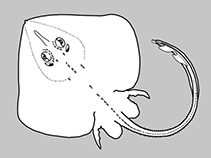
Cruriraja cadenati, Broadfoot leg skate

You can sponsor this page

Cruriraja cadenati Bigelow & Schroeder, 1962

Broadfoot leg skate
Uploaden van uw Foto's en video's
Google afbeelding
Image of Cruriraja cadenati (Broadfoot leg skate)
No image available for this species;
drawing shows typical species in Gurgesiellidae.

Classificatie / Namen Lokale namen | Synoniemen | Catalog of Fishes(Genus, Soort(en)) | ITIS | CoL | WoRMS | Cloffa

Elasmobranchii (haaien en roggen) (sharks and rays) > Rajiformes (Skates and rays) > Gurgesiellidae (Pygmy skates)
Etymology: Cruriraja: Latin, crur, cruris = pertaining to a leg + Latin, raja = a ray (Raja sp) (Ref. 45335).
Eponymy: Dr Jean Cadenat (1908–1992) of the University of Dakar, was a French researcher and ichthyologist at the ‘Office de la recherche scientifique et technique outre-mer’, where he was Director of the Marine Biological Section of the Institute Français [...] (Ref. 128868), visit book page.

Environment: milieu / Klimaatzone / Diepte / distribution range Ecologie

marien bathydemersaal; diepte ? - 458 m (Ref. 26282). Deep-water; 19°N - 18°N

Verspreiding Landen | FAO regio's | Ecosystemen | Voorkomen | Verspreidingskaart | Introducties | Faunafri

Western Central Atlantic: known from the type locality, off the western coast of Puerto Rico.

Grootte / Gewicht / Leeftijd

Maturiteit: Lm ?  range ? - ? cm

Biologie     Verklarende woordenlijst (bv. epibenthic)

Holotype taken from a depth of about 458 m (Ref. 26282). Oviparous (Ref. 50449). Eggs have horn-like projections on the shell (Ref. 205).

Levenscyclus en paargedrag Maturiteit | Voortplanting | Paaien | Eieren | Fecunditeit | Larven

Oviparous, paired eggs are laid. Embryos feed solely on yolk (Ref. 50449). Eggs have horn-like projections on the shell (Ref. 205).

Hoofdreferentie Upload uw referenties | Referenties | Coördinator | Medewerkers

McEachran, J.D. and K.A. Dunn, 1998. Phylogenetic analysis of skates, a morphologically conservative clade of elasmobranchs (Chondrichthyes: Rajidae). Copeia 1998(2):271-290. (Ref. 27314)

Status op de Rode Lijst van het IUCN (Ref. 130435: Version 2025-1)

  Niet bedreigd (LC) ; Date assessed: 23 June 2019

CITES

Not Evaluated

CMS (Ref. 116361)

Not Evaluated

Gevaar voor de mens

  Harmless


Gebruik door de mens

FAO - Publication: search | FishSource |

Meer informatie

Trofische ecologie
Food items (preys)
Dieetsamenstelling
Voedselconsumptie
Food rations
Predatoren
Ecologie
Ecologie
Home ranges
Population dynamics
Groeiparameters
Max. ages / sizes
Length-weight rel.
Length-length rel.
Lengtefrequenties
Massaconversie
Rekrutering
Abundantie
Life cycle
Voortplanting
Maturiteit
Maturity/Gills rel.
Fecunditeit
Paaien
Spawning aggregations
Eieren
Ontwikkeling van de eieren
Larven
Larvale populatiedynamiek
Verspreiding
Landen
FAO regio's
Ecosystemen
Voorkomen
Introducties
BRUVS - Videos
Anatomy
Kieuwoppervlak
Brain
Otolith
Physiology
Body composition
Nutrients
Zuurstofverbruik
Zwemtype
Zwemsnelheid
Visual pigments
Fish sound
Diseases & Parasites
Toxicity (LC50s)
Genetica
genoom
Genetica
Heterozygosity
Erfelijkheid
Human related
Aquaculture systems
Aquacultuurprofielen
Kweeklijnen
Ciguatera cases
Stamps, coins, misc.
Outreach
Medewerkers
Taxonomy
Lokale namen
Synoniemen
Morfologie
Morfometrie
Afbeeldingen
Referenties
Referenties

Tools

Speciale rapporten

Download XML

Internetbronnen

AFORO (otoliths) | Aquatic Commons | BHL | Cloffa | Websites from users | Bekijk FishWatcher | CISTI | Catalog of Fishes: Genus, Soort(en) | DiscoverLife | ECOTOX | FAO - Publication: search | Faunafri | Fishipedia | Fishtrace | GloBI | Google Books | Google Scholar | Google | IGFA World Record | OneZoom | Open Tree of Life | Otolith Atlas of Taiwan Fishes | PubMed | Reef Life Survey | Socotra Atlas | TreeBase | Tree of Life | Wikipedia: ga naar, zoek | Zoobank | Zoological Record

Estimates based on models

Fylogenetische diversiteitsindex (Ref. 82804):  PD50 = 0.5039   [Uniqueness, from 0.5 = low to 2.0 = high].
Bayesian length-weight: a=0.00661 (0.00222 - 0.01969), b=2.95 (2.71 - 3.19), in cm total length, based on LWR estimates for this (Sub)family-body shape (Ref. 93245).
Trofisch niveau (Ref. 69278):  3.8   ±0.6 se; based on size and trophs of closest relatives
Weerstandsvermogen (Ref. 120179):  laag, minimale populatieverdubbelingstijd 4,5-14 jaar (Fec assumed to be <100).
Fishing Vulnerability (Ref. 59153):  Low to moderate vulnerability (35 of 100). 🛈