



Carica il tuo foto e Video
Immagini | Google image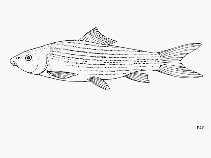 Labeo mesops
Immagine di FAO
Immagini | Google image
Immagine di FAO
Classificazione / Nomi Nomi Comuni | Sinonimi | Catalog of Fishes(Genere, Specie) | ITIS | CoL | WoRMS | Cloffa
> Cypriniformes (Carps) > Cyprinidae (Minnows or carps) > Labeoninae
Etymology: Labeo: Latin, labeo = one who has large lips (Ref. 45335); mesops: From the Greek word mesos meaning middle or half and opsis meaning sight; name refers to the state of the type material which was only half of the skin (Ref. 26190).
More on author: Günther.
Etymology: Labeo: Latin, labeo = one who has large lips (Ref. 45335); mesops: From the Greek word mesos meaning middle or half and opsis meaning sight; name refers to the state of the type material which was only half of the skin (Ref. 26190).
More on author: Günther.
Ambiente: milieu / zona climatica / distribuzione batimetrica / gamma di distribuzione Ecologia
; acqua dolce benthopelagico; potamodromo (Ref. 51243). Tropical
Distribuzione Territories | Aree FAO | Ecosistemi | Presenze | Mappa dei ritrovamenti | Introduzioni | Faunafri
Africa: present in Lake Malawi basin (Ref. 1878, 52161, 55909, 96560), Juba system (1440) and Ruvuma River (Ref. 1440, 97286). Status Tana River population is uncertain (Ref. 52331). Reports from the Lufira River, Upper Congo River basin (Ref. 1440, 26190), are misidentifications of Labeo rosae (Ref. 96560).
Lunghezza alla prima maturità / Dimensione / Peso / Età
Breve descrizione Chiavi di identificazione | Morfologia | Morfometria
Spine dorsali (totale) : 3; Raggi dorsali molli (totale) : 10 - 12; Spine anali: 3; Raggi anali molli: 5; Vertebre: 34.
Body shape (shape guide): fusiform / normal; Cross section: oval.
Body shape (shape guide): fusiform / normal; Cross section: oval.
Found in shallow water over sandy bottoms (Ref. 5595, 52161). Is a mud-feeder (Ref. 52161), feeds from the biocover and sediment on the sand (Ref. 5595). Also caught using weirs and baskets; formerly very abundant in Malawi, but now rare except where rivers drain undisturbed soil; possible that silt prevents development of eggs (Ref. 4967). Indications that it may leave the lake and run up rivers to spawn (Ref. 52161).
Ciclo vitale e comportamento di accoppiamento Maturità | Riproduzione | Deposizione | Uova | Fecondità | Larve
Spawns in small, muddy wet season rivers leading to swampy dambos (Ref. 2781). Holds its spawn until the rivers flood.
Riferimento principale
Caricare le referenze | Bibliografia | Coordinatore | Collaboratori
Tshibwabwa, S.M., 1997. Systématique des espèces africaines du genre Labeo (Teleostei, Cyprinidae) dans les régions ichtyogéographiques de Basse-Guinée et du Congo. I. Presses Universitaires de Namur, Namur, Belgique. 302 p. (Ref. 26190)
Stato della Lista Rossa IUCN (Ref. 130435: Version 2025-2 (Global))
Critically Endangered (CR) (A2ac+3cd); Date assessed: 23 May 2018
CITES
Not Evaluated
Minaccia per l'uomo
Harmless
Usi umani
Pesca: di nessun interesse; Acquacoltura: sperimentale; Acquario: Commerciale
FAO - Publication: search | FishSource |
Informazioni ulteriori
Ecologia trofica
Articoli alimentari (prede)
Alimentazione
Consumo di cibo
Razioni alimentari
Predatori
Articoli alimentari (prede)
Alimentazione
Consumo di cibo
Razioni alimentari
Predatori
Dinamica della popolazione
Parametri di crescita
Età massima / dimensioni massime
Rapporto lunghezza-peso.
Lunghezza-lunghezza rel.
Lunghezza-frequenze
Conversione di massa
Reclutamento
Abbondanza
Parametri di crescita
Età massima / dimensioni massime
Rapporto lunghezza-peso.
Lunghezza-lunghezza rel.
Lunghezza-frequenze
Conversione di massa
Reclutamento
Abbondanza
Ciclo di vita
Riproduzione
Maturità
Maturità/Gli occhielli sono relativi.
Fecondità
Deposizione
Aggregazioni riproduttive
Uova
Sviluppo delle uova
Larve
Dinamica popolazioni larvali
Riproduzione
Maturità
Maturità/Gli occhielli sono relativi.
Fecondità
Deposizione
Aggregazioni riproduttive
Uova
Sviluppo delle uova
Larve
Dinamica popolazioni larvali
Anatomia
Area branchiale
Cervello
Otolite
Area branchiale
Cervello
Otolite
Fisiologia
Composizione corporea
Nutrienti
Consumo di ossigeno
Tipo di nuoto
Velocità di nuoto
Pigmenti visivi
Suono del pesce
Malattie e parassiti
Tossicità (LC50)
Composizione corporea
Nutrienti
Consumo di ossigeno
Tipo di nuoto
Velocità di nuoto
Pigmenti visivi
Suono del pesce
Malattie e parassiti
Tossicità (LC50)
Genetica
Genome
Genetica
Eterozigosi
Ereditarietà
Diversità genetica
Genome
Genetica
Eterozigosi
Ereditarietà
Diversità genetica
Legato all'uomo
Sistemi di acquacoltura
Profili di acquacoltura
Varietà
Casi di Ciguatera
Francobolli, monete, materiale vario.
Sistemi di acquacoltura
Profili di acquacoltura
Varietà
Casi di Ciguatera
Francobolli, monete, materiale vario.
Strumenti
Libro elettronico | Giuda pratica | Generatore frequenze di lunghezza | Strumento Parametri Biologici | Mappa dei ritrovamenti |
Cattura-MSY |
Rapporti speciali
Controllo della manutenzione dell'acquario | Verificare la presenza di schede informative sulle specie | Verifica delle schede informative sull'acquacoltura
Scarica XML
Fonti Internet
AFORO (otoliths) | Aquatic Commons | BHL | Cloffa | Websites from users | Check FishWatcher | CISTI | Catalog of Fishes: Genere, Specie | DiscoverLife | ECOTOX | FAO - Publication: search | Faunafri | Fishipedia | Fishtrace | GloBI | Google Books | Google Scholar | Google | IGFA World Record | OneZoom | Open Tree of Life | Otolith Atlas of Taiwan Fishes | PubMed | Reef Life Survey | Socotra Atlas | TreeBase | Tree of Life | Wikipedia: Go, ricerca | World Records Freshwater Fishing | Zoobank | Record zoologico
Stime basate su modelli
Indice di diversità filogenetica (Fonte Biblio. 82804): PD50 = 0.5000 [Uniqueness, from 0.5 = low to 2.0 = high].
Bayesian length-weight: a=0.00912 (0.00420 - 0.01982), b=3.05 (2.88 - 3.22), in cm total length, based on LWR estimates for this Genus-body shape (Ref. 93245).
Livello trofico (Fonte Biblio. 69278): 2.0 ±0.00 se; based on food items.
Resilienza (Fonte Biblio. 120179): Medio, tempo minimo di raddoppiamento della popolazione 1.4 - 4.4 anni (Preliminary K or Fecundity.).
Nutrienti (Ref. 124155): Calcium = 187 [52, 326] mg/100g; Iron = 0.926 [0.548, 1.671] mg/100g; Protein = 16.3 [15.4, 17.2] %; Omega3 = 0.418 [0.163, 1.162] g/100g; Selenium = 305 [114, 870] μg/100g; VitaminA = 20.6 [7.7, 57.4] μg/100g; Zinc = 1.64 [0.88, 3.32] mg/100g (wet weight);