>
Gobiiformes (Gobies) >
Gobiidae (Gobies) > Gobiinae
Etymology: Fusigobius: Latin, fusus = spindle + Latin, gobius = gudgeon (Ref. 45335); aureus: aureus (Latin for yellow) referring to the many 'golden-yellow' spots scattered on the body and fins (Ref. 31555).
Environment: milieu / climate zone / εύρος βάθους / distribution range
Οικολογία
Θαλασσινό(ά) Υφαλόφιλο(α); εύρος βάθους 5 - 25 m (Ref. 90102). Tropical
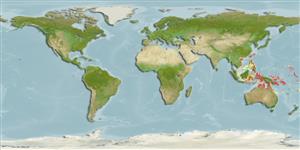
Western Central Pacific: Indonesia, Solomon Islands, and the Coral Sea.
Μέγεθος / Βάρος / Age
Γεννητική Ωρίμανση: Lm ? range ? - ? cm
Max length : 3.5 cm SL αρσενικό/απροσδιόριστο; (Ref. 31555)
Short description
Κλείδες προσδιορισμού | Μορφολογία | Μορφομετρία
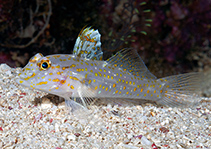
Ραχιαίες άκανθες (συνολικά) : 7; Μαλακές ραχιαίες ακτίνες (συνολικά) : 9; Εδρικές άκανθες: 1; Μαλακές εδρικές ακτίνες: 8. Pectorals large and rounded; pelvic fins largely separated but united at base, the connecting membrane very short and concave in outer margin, without inter-spine frenum (Ref. 31555). Body with a row of golden-yellow spots along mid-line of lateral surfaces and with some rows of smaller golden-yellow spots on both dorsal and ventral surfaces. An oblique, yellow line on cheek and snout. Caudal base with a diaper-shaped black blotch. Dorsal and caudal fins with some rows of smaller golden-yellow spots. First dorsal with a large black blotch, with its lower half tinged orange. Pelvic fins largely separated except for a limited linkage by a very narrow connecting membrane (Ref. 31555); characterized further by having rounded caudal fin; longitudinal scale series 24-25; ctenoid body scales becoming cycloid anterior to pectoral and pelvic fins; absence of scales on operculum; opening of gill extending to or almost to vertical at posterior edge of preopercle; depth of body 4.3-4.8 in SL (Ref. 90102).
Body shape (shape guide): fusiform / normal.
Inhabits seaward reefs in 5-25 m (Ref. 90102).
Life cycle and mating behavior
Γεννητική Ωρίμανση | Αναπαραγωγή | Γεννοβολία | Αβγά | Γονιμότητα | Προνύμφες
Chen, I.-S. and K.-T. Shao, 1997. Fusigobius aureus, a new species of gobiid fish (Perciformes, Gobiidae) from Flores Island, Indonesia. Acta Zool. Taiwanica 8(2):87-92. (Ref. 31555)
IUCN Red List Status (Ref. 130435: Version 2025-1)
Threat to humans
Harmless
Human uses
Εργαλεία
Special reports
Download XML
Διαδικτυακές πηγές
Estimates based on models
Preferred temperature (Αναφ.
123201): 27.4 - 29.4, mean 28.8 °C (based on 1078 cells).
Phylogenetic diversity index (Αναφ.
82804): PD
50 = 0.5005 [Uniqueness, from 0.5 = low to 2.0 = high].
Bayesian length-weight: a=0.01023 (0.00477 - 0.02194), b=3.01 (2.83 - 3.19), in cm total length, based on LWR estimates for this (Sub)family-body shape (Ref.
93245).
Τροφικό Επίπεδο (Αναφ.
69278): 3.2 ±0.3 se; based on size and trophs of closest relatives
Ελαστικότητα (Αναφ.
120179): Υψηλό, ελάχιστος χρόνος για διπλασιασμό πληθυσμού < 15 μήνες (Preliminary K or Fecundity.).
Fishing Vulnerability (Ref.
59153): Low vulnerability (10 of 100).
🛈