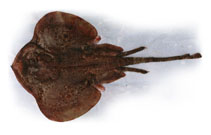
sub class Elasmobranchii (ฉลามและกระเบน) (sharks and rays) >
Rajiformes (Skates and rays) >
Arhynchobatidae (Softnose skates)
Etymology: Psammobatis: Greek, psammos = sand + Greek, batis, batidos = a ray (Raja sp.) (Ref. 45335).
Eponymy: Dr Frederico Guillermo ‘Carlos’ (Friedrich Wilhelm Carl) Berg (1843–1902) was a Latvian entomologist and naturalist. [...] (Ref. 128868), visit book page.
Environment: milieu / climate zone / ระดับความลึก / distribution range
นิเวศวิทยา
เกี่ยวกับทะเล,น้ำเค็ม สัตว์น้ำหน้าดิน. Subtropical
Southwest Atlantic: Brazil to Argentina (Ref. 58839).
ขนาด / น้ำหนัก / Age
วัยเจริญพันธุ์: Lm ? range ? - ? cm
Max length : 47.5 cm TL เพศผู้/กระเทย; (Ref. 86990)
Oviparous (Ref. 50449). Eggs have horn-like projections on the shell (Ref. 205).
Life cycle and mating behavior
วัยเจริญพันธุ์ | การสืบพันธุ์ | การวางไข่ | เซลสืบพันธ์ของเพศเมีย(ไข่) | ความดกของไข่ | ตัวอ่อน
Oviparous, paired eggs are laid. Embryos feed solely on yolk (Ref. 50449).
McEachran, J.D. and K.A. Dunn, 1998. Phylogenetic analysis of skates, a morphologically conservative clade of elasmobranchs (Chondrichthyes: Rajidae). Copeia 1998(2):271-290. (Ref. 27314)
IUCN Red List Status (Ref. 130435: Version 2025-1)
Threat to humans
Harmless
Human uses
เครื่องมือ
Special reports
Download XML
แหล่งที่มาจากอินเตอร์เน็ต
Estimates based on models
Preferred temperature (อ้างอิง
123201): 5.5 - 14.3, mean 8.6 °C (based on 109 cells).
Phylogenetic diversity index (อ้างอิง
82804): PD
50 = 0.5039 [Uniqueness, from 0.5 = low to 2.0 = high].
Bayesian length-weight: a=0.00562 (0.00288 - 0.01097), b=3.11 (2.94 - 3.28), in cm total length, based on LWR estimates for this (Sub)family-body shape (Ref.
93245).
ระดับชั้นอาหาร (อ้างอิง
69278): 3.8 ±0.7 se; based on size and trophs of closest relatives
ความสามารถในการกลับคืนสู่ปกติ (อ้างอิง
120179): ต่ำ, เวลาต่ำสุดที่จะทำให้ประชากรเพิ่มขึ้นเป็น 2 เท่าใช้เวลา 4.5 - 14 ปี (Fec assumed to be <100).
Fishing Vulnerability (Ref.
59153): Moderate vulnerability (38 of 100).
🛈