>
Cypriniformes (Carps) >
Cyprinidae (Minnows or carps) > Torinae
Etymology: Carasobarbus: Latinization of , karass, karausche, European crucian carp + Latin, barbus = barbel (Ref. 45335).
Eponymy: Ernest Chantre (1843–1924) was a French naturalist, geologist, archaeologist and anthropologist in Asia Minor undertaking many trips accompanied by his wife (1890– 1894). [...] (Ref. 128868), visit book page.
More on author: Sauvage.
Environment: milieu / climate zone / kisaran kedalaman / distribution range
Ekologi
; air tawar bentopelagis. Temperate
Asia: Orontes River drainage in Syria and Turkey (Ref. 57642, 94477).
Size / Weight / umur
Kematangan: Lm ? range ? - ? cm
Max length : 56.1 cm NG jantan/; (Ref. 57642)
deskripsi pendek
Kunci identifiaksi (pengenalan) | Morfologi | Morfometrik
Duri punggung (Keseluruhan (total)) : 3 - 4; duri punggung lunak (Keseluruhan (total)) : 9 - 10. D III-IV, 9-10; A 2-3/(5) 6 (7); L.lat. (29) 30-35 (36); Sp. br. 12-15; D. phar. 5.3.2-2.3.5: Circum ped.scales 12 or 14 (2 1/2 or 3 1/2 above the lateral line scale and 2 l/2 below it on each side).
The average number of branched rays in the dorsal fin is 9.76 of the 61 specimens examined had six branched rays in the anal fin, two had five and one had seven. The last simple ray of the dorsal fin, moderately ossified, and its posterior margin is
denticulated, with denticles being slightly larger than in C. canis and C. luteus.
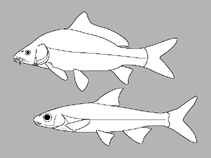
The upper and lower profiles of the body are similar, both being slightly convex. The mouth is subterminal; lips thick and smooth as in the other members of the genus; mouth small, its opening lies in front of the vertical through the anterior margin of the nostril. All specimens have short posterior barbels. In 57.3 % of the specimens from Turkey, there are also very short (rudimentary) anterior barbels; in 18.2, % the anterior barbels are lacking, whereas in 23.4 % there is a single anterior barbel, either on the right or one the left side. The presence or absence of anterior barbels is not correlated with the size of the specimen (Ref. 57642).
Life cycle and mating behavior
Kematangan | Reproduksi, perkembang biakan | Pemijahan | telur-telur | Fecundity | Larva
Ekmekçi, F.G. and P. Banarescu, 1998. A revision of the generic position of Barynotus (Systomus) verhoeffi, and the validity of the genera Carasobarbus, Kosswigobarbus and Mesopotamichthys (Pisces, Cyprinidae). Folia Zool. 47(Suppl. 1):87-96. (Ref. 57642)
Status IUCN Red List (Ref. 130435: Version 2025-1)
ancaman kepada manusia
Harmless
penggunaan manusia
Perikanan: tidak ada kepentingan
Alat, peralatan
laporan khas
muat turun XML
Sumber internet
Estimates based on models
Phylogenetic diversity index (Acuan
82804): PD
50 = 0.5001 [Uniqueness, from 0.5 = low to 2.0 = high].
Bayesian length-weight: a=0.00955 (0.00430 - 0.02123), b=3.02 (2.84 - 3.20), in cm total length, based on LWR estimates for this (Sub)family-body shape (Ref.
93245).
Trophic level (Acuan
69278): 3.0 ±0.4 se; based on size and trophs of closest relatives
Daya lenting (Acuan
120179): sedang, Waktu penggandaan populasi minimum 1.4 - 4.4 tahun (Assuming Fec < 10,000).
Fishing Vulnerability (Ref.
59153): Low vulnerability (18 of 100).
🛈