>
Ophidiiformes (Cusk eels) >
Dinematichthyidae (Viviparous brotula)
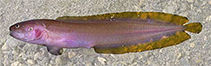
Etymology: Beaglichthys: Related to the Darwin´s ship Beagle + Greek, ichthys = fish (Ref. 45335); macrophthalmus: Named from the large eyes (Ref. 10898).
Environment: milieu / climate zone / Tiefenbereich / distribution range
Ökologie
seewasser riff-verbunden. Tropical
Indo-West Pacific: northern coast of Australia.to southern coast of New Guinea.
Size / Gewicht / Alter
Geschlechtsreife: Lm ? range ? - ? cm
Max length : 9.6 cm SL Männchen/unbestimmt; (Ref. 76869); 7.8 cm SL (female)
Rückenflossenstacheln (insgesamt) : 1; Rückenflossenweichstrahlen (insgesamt) : 111; Afterflossenstacheln: 0; Afterflossenweichstrahlen: 83; Wirbelzahl: 51 - 56. Thick skin covers the head and body. Scaly cheek. Snout, opercle and top of head without scales. Large, imbricate scales cover the body.
Body shape (shape guide): elongated; Cross section: compressed.
A benthic species which occurs in inshore waters (Ref. 75154). Rare species and known from a single specimen (Ref. 34024). Size at birth 2.33 cm TL (Ref. 34024). Maximum length of female from Ref. 10898. Depth range unkown, probably confined to shallow reefs among rock and coral crevices (Ref 90102).
Life cycle and mating behavior
Geschlechtsreife | Fortpflanzung | Ablaichen | Eier | Fecundity | Larven
Schwarzhans, W. and P.R. Møller, 2007. Review of the Dinematichthyini (Teleostei: Bythitidae) of the Indo-west Pacific. Part III. Beaglichthys, Brosmolus, Monothrix and eight new genera with description of 20 new species. The Beagle, Records of the Museums and Art Galleries of the Northern Territory 23:29-110. (Ref. 76869)
IUCN Rote Liste Status (Ref. 130435: Version 2025-1)
Bedrohung für Menschen
Harmless
Nutzung durch Menschen
Fischereien: nicht kommerziell
Tools
Zusatzinformationen
Download XML
Internet Quellen
Estimates based on models
Phylogenetic diversity index (Ref.
82804): PD
50 = 0.6250 [Uniqueness, from 0.5 = low to 2.0 = high].
Bayesian length-weight: a=0.00389 (0.00180 - 0.00842), b=3.12 (2.94 - 3.30), in cm total length, based on all LWR estimates for this body shape (Ref.
93245).
Trophic level (Ref.
69278): 3.4 ±0.5 se; based on size and trophs of closest relatives
Widerstandsfähigkeit (Ref.
120179): niedrig, Verdopplung der Population dauert 4,5 - 14 Jahre. (Assuming Fec < 100).
Fishing Vulnerability (Ref.
59153): Low vulnerability (10 of 100).
🛈