Klassifizierung / Names
Namen | Synonyme | Catalog of Fishes(Gattung, Arten) | ITIS | CoL | WoRMS | Cloffa
Environment: milieu / climate zone / Tiefenbereich / distribution range
Ökologie
; süßwasser benthopelagisch. Tropical; 13°N - 11°N
Size / Gewicht / Alter
Geschlechtsreife: Lm ? range ? - ? cm
Max length : 41.0 cm FL Männchen/unbestimmt; (Ref. 35835)
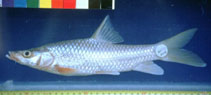
Rückenflossenstacheln (insgesamt) : 0; Rückenflossenweichstrahlen (insgesamt) : 12 - 13; Afterflossenstacheln: 0; Afterflossenweichstrahlen: 8. Snout more than 4 times in head length; interorbital width more than 2 times in head width; head depth more than 2 times in head length; operculum depth more than 3.4 times in head length; silvery white.
Body shape (shape guide): elongated.
Over muddy, sandy and rocky substrates all over Lake Tana, preferably in water deeper than 6 m. Juveniles feed on zooplankton and insect larvae. Adults feed on other fish (Ref. 35835).
Life cycle and mating behavior
Geschlechtsreife | Fortpflanzung | Ablaichen | Eier | Fecundity | Larven
Nagelkerke, L.A.J. and F.A. Sibbing, 1997. A revision of the large barbs (Barbus spp., Cyprinidae, Teleostei) of Lake Tana, Ethiopia, with a description of seven new species. p. 105-170. In L.A.J. Nagelkerke (ed.) The barbs of Lake Tana, Ethiopia: morphological diversity and its implications for taxonomy, trophic resource partititioning and fisheries. Wageningen University, The Netherlands. (Ref. 35835)
IUCN Rote Liste Status (Ref. 130435: Version 2025-1)
Bedrohung für Menschen
Harmless
Nutzung durch Menschen
Fischereien: nicht kommerziell
Tools
Zusatzinformationen
Download XML
Internet Quellen
Estimates based on models
Phylogenetic diversity index (Ref.
82804): PD
50 = 0.5000 [Uniqueness, from 0.5 = low to 2.0 = high].
Bayesian length-weight: a=0.00427 (0.00195 - 0.00935), b=3.11 (2.90 - 3.32), in cm total length, based on LWR estimates for this (Sub)family-body shape (Ref.
93245).
Trophic level (Ref.
69278): 3.6 ±0.53 se; based on food items.
Widerstandsfähigkeit (Ref.
120179): mittel, Verdopplung der Population dauert 1,4 - 4,4 Jahre. (Preliminary K or Fecundity.).
Fishing Vulnerability (Ref.
59153): Moderate vulnerability (36 of 100).
🛈