Klassifizierung / Names
Namen | Synonyme | Catalog of Fishes(Gattung, Arten) | ITIS | CoL | WoRMS | Cloffa
Issue
See Vari (1989:17) for detailed description.
Environment: milieu / climate zone / Tiefenbereich / distribution range
Ökologie
; süßwasser benthopelagisch. Tropical
South America: Essequibo, Orinoco, and Branco River basins, central portion of the Amazon River basin. Reported from Argentina (Ref. 9086).
Size / Gewicht / Alter
Geschlechtsreife: Lm ? range ? - ? cm
Max length : 12.9 cm SL Männchen/unbestimmt; (Ref. 34107)
Kurzbeschreibung
Bestimmungsschlüssel | Morphologie | Morphometrie
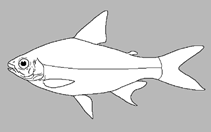
This species has small silvery scales; small mouth, and with a relatively large adipose fin (Ref. 10615).
A mud-eating fish, feeding on the organic matter that forms on submerged stones and higher plants (aufwuchs). Matures sexually under normal rain patterns with first spawning occurring during the first year. Individuals of approximately 16 cm total length have reached sexual maturity. A typical migratory fish, with periodical and prolific reproduction. It does not spawn in captivity nor does it react satisfactorily to the common induced spawning techniques used successfully with other species (Ref. 10615).
Life cycle and mating behavior
Geschlechtsreife | Fortpflanzung | Ablaichen | Eier | Fecundity | Larven
Vari, R.P., 1989. Systematics of the neotropical characiform genus Psectrogaster Eigenmann and Eigenmann (Pisces: Characiformes). Smithson. Contri. Zool. No. 481, 43 p. (Ref. 34107)
IUCN Rote Liste Status (Ref. 130435: Version 2025-1)
Bedrohung für Menschen
Harmless
Nutzung durch Menschen
Tools
Zusatzinformationen
Download XML
Internet Quellen
Estimates based on models
Phylogenetic diversity index (Ref.
82804): PD
50 = 0.5039 [Uniqueness, from 0.5 = low to 2.0 = high].
Bayesian length-weight: a=0.01549 (0.00716 - 0.03351), b=3.01 (2.84 - 3.18), in cm total length, based on LWR estimates for this (Sub)family-body shape (Ref.
93245).
Trophic level (Ref.
69278): 2.0 ±0.00 se; based on food items.
Widerstandsfähigkeit (Ref.
120179): hoch, Verdopplung der Population dauert weniger als 15 Monate. (Preliminary K or Fecundity.).
Fishing Vulnerability (Ref.
59153): Low vulnerability (10 of 100).
🛈