>
Ovalentaria/misc (Various families in series Ovalentaria) >
Pomacentridae (Damselfishes) > Pomacentrinae
Etymology: Chrysiptera: Greek, chrysos = golden + Greek, pteron = fin, wing (Ref. 45335).
More on author: Cuvier.
Environment: milieu / climate zone / djupintervall / distribution range
Ekologi
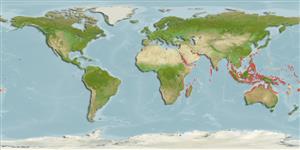
marina revassocierade; ej vandrande; djupintervall 0 - 3 m (Ref. 4391). Tropical; 32°N - 30°S, 30°E - 173°W
Indo-West Pacific: Red Sea and East Africa to Fiji, north to Ryukyu Islands, south to the southern Great Barrier Reef. Recently reported from Tonga (Ref. 53797).
Size / Vikt / Age
Könsmognad: Lm ? range ? - ? cm
Max length : 10.0 cm TL hane/ej könsbestämd; (Ref. 48636)
Short description
Bestämningsnycklar | Morfologi | Morfometri
Taggstrålar i ryggfenan (totalt) : 13; Mjukstrålar i ryggfenan (totalt) : 13 - 14; Taggstrålar i analfenan: 2; Mjukstrålar i analfenan: 12 - 14.
Body shape (shape guide): fusiform / normal; Cross section: oval.
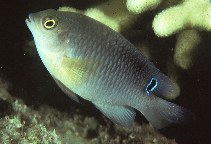
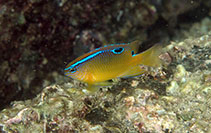
Adults are found solitarily or in small groups among coastal algal reefs, rubble or over open beach-rock of reef flats exposed to moderate surge and feeds mainly on benthic algae (Ref. 1602). Oviparous, distinct pairing during breeding (Ref. 205). Eggs are demersal and adhere to the substrate (Ref. 205). Males guard and aerate the eggs (Ref. 205). Diurnal species (Ref. 54980, 120737).
Life cycle and mating behavior
Könsmognad | Reproduktion | Lek | Ägg | Fecundity | Larver
Oviparous, distinct pairing during breeding (Ref. 205). Eggs are demersal and adhere to the substrate (Ref. 205). Males guard and aerate the eggs (Ref. 205).
Allen, G.R., 1991. Damselfishes of the world. Mergus Publishers, Melle, Germany. 271 p. (Ref. 7247)
IUCN Red List Status (Ref. 130435: Version 2025-1)
Threat to humans
Harmless
Human uses
Fiskeri: mindre kommeriell; Akvarium: Kommersiell
Verktyg
Special reports
Download XML
Internet-källor
Estimates based on models
Preferred temperature (Ref.
123201): 25.2 - 29.3, mean 28.4 °C (based on 2729 cells).
Phylogenetic diversity index (Ref.
82804): PD
50 = 0.5000 [Uniqueness, from 0.5 = low to 2.0 = high].
Bayesian length-weight: a=0.01479 (0.00651 - 0.03363), b=3.00 (2.81 - 3.19), in cm total length, based on LWR estimates for this (Sub)family-body shape (Ref.
93245).
Trofisk nivå (Ref.
69278): 2.1 ±0.2 se; based on diet studies.
Resiliens (Ref.
120179): Hög, lägsta populationsfördubblingstid mindre än 15 månader (Preliminary K or Fecundity.).
Fishing Vulnerability (Ref.
59153): Low vulnerability (10 of 100).
🛈
Nutrients (Ref.
124155): Calcium = 150 [77, 269] mg/100g; Iron = 0.918 [0.519, 1.561] mg/100g; Protein = 18.5 [17.3, 19.6] %; Omega3 = 0.112 [0.062, 0.201] g/100g; Selenium = 15.1 [8.2, 30.8] μg/100g; VitaminA = 124 [35, 459] μg/100g; Zinc = 2.6 [1.7, 3.8] mg/100g (wet weight);